
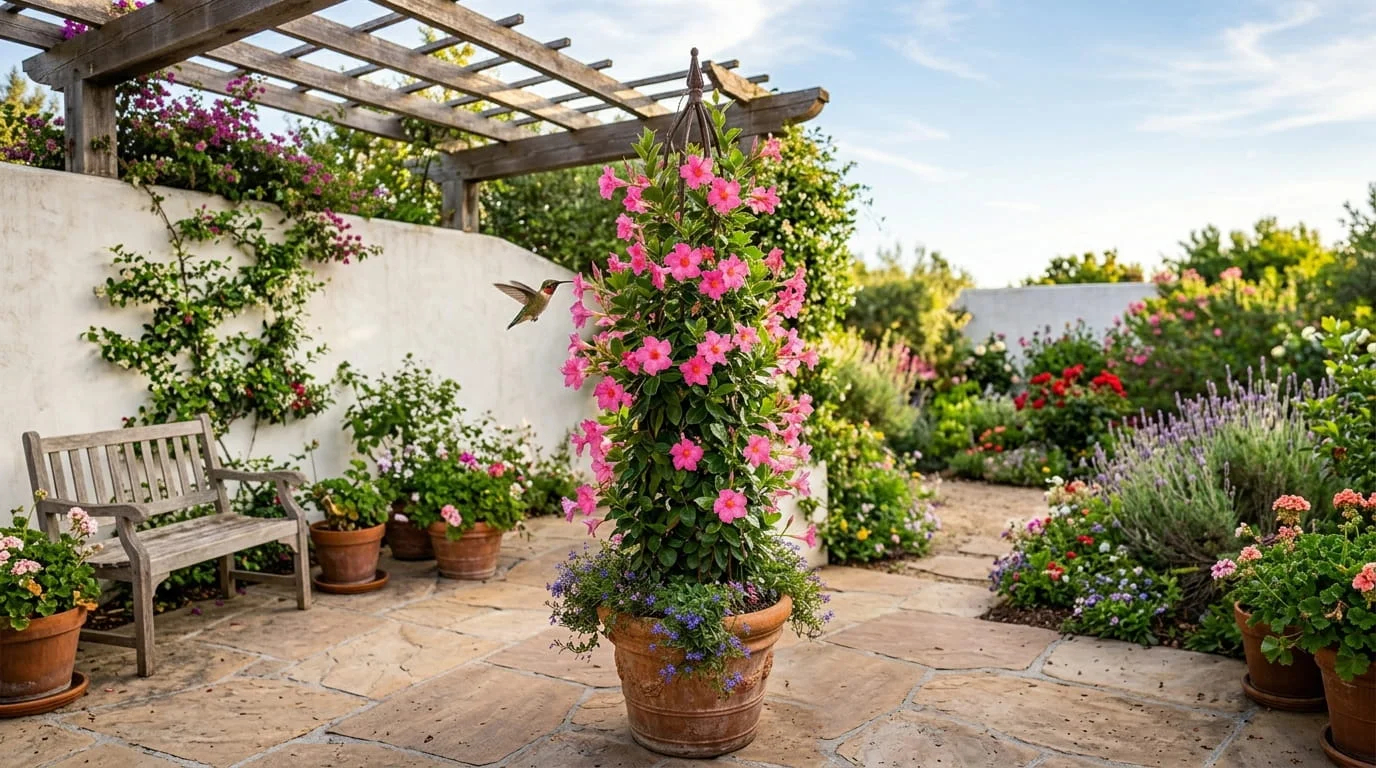

The first time I planted the mandevilla, I simply stuck it into a clay pot in my south facing garden and ignored it the rest of the summer. Before August was out, it had climbed six feet up a rusty iron obelisk, clothed itself in masses of brilliant pink blooms and captured all the hummingbirds in the vicinity. I had anticipated a challenging experience with the plant. This proved not to be the case.
It is a genus of flowering vines belonging to the tropical and subtropical parts of the world under the family Apocynaceae. It was scientifically named in 1840 by a British diplomat, as well as a gardener, by the name of Henry Mandeville, whose life spanned from 1773 to 1861. Among the other names used for this plant include rocktrumpet or rock trumpet, which refers to the flower’s unique trumpet shape.
Where Mandevilla Comes From
The mandevilla plant family is indigenous to a large geographical region ranging from the Southwestern United States to Mexico, Central America, the West Indies, and South America. Many of the species grow naturally within the forests of Serra dos Órgãos in Rio de Janeiro, Brazil. In essence, knowing the geographical origin of the plant informs one on all that the plant requires for successful cultivation, namely heat, moisture, high quality organic soil, and constant hydration.
It is a huge genus and complicated from a taxonomic standpoint. Within the subfamily Apocynoideae and tribe Mesechiteae, it belongs to the Gentianales order and has several other scientific names, such as Dipladenia, Amblyanthera, Eriadenia, Laseguea, Macrosiphonia, Mitozus, and Salpinctes, which were used in previous years while describing its taxonomy.
According to the Kew World Checklist and USDA PLANTS Database, the current name of the genus is Mandevilla Lindl, which is the name accepted by these two databases after many years of naming changes.
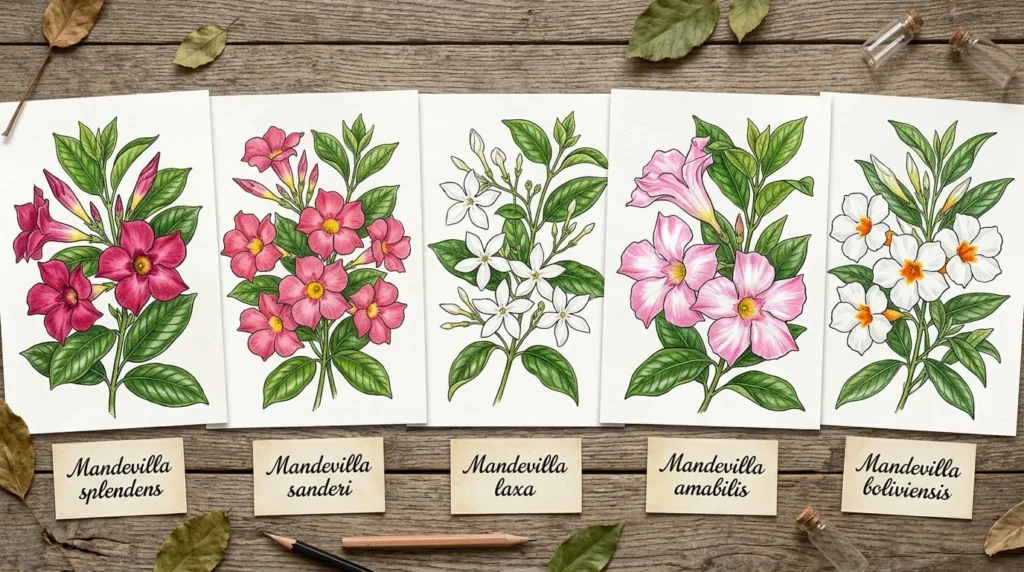
The main species contributing to the development of garden hybrids today are M. amabilis, M. splendens from Rio de Janeiro, and M. sanderi.
What Mandevilla Looks Like
Probably the most distinguishing quality of the plant is trumpet-shaped five-petal flowers of bright red, white, pink and yellow colors sometimes with yellow throat providing second color tone to the bloom. Flowering season begins in late spring and ends in autumn, and flowers produce sweet aroma making the warm afternoon air irresistible to hummingbirds, bees and butterflies.
The leaves of the plant are generally oval, shiny and green with surface varying between smooth and leather-like texture measuring between 2-8 inches. Vining cultivars exhibit twining qualities as they wind around supports in search of additional space. Newer cultivars, in their turn, feature shrubbing qualities thus widening design possibilities greatly.
There is an enormous difference in plant height within the group. Height of garden cultivars varies between 1-20 feet tall with 1-15 feet spread in width, depending on cultivar type, type of support and climate zone. The most productive climatic conditions are found in frost-free regions with zones 10-11, where plant continues growing reaching its maximum height and width.
Growing Zones and Climate Requirements
The mandevilla plant grows well in Zones 8 to 11 as a perennial, although in colder zones, people grow it as an annual plant, and it survives quite well. In areas where there is no frost, it can survive outdoors all year round. If grown in colder zones, the mandevilla can be grown as an annual plant, planted when there is no more threat of frost.
The temperature ideal for plant growth outside is between 68 and 90 degrees F. Once it drops below 45 to 50 degrees, signs of frost will be observed. It is time to take potted plants indoors when there is a regular dropping to 50 degrees at night. Indoors, the recommended nighttime temperature should be kept between 60 and 65 degrees and day temperatures should reach 70 degrees or more.
Humidity is not something luxurious but an actual requirement. In environments where humidity is low, spraying the plants will help increase it to provide enough moisture for their growth. Plants being stored inside a home where the heating system is on create drier conditions than any environment outside.
How to Plant Mandevilla
Planting time
In mid to late spring outdoors when there is no risk of frost. Do not plant mandevilla until night-time temperatures are above 50 degrees Fahrenheit, and daytime temperatures are 60 degrees Fahrenheit or more.
Location
The most basic requirements for growing mandevilla are that it requires full sunlight and fertile, well-drained soil. It needs at least six to eight hours of direct sunlight daily to ensure proper blooming. In warmer regions, protect it from the intense heat of the afternoon sun.
Planting instructions
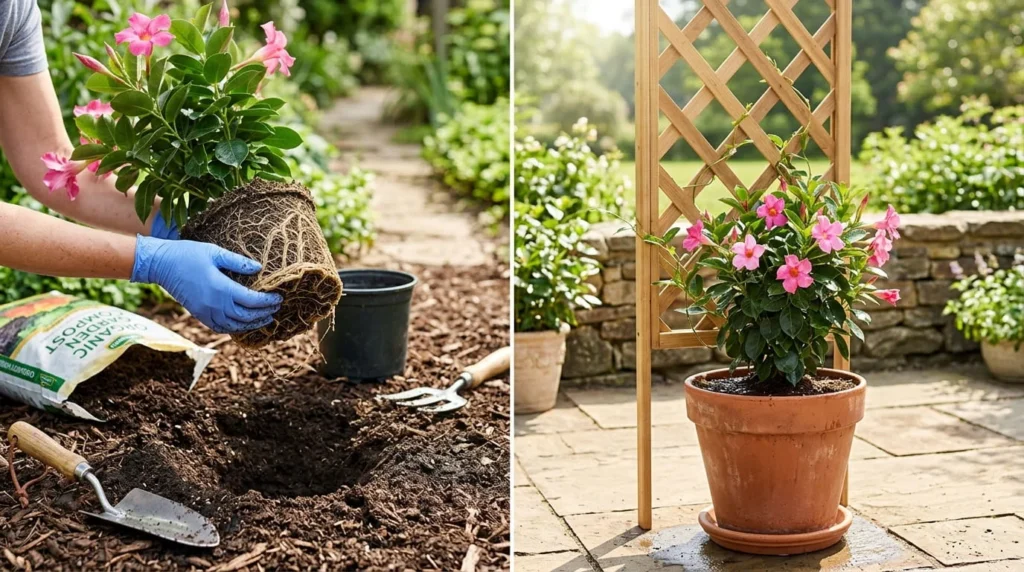
Work the soil at the planting site before mixing a good amount of compost into the planting soil. Create a hole that is larger and equally deep to the root ball. Gently lift the plant out of the nursery pot and loosen the tangled roots if any. Plant it at such an angle where the upper surface of the root ball is above the soil level. This will prevent moisture from accumulating near the roots. Firm up the soil by pressing down on it gently and provide plenty of water.
Soil requirements
The perfect soil for planting mandevillas is sandy soil mixed with lots of compost, having a pH ranging from 6.6 to 7.8. It is important that the soil is well-drained since root rotting is the main reason behind the death of these plants. The cause of this problem is waterlogged soil, not any type of pests or diseases.
Mandevilla Care Through the Season
Watering
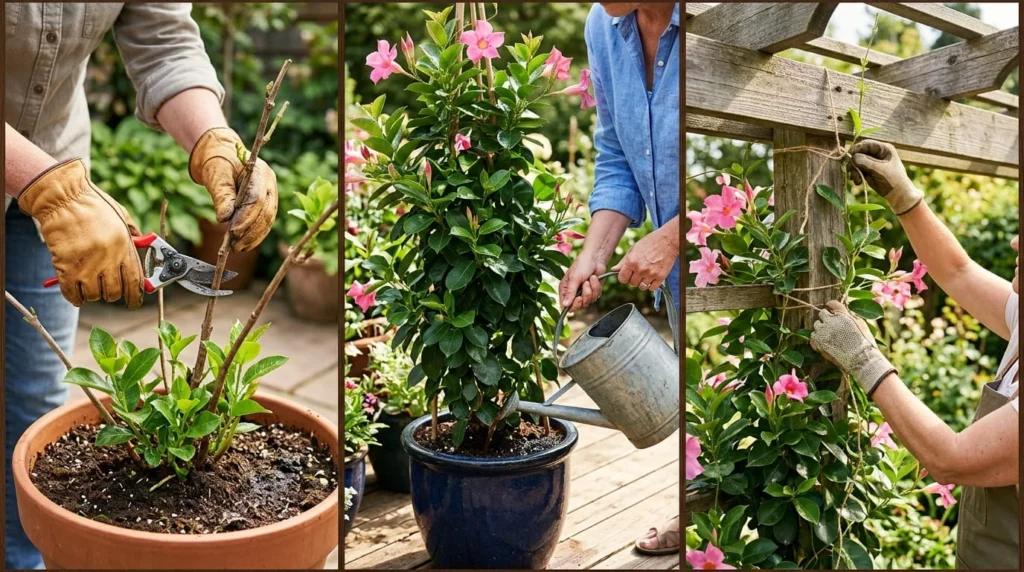
Soil should always be kept moist. Excess watering results in root rot. On the other hand, insufficient watering will cause the plant stress and reduce blooming. Thus, the trick lies in ensuring that the topsoil has dried slightly before watering especially when the soil one inch down is dry.
Feeding
Plants should be fertilized twice a month using slow-release or high phosphorous fertilizers. Why? High phosphorous levels ensure blooming. Nitrogen, on the other hand, ensures foliage. One should discontinue fertilization when overwintering during the period from fall through early spring, since this period marks the semi dormant stage of this plant.
Pruning
Plants should be cut back by up to one third in late winter or early spring, before new growth begins. Dead and diseased stems should be pruned out, and the plants shaped according to preference. If fuller plants are desired, then the tip of each stem should be pinched back during the growing season. Important fact: Mandevilla flowers bloom on new growth; hence, pruning in later summer will reduce the formation of flowers for the following season. They do not require deadheading since flowers fall off without creating messes.
Support
Climbing varieties have a twining nature, and so a trellis, pergola, obelisk, or arbor must be provided in order for them to climb on. Training can be achieved by tying stems as they grow. Climbing varieties sprawl on the ground when there is no support.
Pests, Diseases, and Overwintering
In outdoor settings, when the right growing conditions are met, mandevilla becomes practically pest-free. In addition, the plants have deer resistance qualities, although, during times of scarcity, deer tend to eat the foliage. The cut stems of the plant release a sticky milky sap that is mildly toxic and should be handled carefully to avoid skin irritation.
Indoor overwintered plants are prone to pests. The common ones are aphids, scales, mealy bugs, spider mites, and whiteflies. To treat an infestation, use insecticidal soap or neem oil as directed on the label and repeat as needed. Diseases that affect plants include root rot, powdery mildew, anthracnose, leaf spot, botrytis, fusarium rot, southern wilt, and crown gall; however, all but the first two can be prevented by ensuring proper drainage and good air flow.
To overwinter plants, bring them inside when temperatures outside fall below 50 degrees Fahrenheit. Put them in a window with bright indirect sunlight and stop fertilizing. Water them sparingly as they will not be actively growing in winter and will require less water than they do during the summer months. Check for any pests before moving plants indoors, as indoor conditions provide them with the opportunity to flourish. Return plants outside when nighttime temperatures are above 50 degrees F.
Best Mandevilla Varieties to Grow
Variety landscapes in mandevilla have developed to become extensive in recent times due to the efforts of breeders at organizations such as Proven Winners. Knowledge of the main variety types is important for limiting the decision-making process.
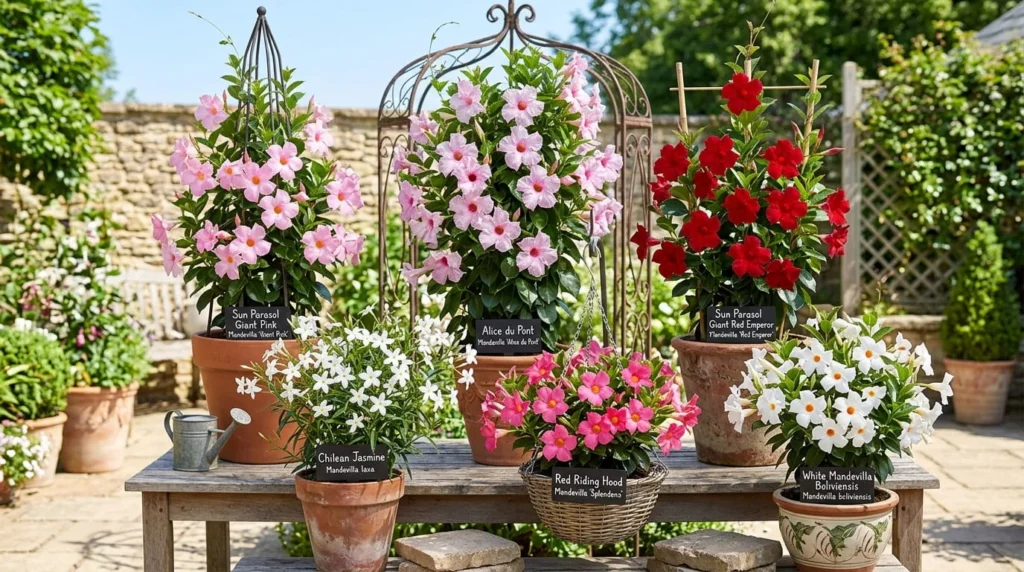
Sun Parasol Giant Pink Mandevilla Cultivar
The Sun Parasol Giant Pink mandevilla cultivar, which thrives in USDA zones 10-11, bears large soft pink blooms measuring up to five inches in diameter on vigorous semi-bushy plants growing ten to fifteen feet in height and two to three feet in width. Its glossy dark green leaves possess inherent pest and disease resistance. This cultivar is perfect for an eye catching patio plant.
Sun Parasol Giant Red Emperor Mandevilla Cultivar
The Sun Parasol Giant Red Emperor mandevilla cultivar offers lush red blooms measuring up to five inches in diameter, high heat tolerance, and superior disease resistance. If attracting pollinators such as hummingbirds is your aim, this cultivar will meet your needs due to its rich red flower color.
Mandevilla Amabilis Or Alice Du Pont
Mandevilla amabilis or Alice du Pont features textured leaves and large iced-pink blooms measuring four inches in diameter and blooming from late spring through summer till fall. In its climbing habit, it grows ten to twenty feet tall. This cultivar can be grown successfully on an arbor or trellis planting.
Chilean Jasmine Mandevilla Laxa
The Chilean Jasmine Mandevilla laxa is the most cold-hardy of all the commonly available species of Mandevilla and has been given a zone rating of 8-11 with a spread of 3 to 15 feet. This variety is known for its pure white flowers measuring 2.5 inches in diameter with a wonderful vanilla fragrance which makes it an ideal choice for use as a patio plant. After blooming, long bean-like seed pods are produced by this plant which resemble vanilla bean pods.
Red Riding Hood Mandevilla Sanderi
The Red Riding Hood Mandevilla sanderi has a compact vining growth habit that reaches a height of 6 to 8 feet with a spread of only 2 feet. This variety produces lovely rosy pink tubular flowers that are 3 inches in length and have a yellow colored throat opening. Blooming season extends from spring until the first frost arrives.
White Mandevilla Boliviensis
White Mandevilla boliviensis, alternatively known as Dipladenia boliviensis, is commonly referred to as white dipladenia and features elegant 3-inch white blooms with orange yellow throats arranged in groups of 3 to 7 flowers per branch. This flowering vine can be grown on a latticework-type trellis for privacy screening purposes, grown as a compact bush shrub in pots, or displayed as a landscape centerpiece.
Bombshell
The Bombshell series offered by Proven Winners includes varieties in Coral Pink, Pink, Red, Vining Red, and White and features small, controllable growth perfect for smaller pot sizes and limited garden areas. Adding even more color options to this list is the Diamantina series with varieties in Coral Orange Sunrise and Opal Yellow; these plants are Dipladenia hybrids and related to mandevillas but feature a bushier growth and smaller blooms in additional shades of coral and apricot.
Completing this line up are Sun Parasol Mauvelous, Bluephoria, Apricot, Double Pink Blush, Giant Crimson, and Giant Peach Sunrise which belong to the Sun Parasol collection. Each plant in the group is unique in its coloration and available only through Proven Winners online.
Mandevilla vs. Dipladenia Understanding the Difference
While there are several plants similar to mandevilla, Dipladenia is the one most likely to be mistaken for mandevilla because of its strong resemblance to mandevilla. Dipladenia is closely related to mandevilla in terms of being a tropical plant that produces trumpet-shaped flowers. Moreover, both of these plants are climbers that can grow as mound-forming plants as well. However, the main differences include the color of flowers, leaf texture, and plant appearance.
As a rule, Dipladenia has flowers that vary in shape from other flowers. Dipladenia has more colorful blooms ranging from coral to apricot. Additionally, mandevilla flowers have more textured leaves than Dipladenia ones. Both types of plants can be crossbred. As a result, some newer varieties of Dipladenia now have vines and become more similar to mandevilla.
The practical implication of this knowledge for the gardener consists in understanding the difference between mandevilla and Dipladenia in terms of growing and maintenance. While mandevilla is a good choice to create a vertical composition along an arbor or pergola, Dipladenia should be preferred when growing the plant in a container or hanging basket.
Design Ideas for Mandevilla in the Landscape
Versatility is an underrated feature of the mandevilla plant. Everyone recognizes it as a pot plant because it is indeed a great one but its uses go way beyond that.
Use a large vining mandevilla to hide a view or create a privacy shield for a patio or deck area using a lattice-type trellis. Put a vining variety into a pot and train it on an obelisk to serve as a centerpiece on a sunny courtyard or deck area. Put a bushy variety into a decorative colored pot in front of the entrance to a house as a beautiful accent during the seasons.
Put a mandevilla vine up an arbor or pergola together with a spring blooming clematis to bloom continuously from spring to autumn. Hang a bush or vining variety from a basket on a porch or shepherd’s hook. Line a pathway or sidewalk with shrubs for color and easy maintenance.
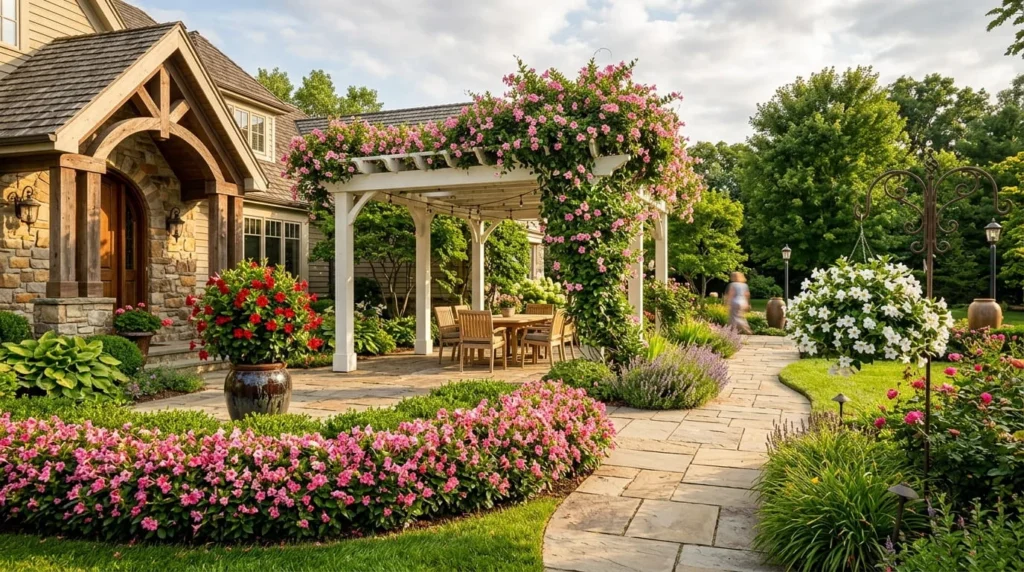
When planting in slopes or hillsides, select a more bushy type to plant up the slope or allow it to hang over a rock wall, thus making its trailing characteristic beneficial and not a disadvantage. When using for borders, plant more compact types in mass or along edges of a deck or patio area where the repeat blooming colors become striking, but do not need the trellises required by vines.
The combination of impressive flowers, glossy leaves, a bloom period from late spring to frost, as well as the real attraction of birds, bees, and butterflies makes this plant the best purchase you could make when growing in the warmth of the season. This tropical beauty is impressive on any scale, from individual plants grown in a hanging basket to an entire pergola that covers an entire entertaining area during summer.
Conclusion
Mandevilla earns its right in your garden through performance. Right from its placement in your garden once the temperature remains 50 degrees F throughout the night to its removal from there just before the first frost, Mandevilla does not disappoint much at all.
The trumpet-like flowers available in red, pink, white, and yellow; the smooth oval leaves; the fragrance that lures hummingbirds, bees, and butterflies; all this does not need any expertise and technicality in its cultivation. It just requires ample sunlight, well-draining soil, an obelisk or trellis to cling on to, watering whenever the top inch of soil dries up, and phosphorous fertilizers twice a week.
Depending on whether you select Sun Parasol Giant Pink for your patio pot, Alice du Pont for shading an arbor, Chilean jasmine for its delicious vanilla scent, Red Riding Hood for hanging baskets, or any of the Bombshell or Diamantina varieties of Proven Winners, the plant will grow with you wherever you are located. It grows perennially in zones 8-11, as an annual in colder areas, and as an indoor plant that can be replanted next year everywhere in between.
Frequently Asked Questions (FAQ’s)
Mandevilla is a tropical flowering vine known for its trumpet-shaped blooms, glossy leaves, and long flowering season. It is popular because it adds vibrant colour to gardens, patios, and outdoor spaces while attracting hummingbirds and butterflies.
Mandevilla grows best in full sunlight, well-drained fertile soil, and warm temperatures. Regular watering, proper feeding, pruning, and helping climbing support the plant grow and flower.
Mandevilla and Dipladenia are closely related plants with similar trumpet-shaped flowers, but they differ in growth style and appearance. Mandevilla is better suited for climbing structures like trellises, while Dipladenia works well in containers and hanging baskets.
Mandevilla prefers warm climates and grows as a perennial in zones 8–11. In colder areas, it should be brought indoors before temperatures drop below about 50°F to protect it during winter.
Compact varieties such as Bombshell are suitable for smaller containers and limited garden areas, while larger varieties like Sun Parasol Giant Pink work well as statement patio plants. The best choice depends on available space and whether you want a climbing or bushier plant.

10 thoughts on “Mandevilla by Rapid Home Direct |The Complete Guide to Growing, Caring For, and Choosing the Right Tropical Vine for Your Garden”