
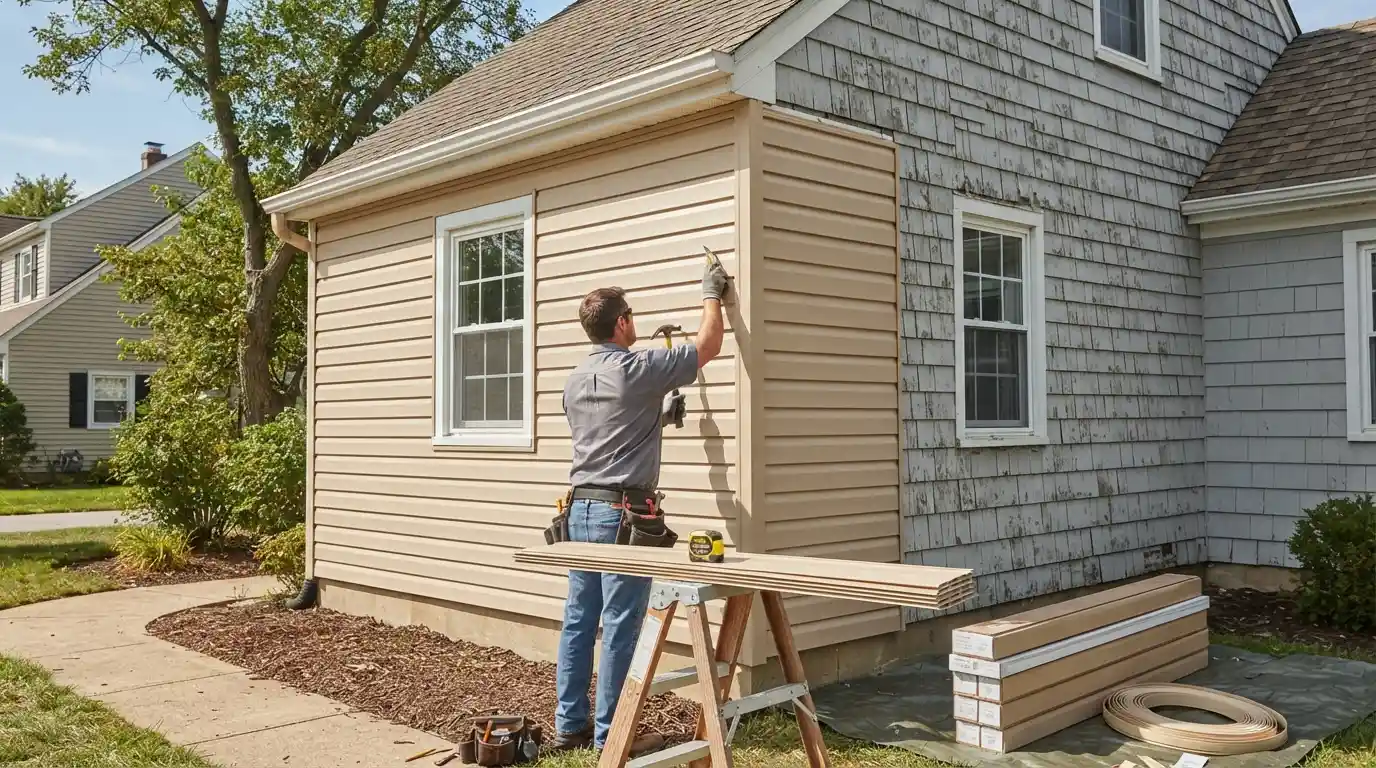

My neighbor got a quote for her whole house last spring and nearly fell over when the number came back at $22,000. Turned out the contractor had bumped her straight into premium insulated panels without really asking what she needed, when standard grade would’ve done the job fine for less than half that price. She ended up getting a second quote, same house, same square footage, and it came in around $9,800.
Same siding job, wildly different number, just because nobody explained the grade tiers to her the first time around. That gap is basically the whole story with vinyl siding cost. The material itself is cheap on paper. What actually moves the number is grade, labor, and a handful of decisions most homeowners never even realize they’re making.
Why the Same House Can Get Wildly Different Vinyl Siding Quotes
Two contractors can walk the same property and hand you numbers that look like they’re pricing entirely different houses. Most of that gap comes down to a few specific variables, not just markup.
Material Cost Versus Installed Cost, and Where the Real Money Goes
Raw vinyl siding material runs somewhere between $3 and $12 a square foot depending on grade, but that number alone doesn’t tell you much. Add labor and you’re usually looking at $4 to $12 a square foot for a standard job, jumping to $7 or even $18 once you’re dealing with premium panels and fussier trim work. The national average total sits around $12,299 this year, though I’ve seen quotes anywhere from $6,370 up past $18,000 depending on the house. My neighbor’s first quote sat right up near the top of that range, and honestly nothing about her house justified it.
Labor is usually the biggest chunk, often half the total bill, and it climbs fast if a crew’s dealing with dormers, bay windows, or a second story that slows everything down. Contractors typically charge $40 to $80 an hour, more if there aren’t a lot of licensed siding pros in your area to begin with. Then there’s tearing off the old siding, which adds roughly $0.70 to $2 a square foot, usually landing somewhere between $1,000 and $3,000 total, a cost a lot of people don’t think to ask about until it shows up as its own line on the invoice.
Home Size and How Square Footage Changes the Total Number
A smaller 1,000 square foot place might run $2,500 to $10,750 total, while something closer to 4,000 square feet can climb from $10,000 all the way to $43,000 depending on grade and how complicated the house is. Somewhere around 2,500 square feet is where most homes I’ve seen quoted actually land, usually between $5,000 and $15,000. My cousin’s house is about 2,000 square feet, and her full re-side came out close to $12,000 with standard grade panels, which matched up pretty well once her contractor walked her through where every dollar was going.
Bigger square footage doesn’t automatically mean a proportionally bigger bill either. What really drives the number up is corners, trim, and architectural detail, way more than raw panel count. A plain rectangular ranch is genuinely cheaper per square foot to side than a house covered in gables and bump outs, even if both houses measure out identically on paper. That’s really the whole reason two similarly sized homes can walk away with quotes that don’t even look like they’re for the same kind of job.
Vinyl Siding Grades and Why the Cheapest Option Isn’t Always the Trap
Grade is where my neighbor’s original quote went sideways, and it’s honestly the single biggest lever homeowners have over their final number.
Builder Grade, Standard and Premium Panels Compared
Builder grade sits at the bottom, typically $2 to $4 a square foot, with a thin 0.040 inch panel that’s fine if you’re siding a rental or flipping the house soon, but not something I’d want on a place I planned to keep for twenty years. Standard grade bumps up to $4.50 to $6 a square foot with a slightly beefier 0.042 inch panel, and it holds up noticeably better against wind and impact. My cousin picked standard specifically because her contractor mentioned that builder grade panels tend to go wavy after a few years in direct sun, and she didn’t want to deal with that down the road.
Premium runs $8 to $12 a square foot, thicker still at 0.046 inches, and it resists warping and fading well over a lifespan that can stretch 20 to 40 years. Insulated vinyl sits in a similar price range, $7 to $12 a square foot, but adds real energy savings on top of the 0.050 inch panel thickness. My neighbor’s original contractor quoted her insulated premium without once asking whether energy efficiency actually mattered for her house or her climate, which in hindsight was a pretty obvious upsell. None of these grades is the automatic right answer. It comes down to how long you’re staying put and what your winters or summers are actually like.
Style Choices That Change the Price Without Changing the Grade
Style moves the number too, sometimes by more than people expect walking in. Standard horizontal lap is the cheapest and most common option out there, while Dutch lap and beaded styles add a subtle shadow line for a small bump in price. Board and batten or vertical siding costs more per square foot than horizontal, mostly because it just takes longer to install and requires more careful measuring along the way. Vinyl shake and shingle styles, made to mimic cedar shake, sit toward the top of the price range and really only make sense if the house’s architecture calls for that specific look.
Panel length plays into it as well, since longer 16.7 or 25 foot panels mean fewer seams, and some homeowners are happy to pay extra for that on a front facing wall people actually look at. My neighbor eventually went with a mid range Dutch lap in standard grade, and her total landed around $11,000, a number she felt a lot better about than that first inflated quote. Picking style based on what actually suits the house, instead of just going with whatever a contractor suggests first, keeps the number from drifting up for no real reason.
How to Actually Lower Vinyl Siding Cost Without Cutting Corners
There’s a real difference between cutting corners and just being smart about timing and sourcing, and most homeowners never get shown the second option.
Timing, Bundling and In-Stock Materials That Cut Real Costs
Getting siding done in the fall or winter, when most contractors have more open slots on their calendar, tends to shave labor costs down since there’s less competition for a crew’s time. Sticking with in-stock siding instead of a custom color saves another 10 to 25 percent in plenty of cases, mostly because custom orders come with lead time and markup that in-stock panels just don’t carry. My neighbor’s second contractor brought this up unprompted, something her first contractor never mentioned at all. Bundling siding with gutters, windows, or fascia work can knock off another 10 to 25 percent, since a crew already set up on your property costs less per hour than mobilizing separately for each job.
Getting three to five quotes is still worth the hassle too, because pricing really does swing more between contractors than most people assume before they start calling around. You can even push back a bit on material pricing directly with a supplier if you’re willing to put in the extra legwork. None of this means sacrificing quality anywhere. It just means asking a few more questions before signing, the exact step my neighbor missed the first time.
DIY Portions, Financing and Where Cutting Corners Actually Backfires
Tearing off the old siding yourself before a crew shows up can save $1,000 to $3,000, since that cost just disappears from the professional quote. It’s doable if you’ve got the time and don’t mind a messy weekend, though it’s easy to underestimate how long it actually takes if you’ve never done it. Buying your own materials and having the contractor handle labor only is another option, though it does mean you’re on the hook if anything turns out defective rather than the installer. A lot of contractors now offer financing too, sometimes with a promotional zero percent window, which helps if you’re not sitting on the full amount in cash. Here’s the part that actually bites people though.
Skipping structural repairs to save a bit upfront, just patching over rotten sheathing instead of replacing it, almost always comes back around as buckling or water damage a few years later, and fixing that costs way more than doing it right the first time would have. My neighbor’s original contractor, in fairness, did flag some soft sheathing near a window before quoting her, and that’s honestly the kind of honesty worth paying a little extra for.
Conclusion
My neighbor’s two wildly different quotes for the exact same house sum up vinyl siding cost pretty well. The material itself isn’t expensive, but grade, style, labor, and a few smart timing choices can swing the final number by thousands either way. Getting a few quotes, actually understanding what each grade tier gets you, and asking straight up about removal costs and structural repairs before signing anything protects your budget a lot better than just trusting the first number you’re handed. A little homework upfront, the kind my neighbor eventually did on her second quote, is really what separates a fair price from one that’s quietly padded.
Frequently Asked Questions
How much does vinyl siding cost installed?
Expect $4 to $12 a square foot for standard grade work, and $7 to $18 if you’re going premium or insulated. Nationally the average total sits around $12,299, though I’ve seen it run anywhere from $6,370 to $18,378 depending on the house.
What’s the cheapest vinyl siding option out there?
Builder grade, usually $2 to $4 a square foot for material. It’s fine for a rental or a house you won’t own long, but it tends to go wavy sooner than standard or premium panels would.
Does putting vinyl siding on actually raise home value?
Nationally you’re looking at roughly a 77 percent return at resale, though that jumps to about 96.3 percent in some regions like the Middle Atlantic. Fiber cement tends to return more, closer to 114 percent, but it costs a lot more going in.
Is there actually a cheaper time of year to install vinyl siding?
Yes, fall and winter installs tend to run cheaper labor wise since contractors have more open schedule gaps then. Pair that timing with in-stock materials instead of a custom order and you’ll usually see the biggest real savings.
