

That year when my shower head developed the appearance of having been painted by chalk, I assumed that I had purchased a low-quality one which had finally given up the ghost. No such thing. The plumber working on something totally different just took one glance at it, ran his thumbnail against the white scum and uttered the magic word “scale.” My water heater, he pointed out, was almost certainly fighting the same battle internally, just somewhere I couldn’t see it working harder every cycle to push heat through a layer of mineral buildup that was quietly shortening its life and raising my energy bill in the process.
That conversation is what sent me down the whole house water filtration rabbit hole, and what I learned along the way is that the category is genuinely confusing by design. Half the marketing language treats “filter” and “softener” as interchangeable when they solve completely different problems, and most cost guides hand you a number without ever explaining what that number actually buys you.
What a Whole House System Actually Does and Why It’s Not the Same as a Water Softener:
The whole house water filter, which is another name for the point of entry water filter or POE system, is attached to the main water pipe that enters your house and cleanses all of it before going anywhere else within your house. This is precisely the key difference between the point of use filters such as the under-sink, faucet, and countertop water filters, which clean up water only at one particular tap. The whole house water filtration process includes cleaning of water of the kitchen tap, all showers, laundry machines, and all other appliances at once.
The confusion that trips up most homeowners first:
Difference between whole house filter and water softener. They do two entirely different things. Filters use filtration, adsorption, and/or UV to remove chlorine, chloramines, sediment, heavy metals, lead, PFAS, VOCs, bacteria from the water. Water softeners do not filter the water in order to remove any impurities; their function is to soften the water from the minerals, calcium, and magnesium, which cause scale, limescale.
And the chalky buildup on your shower head, which began my own research. Salt-free water conditioners and salt-free conditioners approach mineral hardness in a way that salt based water softeners do not. They prevent the bonding of minerals so they cannot form hard substances, instead of removing them using the ion exchange process. Many homes actually require both a filter and conditioner, which leads to combination filtration systems.
Multi-stage filtration system:
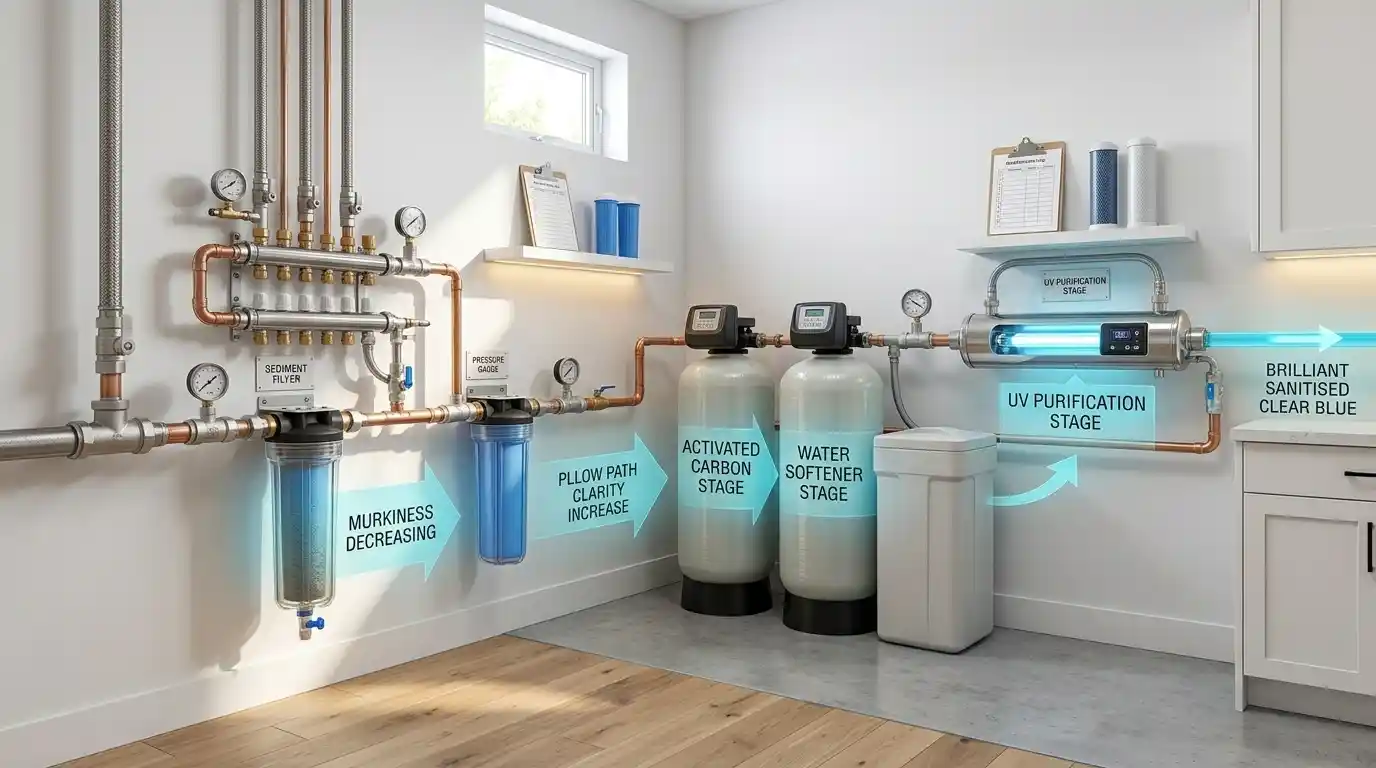
A multi-stage filtration system typically layers several of these technologies. A sediment pre-filter removes rust and particulates first, protecting downstream components from physical wear. Activated carbon filter or catalytic carbon filter media handles chlorine and chloramine reduction next catalytic carbon specifically matters because over 30% of US utilities now use chloramine instead of standard chlorine, and standard carbon struggles to break chloramine down effectively where catalytic carbon does it well.
Coconut shell GAC, or granular activated carbon, is considered the gold standard within this category specifically because of its higher surface area and purity compared to coal-based alternatives. KDF media or a KDF sponge a copper-zinc alloy frequently rides alongside the carbon stage to assist with heavy metals removal and inhibit bacterial growth within the tank itself. Optional UV purification system or UV light water treatment stages destroy bacteria and viruses through disinfection rather than filtration, typically reserved for well water or systems where biological contamination is a documented concern.
Reverse Osmosis, Distillers, and Ionizers: The Specialist Technologies Worth Understanding:
Reverse osmosis system technology removes more than 90% of all contaminants through a permeable membrane filter, making it the most thorough single technology on this list. Whole house reverse osmosis installation runs considerably higher than standard carbon-based systems a meaningful jump that reflects both the equipment and the more complex plumbing work involved and produces more wastewater than other filtration methods as a structural trade-off of how the membrane technology functions. For most households, reverse osmosis makes more financial sense installed at point-of-use rather than point-of-entry, treating drinking and cooking water specifically rather than the entire home’s supply.
Water distiller systems:
Water distiller systems purify water by boiling and condensing it, physically separating water vapor from bacteria, heavy metals, and most chemicals left behind in the original liquid. These systems purify a modest daily volume rather than the household’s full supply, which is why they’re typically deployed for drinking water specifically rather than whole house water purification. Water ionizer units use electrolysis to create alkaline water for drinking and acidic water for cleaning purposes a DIY-friendly countertop technology that requires an electrical outlet nearby and sits outside the mainstream whole house filtration conversation entirely, more a specialty drinking-water product than a household-wide solution.
Chemical injector system technology:
More prevalent in well-water installations than in city water installations, often utilizes chlorine or hydrogen peroxide to deal with iron, bacteria, and hydrogen sulfide or rotten egg-sulfur smell. This is certainly one of those pieces of equipment that is definitely geared towards well-water systems and not for city water homes.
Sizing and Component Decisions That Determine Whether the System Actually Works:
Flow rate and GPM rating are the specifications most homeowners skip past while comparing prices, which is a genuine mistake. Matching filter GPM rating to household peak demand is the single factor that determines whether your new system improves your water or quietly ruins your water pressure. As a rule of thumb, 10 GPM 1-2 bath homes is generally sufficient, while 15 to 20 GPM 3 plus bath homes is the realistic minimum for larger households running multiple fixtures simultaneously.
Does a whole house filter reduce water pressure is one of the most commonly asked questions, and the honest answer depends entirely on correct sizing. A properly sized, properly maintained system causes only 1 to 3 PSI drop properly sized system genuinely unnoticeable in daily use. An undersized system, or one with clogged filter media, can cause 10 to 20 PSI drop undersized system, which shows up as weak showers and slow-filling appliances throughout the house. The fix is rarely the filtration technology itself it’s matching capacity to actual household demand before you buy anything.
Filter Housing and Replacement:
The selection of filter housing, bypass valve, media tank, and double-canister design impacts not only the footprint but also the ease of maintenance. The filter housing will serve you at least 10 years, while the media itself wears out significantly faster. Sediment filters require replacement once in 3 to 12 months, carbon filters once a year, KDF media 5 to 7 years, and the bulbs for the UV light stage once a year if it is included in the system.
The manufacturers often specify the capacity of the filter in gallons processed, not years of usage: 100,000 to 1,000,000 gallons 100,000 to 1,000,000 gallons filter capacity is the typical range in the market; the most advanced tank-based filters have the capacity of 600,000 to 1,000,000 gallons SoftPro capacity which means about 5 years of service SoftPro lifespan. Filters that work on the principle of the cartridge filtration system have a smaller capacity: for example, the cartridge of the brand Kind’s E-1000 is able to process 80,000 gallons or 1 year.
NSF certification:
NSF certification matters more than most marketing copy suggests. NSF/ANSI 42 covers aesthetic effects like chlorine taste and odor; NSF/ANSI 53 covers health effects including lead and certain VOCs; NSF/ANSI 61 and NSF/ANSI 372 address material safety and lead-free component standards specifically. A system without published, verifiable certifications against the contaminants you actually care about is a system you’re trusting on faith rather than evidence.
What It Actually Costs and What’s Hiding Inside the Number:
Whole house filtration system cost spans a genuinely wide range depending on technology and household size. Across multiple current sources, the consistent middle ground sits around $1,500 to $5,500 installed average 2026, with Home Guide citing a comparable $850 to $5,400 installed average and Angi reporting $1,129 to $3,539 average with a reported overall average around $2,273 average cost Angi. Entry-level salt-free conditioner units like NuvoH2O start under $700 starting NuvoH2O compact for smaller homes, while whole house reverse osmosis installation climbs to $4,800 to $8,000 the most expensive single-technology option on the market, reflecting both equipment complexity and the more invasive plumbing work involved.
Installation itself is the line item most homeowners underbudget. A straightforward setup with easy plumbing access runs $300 to $800 simple installation, while systems requiring electrical work for a UV stage, or significant pipe modifications, can push installation costs to $1,500 to $2,000 plus complex installation UV. Plumber rates typically run $50 to $200 per hour plumber rate, with a standard install taking roughly two to three hours typical install time for an experienced professional meaning labor alone often lands in the $300 to $600 range even before accounting for parts.
Ongoing costs:
Ongoing costs are the part that genuinely separates systems on long-term value rather than sticker price. Annual filter replacement runs $100 to $300 per year filter replacement on most systems, with whole-house maintenance more broadly spanning $80 to $500 plus annual maintenance range depending on system complexity mid-range systems typically settling around $170 to $300 annually mid-range systems once sediment changes, an annual carbon swap, and an optional UV bulb are all factored in together.
Whole house water filter vs bottled water cost:
Comparison is worth running for anyone hesitating on the upfront number. A household spending $100 a month on bottled water pays roughly $1,200 annually bottled water cost triple a typical mid-range filtration system’s yearly maintenance cost while bottled water has been shown to carry 2,125% more microplastics than properly filtered tap water. With 87% Americans concerned tap water quality according to recent industry survey data, the financial case and the health-driven case for whole house filtration increasingly point the same direction.
How to Actually Choose the Right System for Your Specific Water:
The honest starting point for any whole house filtration decision is your actual water, not a generic bestseller list. Pulling your utility’s Consumer Confidence Report the CCR water report every municipal supplier publishes annually shows exactly what contaminants are present in your tap water and at what concentration, and it’s free. For well water households, municipal CCR data doesn’t apply, and a private water quality testing service becomes essential instead, since well water contaminants like iron, manganese, sulfur odor, and bacteria vary enormously even between neighboring properties on the same aquifer.
City water vs well water filtration:
Filtering requirements for city water and well water systems differ considerably after that. In the case of families with municipal water who have issues mainly with the taste and smell of chlorine or chloramine in their water supply, a catalytic carbon filter without iron and sulfur specific media is usually sufficient. Families with well water often require a custom made filter system based on individual testing results, which may include a combination of sediment filtering, iron and manganese removal, and sometimes even a bacterial system or UV light stage.
DIY vs professional installation:
DIY vs professional installation is a genuine, defensible choice depending on the system. Most cartridge systems are DIY-friendly for homeowners with basic plumbing skills, saving $200 to $500 in labor costs. Professional installation is strongly recommended for multi-stage POE systems, anything requiring electrical work, difficult installation locations, larger pipe modifications, or whenever the manufacturer’s warranty explicitly requires professional installation to remain valid a detail worth confirming before you decide to save money on labor and accidentally void coverage on the equipment itself.
Choosing a whole house water filtration system:
Choosing a whole house water filtration system ultimately comes down to identifying what your water is actually carrying through a real test or your utility’s published report rather than buying based on price or a brand someone recommended in a forum thread. Filters and softeners solve different problems, sizing determines whether the system helps or hurts your water pressure, and the real cost of ownership lives in the maintenance schedule as much as the sticker price. Get those three things right, and the white crust on the showerhead becomes a problem you solved once rather than one you keep scrubbing at every few months.
Conclusion:
Whole house water filtration systems represent one of the best solutions for water purification, but there are certain factors that need to be considered depending on your particular water situation. The difference between filtration and water softening, proper sizing of the system, as well as certification and maintenance costs will help you make an informed decision and purchase a system that will ensure protection from the harmful effects of water for many years to come.
Frequently Asked Questions (FAQ’s)
A whole house water filtration system connects to the main incoming water line and treats water before it reaches taps, showers, appliances, and laundry machines. Unlike an under-sink filter, it works throughout the home rather than at a single outlet.
A whole house filter targets substances such as sediment, chlorine, lead, heavy metals, and certain microorganisms. A water softener primarily removes calcium and magnesium, the minerals responsible for hard water and limescale.
Start with your utility’s water-quality report if you use municipal water, or arrange private testing if your home relies on a well. City water may need carbon filtration to remove chlorine or chloramine, while well water may require treatment for sediment, iron, or sulfur, or UV treatment.
A correctly sized and maintained system should cause only a small pressure change that is unlikely to affect daily use. Weak showers usually point to an undersized system, clogged media, or a flow-rate rating that does not match the household’s peak demand.
The article places typical installed costs around $1,500 to $5,500, although reverse osmosis and complex plumbing work can cost more. Choose a basic cartridge system if you are an experienced DIY homeowner, but use a professional for multi-stage systems, electrical components, and major pipe changes.
