
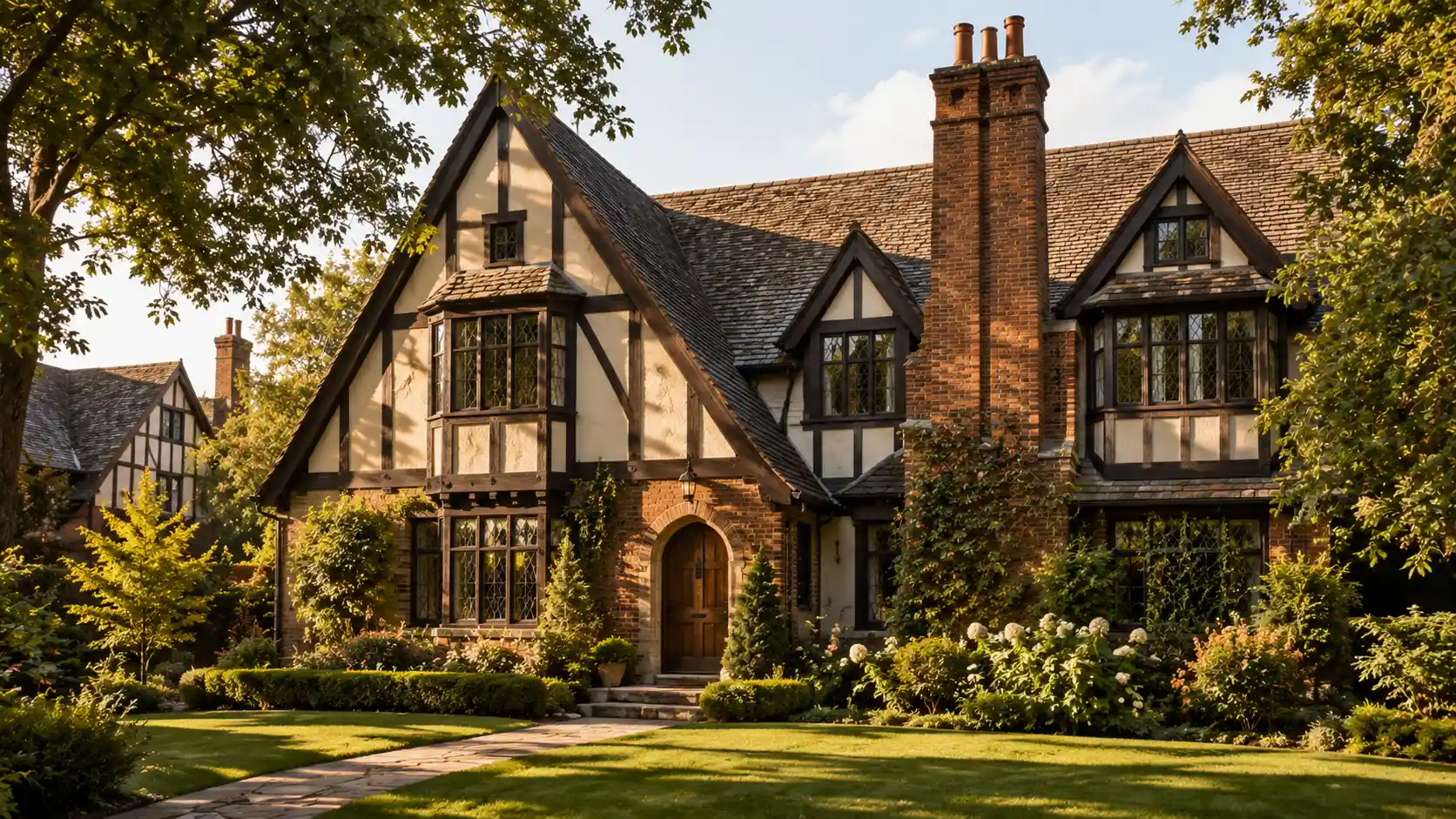

I walked through my first real tudor style house almost by accident, touring a friend’s place in a Pittsburgh PA Tudor homes neighborhood, and I remember standing in the entryway thinking it felt heavier, somehow more permanent, than any newer house I’d been in. That sense of permanence isn’t an accident. It’s baked into how these homes were designed from the start, and once you understand where that comes from, you start seeing tudor style homes everywhere, especially in older American suburbs that boomed during a very specific window of time.
Where Tudor Style Homes Actually Came From
The Tudor period in England ran from 1485 to 1603, named for the Tudor dynasty and its run of Tudor monarchs starting with Henry VII and ending with Queen Elizabeth I, before James I took the throne and shifted England toward Stuart-era taste. Tudor architecture during that stretch covered the reigns of Henry VIII and Edward VI too, and what people now call Elizabethan architecture is really just a later phase of the same broader style, eventually blending into Jacobean architecture as the century turned.
The English Reformation pushed building energy away from religious structures and toward secular ones, while English Gothic forms gradually gave way to a Renaissance aesthetic filtering in through France and the Low Countries. Architectural historians like Nikolaus Pevsner and Francis Woodman have written extensively about this shift, and John Harvey went so far as to argue Tudor Gothic deserved its own category entirely, separate from standard Gothic Perpendicular style work, partly due to continental influence from Flamboyant Gothic happening at the same time.
The Buildings That Still Prove the Point
You don’t have to take historians’ word for it. Hampton Court Palace remains the clearest surviving example of true Tudor architecture, originally built by Cardinal Wolsey before Henry VIII took it over and expanded it considerably. Sutton Place pioneered a more open layout, while Layer Marney Tower shows off the era’s love of Italian-style decoration, sometimes called antik decoration at the time.
Religious buildings got the same treatment, from the Christ Church Gate Canterbury Cathedral to soaring achievements like the Boston Stump, the Louth spire, and the famous fan vault at King’s College Chapel Cambridge. Beyond England itself, the style traveled Wrexham St Giles, Raglan Castle, and Plas Mawr Conwy show genuine Tudor churches and homes throughout Wales Tudor architecture, a connection cemented by the Laws in Wales Acts. Ireland Tudor architecture and even the English exclave Calais carried traces of the same influence during English control.
What Actually Makes a House “Tudor” From the Outside
This is where most homeowners actually start caring. Tudor style house exteriors are instantly recognizable thanks to decorative half-timbering those exposed wood beams set against light-colored stucco or, in many American versions, dark brown black timbering laid over white stucco exterior or off-white cream stucco for maximum high contrast exterior drama. Some homes lean into brick exterior or stone exterior instead, often combining brick and stone accents for texture.
Steeply pitched roofs and steep gabled roofs, frequently with multiple gables stacked across the façade, sit above tall decorative brick chimneys finished with chimney pots that poke dramatically above the roofline. Asymmetrical design and asymmetrical layout are deliberate, not accidental you won’t find mirrored windows or a centered front door on an authentic tudor style house, which is part of what gives these homes their slightly off-kilter, storybook charm.
Windows, Doors, and the Details That Date the Style
Look closely and the windows give away the era almost instantly. Tall narrow windows with multi-paned windows or diamond-shaped panes are everywhere, alongside oriel windows bay windows that project outward from upper floors and leaded glass windows that scatter light in a way modern flat glass simply doesn’t. Arched doorways built around the low pointed Tudor arch shape complete the look, often fitted with a heavy wooden door or rounded wooden door finished in dark iron hardware that looks like it belongs on a castle gate rather than a suburban street.
Stepping Inside a Tudor Style Home
The interior keeps the drama going. Sweeping staircases and elaborate staircases anchor a lot of floor plans, while exposed ceiling beams, wood wainscoting, and wood paneling running across walls give rooms a kind of grounded, masculine warmth. Dark oak beams cross many ceilings, and in the grandest examples, an actual Great Hall complete with a minstrels gallery and an inglenook fireplace serving as the large fireplace focal point recreates a genuinely medieval atmosphere, even in a relatively modest home.
Small Cottage or Sprawling Estate — Tudor Comes in Both
Not every Tudor home is a mansion. On the high end, Stockbroker Tudors describe the sprawling luxury estates built by wealthy buyers, demanding serious property management upkeep to maintain. On the more modest end, Tudor Cottages offer the same handcrafted structural details and gentry status symbol charm at a fraction of the scale, making them genuinely livable rather than purely decorative. Whichever scale you’re drawn to, English Tudor style and French Tudor style diverge slightly English versions lean hardest into half-timbered siding and that classic English manor feel, while French Tudor style pulls in French Country influence, favoring stone and wood exteriors over the typical half-timbered look.
Why America Fell in Love With Tudor in the First Place
Tudor Revival, sometimes simply called Mock Tudor, took off in America starting in the late 1800s and hit peak popularity Tudor during the 1920s 1930s, especially across Tudor Northeast Midwest neighborhoods where merchant class homes and wealthy suburbanites wanted a visible connection to English architectural heritage. You’ll still find dense pockets of these homes today Pittsburgh PA Tudor homes, Washington DC Tudor homes, and Richmond VA Tudor homes among the most recognizable concentrations in the country. The style eventually lost ground to mid-century modern decline after World War II, pushed out partly by urban expansion decline pressures and industrialization decline favoring faster, cost-effective building methods, with a broader brick and stone construction shift replacing labor-intensive timber framing almost everywhere.
Bringing a Tudor Floor Plan Into Modern Life
Modern tudor floor plans manage to keep the old-world appearance while quietly modernizing everything behind the walls. Great rooms, formal dining rooms, and built-in bookshelves sit alongside primary bedroom suites, with angled ceilings on upper floors creating natural window seats and reading nooks tucked under the roofline. Open-concept living and a proper chef’s kitchen now show up regularly in newer builds, alongside smart home technology, a wine cellar for serious collectors, and a dedicated home office all blended into floor plans that still deliver real curb appeal and that weathered elegance buyers specifically seek out.
What It Actually Costs to Own One
Here’s the part nobody glosses over once you actually own one of these: Tudor home renovation cost runs noticeably higher than standard remodeling, largely because Tudor maintenance cost depends on replicating original materials and conserving decorative elements rather than swapping in generic modern substitutes.
Tudor restoration and Tudor remodeling work, especially anything involving timber frame repair, calls for serious historic property preservation know-how, and expensive renovation Tudor projects are simply part of owning a house built around handcrafted, labor-intensive details. Energy efficiency Tudor upgrades help offset some of that eco-friendly home renovations paired with modern energy solutions Tudor home owners are increasingly installing, like an EcoFlow OCEAN Pro power station running on Intelligent Mode power optimization, can meaningfully lower monthly utility bills without touching the home’s structural wood beams or original character.
If You’re Building a Tudor From Scratch
For anyone starting fresh rather than renovating, Tudor house plans now come as digital PDF house plans, often with an add-on CAD files option exported in AutoCAD format for builders who need lot-specific tweaks. Most providers include a free cost-to-build report you punch in your zip code, pick a finish quality level, and get a real estimate back.
Garage options typically include detached garage, courtyard garage, side-load garage, front load garage, and rear load garage configurations, and Tudor house plan licenses generally come in a couple of tiers depending on whether you’re a single homeowner or planning to build the same design repeatedly. Rocket Mortgage financing is one common route buyers use to fund the build once plans are finalized.
Heritage Touches That Still Matter Today
Even older, untouched examples carry small details worth preserving: thatched roofs on some original English examples, the classic black and white theme house look, generous open gardens, and original wooden floors that have aged into something genuinely beautiful. On the construction side, Tudor architecture historically relied on quadrangular house plans before evolving toward more open H-shaped plan and E-shaped plan layouts, with fan vault and pendant vault ceiling work, plus ogee-domed turrets and polygonal plans showing up in the grandest examples, all built with materials specifically chosen to handle damp English weather conditions.
That same engineering logic is exactly why the architectural silhouette and Tudor exterior contrast still reads as sturdy and intentional today, built on a foundation practicality and drama that’s lasted over five centuries.
Conclusion
Tudor style homes have survived wars, architectural fashion swings, and entire shifts in how houses get built, and they’re still standing both literally and in buyer demand because the style was never just decoration. From Hampton Court Palace down to a modest Tudor Cottage on a quiet American street, the same instinct runs through every version: solid materials, deliberate asymmetry, and details built to last centuries rather than decades. Whether you’re restoring an original or building new from a modern Tudor floor plan, that’s the inheritance you’re actually buying into.
Frequently Asked Questions (FAQ’s)
A Tudor-style home is known for steep gabled roofs, decorative timbering, tall chimneys, narrow windows, and an intentionally asymmetrical exterior. It draws on English architecture from the Tudor period, between 1485 and 1603.
Original Tudor architecture refers to buildings created during England’s Tudor period, including major structures such as Hampton Court Palace. By contrast, Tudor Revival, also called Mock Tudor, is a later interpretation that became especially popular in American suburbs during the 1920s and 1930s.
Look for exposed dark timbering against light stucco, steep rooflines, multiple gables, decorative brick chimneys, and leaded or diamond-paned windows. In addition, brick and stone exteriors are common, particularly in American Tudor homes.
They can cost more to restore than standard homes because original timber, masonry, windows, and decorative details often require specialist work. In turn, energy-efficiency upgrades may reduce running costs, but they should be planned carefully to preserve the property’s historic character.
Restoration is best for buyers who value authentic materials and historic craftsmanship and can manage higher maintenance demands. By contrast, a modern Tudor build may be more practical when you want the traditional exterior alongside open-plan living, a modern kitchen, updated technology, and improved energy efficiency.

2 thoughts on “Tudor Style Homes: 9 Stunning Reasons This Centuries-Old Style Refuses to Go Out of Fashion”