
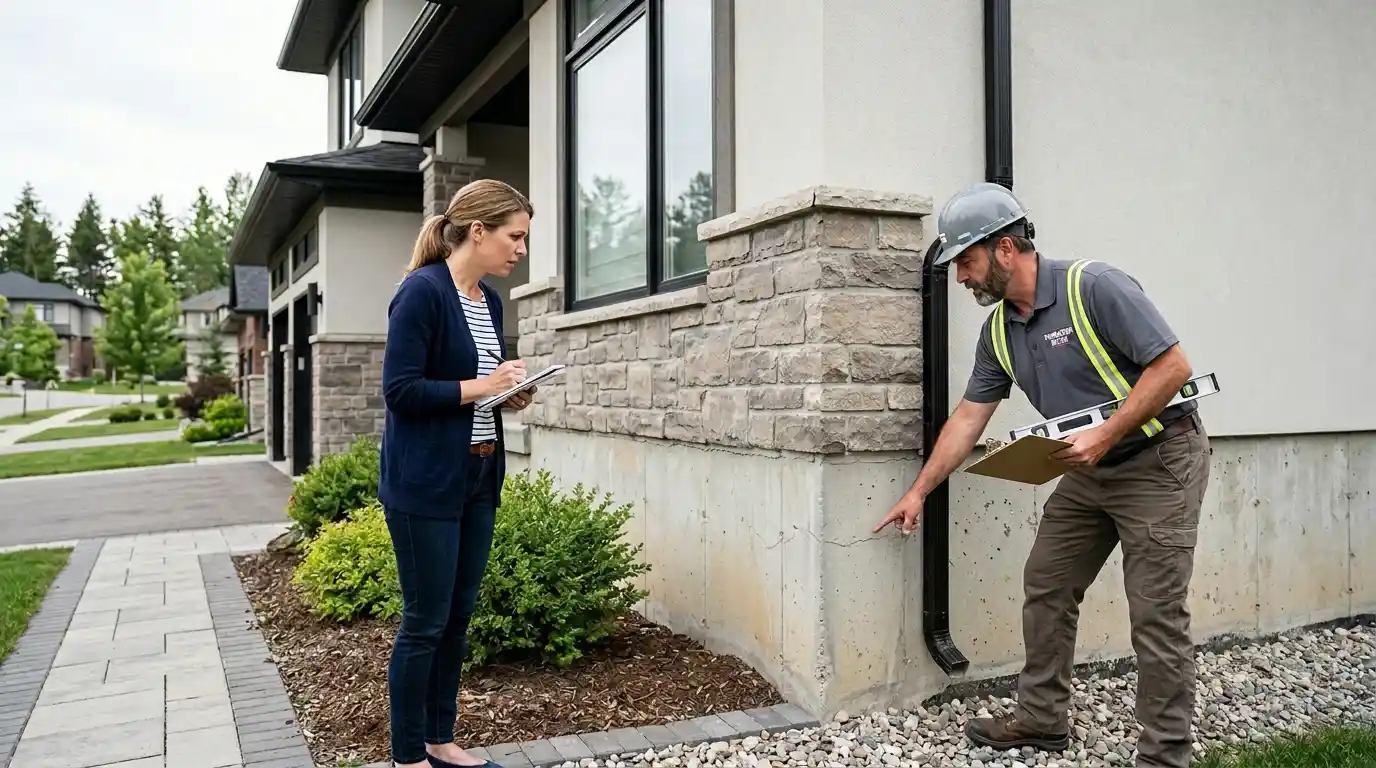

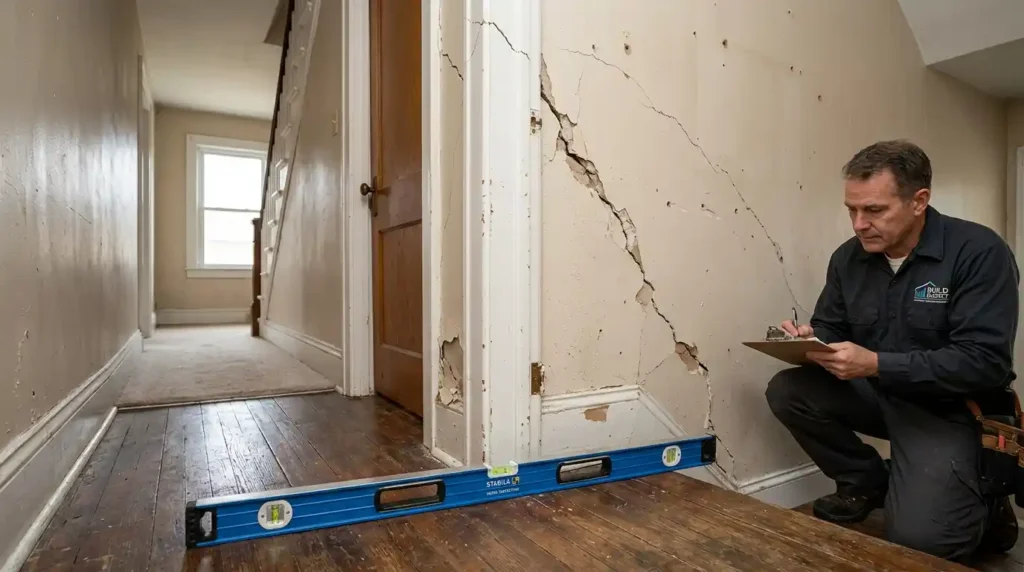
When I first saw the diagonal crack going from the corner of the doorframe all the way to the baseboard, I was sure it was only cosmetic. Peeling paint, age old drywall, natural deterioration. Six months later, the very same door was having problems opening because it was jammed too much to be able to open without applying a shoulder to it. This is how house foundation repair works; when the problem becomes evident, it is normally because it has been developing under the surface for some time already. The sticking door is not the problem. It is just the symptom.
There is a direct correlation between foundation problems and the value of property. If there are problems with the foundation of the home that have not yet been addressed, they may result in a reduction of up to 20 percent of the overall market value of the property. Foundation problems are one of the leading causes for failed property inspections that prevent transactions from going through. The cost of addressing foundation repairs later on tends to be much more expensive than when detected early.
Reading the Warning Signs Before Foundation Damage Gets Expensive:
Foundation settling is common. It is natural that all buildings will experience some form of movement due to compression of the soil underneath caused by weight of the structure itself, moisture variations, and seasonal changes in freeze/thaw cycles. The distinguishing difference between regular foundation settling and problems that will require house foundation repair is the nature of the problem itself.
The appearance of horizontal cracks on the basement walls is the most dangerous indication. It means that the pressure of the soil pushes against the hydrostatic pressure of the foundation wall either because of moisture saturated soil or expansive soil. If not fixed, horizontal cracks will result in bowing of the wall and, ultimately, structural collapse. Diagonal cracks which appear at 45-degree angle around windows and doors are indicative of differential movement. This term describes movement of one part of the foundation differently from other parts. Staircase cracks appear in brick and stone foundations as well.
Cracks In Walls:
While cracks in walls are common indicators, some other possible symptoms of foundation movement include floors that are not level, sloping floors, floors that bounce in a pier and beam house due to damage to support posts, doors and windows that stick after being able to open and close easily before, gaps between walls and ceilings, windows and door frames that appear out of alignment, cracked floor tiles, floors that sag, cracking of concrete slabs, and steps or porch areas that sink. Moisture in crawl space, mold formation, mildew smell, and mustiness inside the house are indicative of moisture coming in through the foundation. Poor indoor air quality due to rotting beams and joists in a pier and beam crawl space, and weeds growing around the foundation are other indications of moisture entry which are often overlooked by homeowners.
Both geotechnical and structural engineers studying the performance of foundations realize that two houses on the same street may have the same cracks caused by totally different factors. Soil testing reports, which will cost you anywhere from $500 to $3,000, and structural reports from independent structural engineers at around $300 to $1,000 before hiring a single foundation repair company are the most underutilized resources in the field of residential foundation assessments. Free inspections by foundation repair firms are sales calls in disguise.
What Causes Foundation Damage: Soil, Water, Roots, and Construction Failures:
Soil:
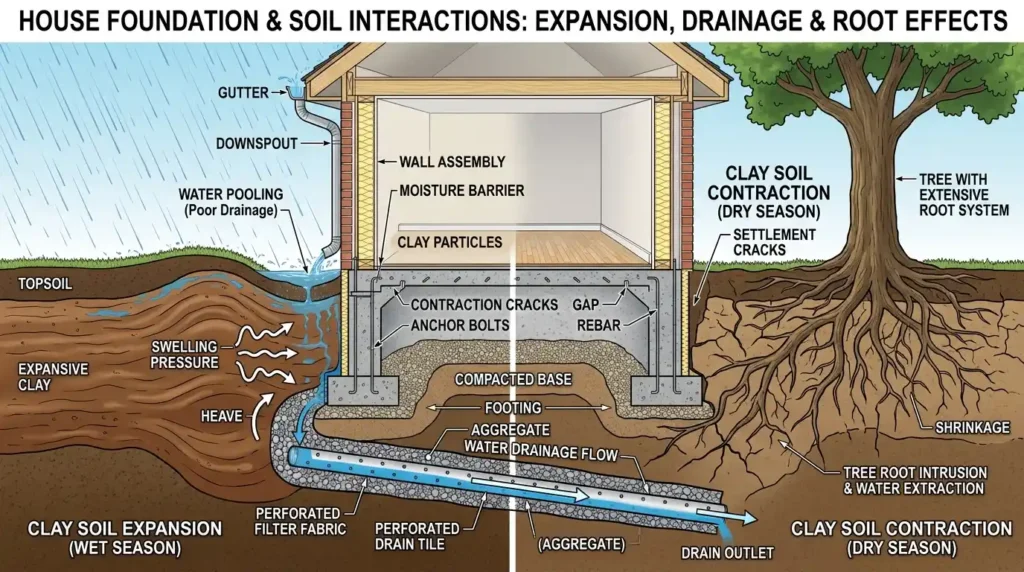
Clay expansive soil is the primary factor responsible for damage to house foundations in America. When the soil is exposed to moisture, it expands, but when there are drought conditions, the soil will shrink greatly. It is this kind of movement that creates cracks in concrete slabs, shifts pier and beam houses, and presses basement walls with growing pressure each year. This happens in Texas, Alabama, and other southern states of America where the foundation settles because of the soil system. It is for this reason that insurers in Texas have excluded slab foundation repairs due to soil movement in their home insurance policies.
Drainage:
The next leading cause of foundation problems is poor drainage. Water buildup against a foundation rather than water drainage will lead to a condition called hydrostatic pressure being exerted on foundation walls. Water buildup under slabs leads to swelling of soil unevenly; thus, differential movement results in concrete cracking. Poor drainage is caused by grading that slopes towards the home rather than away from the structure, clogged gutters causing rain water to flow directly onto the ground near the structure, downspouts ending up too close to the structure, and inadequate perimeter drainage systems or French drains. Solutions to many foundation issues start from outside the house rather than underneath the house; one should have grading done six inches below over ten feet away from the structure, extension of downspouts four to six feet away from the structure, and installation of a sump pump if the basement floor is at grade level.
Roots Of Trees:
The roots of trees, burrowing pests including groundhogs and moles, termites, and infestations of other insects all contribute to an unstable foundation through changing the soil moisture content, causing decay to wooden beams within the crawlspace under the house, and physical displacement of soil and fill beneath the structure. Invasive roots of trees that grow toward the water located beneath the foundation pull the water out of the surrounding soil, resulting in dry spots and creation of voids. Trees planted near the home’s outside walls are repeatedly mentioned in the home inspection reports as factors that can contribute to foundation problems.
Poor Construction:
Poor construction techniques and weak reinforcement used during initial construction of the house result in an initially structurally unstable foundation. Uncompact or unevenly compacted fill and soil, improper reinforcement of concrete, and insufficient footings all represent construction failures not covered by the insurance because these issues do not indicate accidental damage but reflect poor construction techniques. In colder climates, freeze-thaw cycles of soil water molecules result in yearly cracking of the foundation that accumulates through decades due to the lack of insulation of the foundation wall perimeter.
House Foundation Repair Methods: From Crack Sealing to Steel Push Piers:
Repair methods for any kind of foundation repair project totally rely on foundation type, soil condition, and the kind of movement involved. It is all about finding the correct solution for the particular problem, which gives permanent stabilization rather than a temporary one that recurs after a couple of years.
The epoxy injection and the polyurethane injection are effective for sealing hairline cracks as well as minor non-structural cracks. This process costs between $250 to $800 for each repair. It can be done for cracks which are less than 1/8 inches and are not moving at all. For DIYers, there are epoxy injection kits, but when it comes to settlement, sinking, water entry, and bowed walls, then it is all for professionals only.
Polyurethane Foam Injection:
Polyurethane foam injection involves the injection of high-density polyurethane foam through penny-sized holes in concrete leveling projects such as sinking concrete slabs, driveways, garage floors, pool decks, and void filling under foundation slabs. This process cures within about 15 minutes as opposed to mudjacking which takes up to 24-48 hours, and the environmental polyurethane foam products have made it one of the trends in foundation repair in 2026. In mudjacking, a cement-sand-water mixture is pumped under the slab to lift it and fill voids in an efficient manner although it is heavier than polyurethane foam and has a shorter lifespan of 5-10 years.
Helical piers are among the precise tools in the foundation repair contractor’s kit. The modern helical piers have galvanized steel shafts and helical plates which screw into the solid soil to great depths often 30 feet and even more below the unstable and expansive clay soil layer causing the movement of the slab. The helical pier prices range from $1500-$3500 each with residential homes requiring between 6-12 piers and a total job cost between $9000-$40000. Foundation slabs may require between 5-15 piers.
Steel Push Piers:
Steel push piers are inserted hydraulically underground until bedrock or load bearing soil layer is reached, bearing the weight of several story houses, excessive settlement conditions, and structures with buildings over poor soil. Such are the strong solution for extensive foundation settlement greater than 2 inches, as well as stabilizing commercial buildings where helical drilling will not achieve enough torque resistance. The Cable Lock ST Plus by Olshan is a patented system of concrete piles and steel piers combined and joined with cable to provide rigidity in the range from $1,825 to $3,350 per pier, installed without any heavy equipment and disturbing landscaping, thus suitable for residential houses with difficult equipment access.
Wall anchors are used to brace the bowing walls of the basement by securing themselves to the stable ground far away from the building and counteracting any pressure. Wall anchors offer an economical solution to problems concerning the foundation of buildings where the wall is not excessively bowing beyond 2 inches. Carbon fiber repair involves securing high-tension carbon fiber straps on the internal surface of bowing basement walls without the addition of any weight to the walls, and no need for digging into the wall.
Crawl Space:
Crawl space encapsulation and basement waterproofing take care of the moisture infiltration aspect of foundation repair which structural repair can’t fix on its own. Bowing walls fixed without fixing the hydrostatic pressure causing the problem will just continue to bow. Interior drainage systems, sump pumps, perimeter drainage, and exterior waterproofing provide the moisture management system that ensures the permanence of structural repairs instead of making them temporary. Support jacks and beam repair or replacement deal with the structural wood rotting and sagging floors, as well as air and moisture issues, in pier and beam homes resulting from crawl space moisture.
Smart foundation sensors are the biggest foundation repair innovations in 2026. The ability to track structural movement in real time through a smartphone allows you to see whether a foundation is shifting and how it reacts to seasonal changes in moisture, without having to wait for visible signs of damage. When taken together with the eco-friendly polyurethane foams and improved helical piers, house foundation repair in 2026 promises much more promising results than similar repairs done a decade before.
Foundation Repair Costs, Financing, and Insurance Coverage Realities:
The costs of house foundation repairs differ greatly for national figures to be properly interpreted. According to HomeAdvisor’s True Cost Guide for 2025 based on over 40,000 completed projects, the national average is around $5,100 while most people end up paying between $2,200 and $8,100. Olshan’s 2026 data shows the national average of $11,950 when slab underpinning and whole crawlspace rebuilding are accounted for. According to contractor pricing data by PowerLift Foundation Repair for 2024 to 2025, the median cost is at about $7,500. There is substantial regional cost difference as Southern states have prices 15 to 25 percent below the national average because of lower labor rates, while the Pacific coast and New England markets have them 20 to 35 percent higher than the national average.
A full foundation replacement, which involves lifting of the house, removal of the old foundation, and pouring of a new foundation costs $20,000 to $100,000 and happens quite rarely. Lifting the house itself costs $20,000 to $23,000. Cases that seem to be impossible to stabilize at first sight can be handled with piering, waterproofing, and drainage correction for much cheaper.
Coverage For Foundation Repairs:
Coverage for foundation repairs in the homeowner’s policy is much more limited than what homeowners believe. Regular policies provide coverage only for those damages that happen due to sudden and accidental perils such as bursting of pipes, fire, explosion, or a particular storm. Foundation damage due to gradual movement in the soil, drainage problems, settling, tree roots, and expansive clay soils will always remain excluded as it comes within the ambit of maintenance. The earth movement exclusion clause includes settlement, shifting, expanding, sinking, landslide, mud flow, and subsidence. Separate coverage for flood via NFIP and earthquake is needed since they cause their own types of foundation damage. In Texas, insurers exclude slab foundation repairs because of the clay soil movement. The foundation coverage option, which costs about 15 percent of the dwelling limit, can be added to the policy.
Financing House Foundation Repair:
For financing house foundation repair, HELOC rates hover around 8 to 9 percent as of Q1 2026 expensive, but the interest may be tax deductible for home improvement use. FHA 203k rehab loans allow buyers purchasing homes requiring structural repairs to roll foundation repair cost into the mortgage at purchase. Contractor financing through platforms like GreenSky and EnerBank is common read the terms carefully, as deferred interest promotions that convert to 26.99 percent APR if not paid off are a meaningful financial risk. Personal loans cover smaller repairs under $10,000 at rates of 8 to 18 percent depending on credit. USDA Section 504 loans provide up to $40,000 and USDA Section 504 grants up to $10,000 for very low-income homeowners in rural areas dealing with structural repairs.
At the very least, getting at least three estimates from contractors, looking into their track record by contacting previous clients, carefully examining the scope of work in their proposals, comparing the costs and materials, checking that the contractor is fully licensed, bonded and insured, is all that is required in terms of due diligence before embarking on any kind of foundation repair in a house. A good foundation repair company will always offer a transferable warranty on both workmanship and materials, which eliminates all concerns of the potential homebuyer and is thus a resale value asset.
Conclusion:
Home foundation repairs fall under those home improvement choices where waiting is more expensive than action. The timeframe from the $750 fix of a crack to the $30,000 or more of piers and waterproofing may be counted in months of ignoring warning signs rather than in years of deteriorating structures. Knowing the cause of foundation problems like expansive clay soil, improper drainage, tree roots, freezing and thawing, and incorrect construction; knowing how to repair certain foundations and certain damages; and knowing the reality of the insurance and financing environment are all part of making an informed decision that comes from recognizing what needs fixing, not from being forced into a solution. Foundation integrity is not a luxury. It is the base level without which all other home improvements are worthless.
Frequently Asked Questions (FAQ’s)
House foundation repair involves fixing structural problems caused by movement, settlement, moisture issues, or damage beneath a home. It is usually needed when signs such as wall cracks, uneven floors, sticking doors, or foundation movement indicate the problem is more than normal settling.
Not every crack means serious foundation damage, but certain patterns are warning signs. Horizontal basement wall cracks, diagonal cracks near doors and windows, masonry staircase cracks, and issues like sticking doors or uneven floors can indicate foundation movement that requires evaluation.
Normal foundation settling happens as soil naturally compresses and changes with moisture and seasonal conditions. Foundation damage involves movement or structural issues that continue to worsen, such as wall bowing, uneven floors, or significant cracking that compromises the home’s stability.
The cost of house foundation repair depends on the type of damage, repair method, soil conditions, and the size of the project. Minor crack repairs may cost a few hundred dollars, while major stabilisation work involving piers or extensive repairs can reach tens of thousands of dollars.
The right repair method depends on the foundation type, soil conditions, and cause of movement. Small non-structural cracks may only need sealing, while settlement, sinking, or major structural issues may require helical piers, steel push piers, drainage correction, or waterproofing.

8 thoughts on “House Foundation Repair: What Every Homeowner Needs to Know Before Calling a Contractor”