
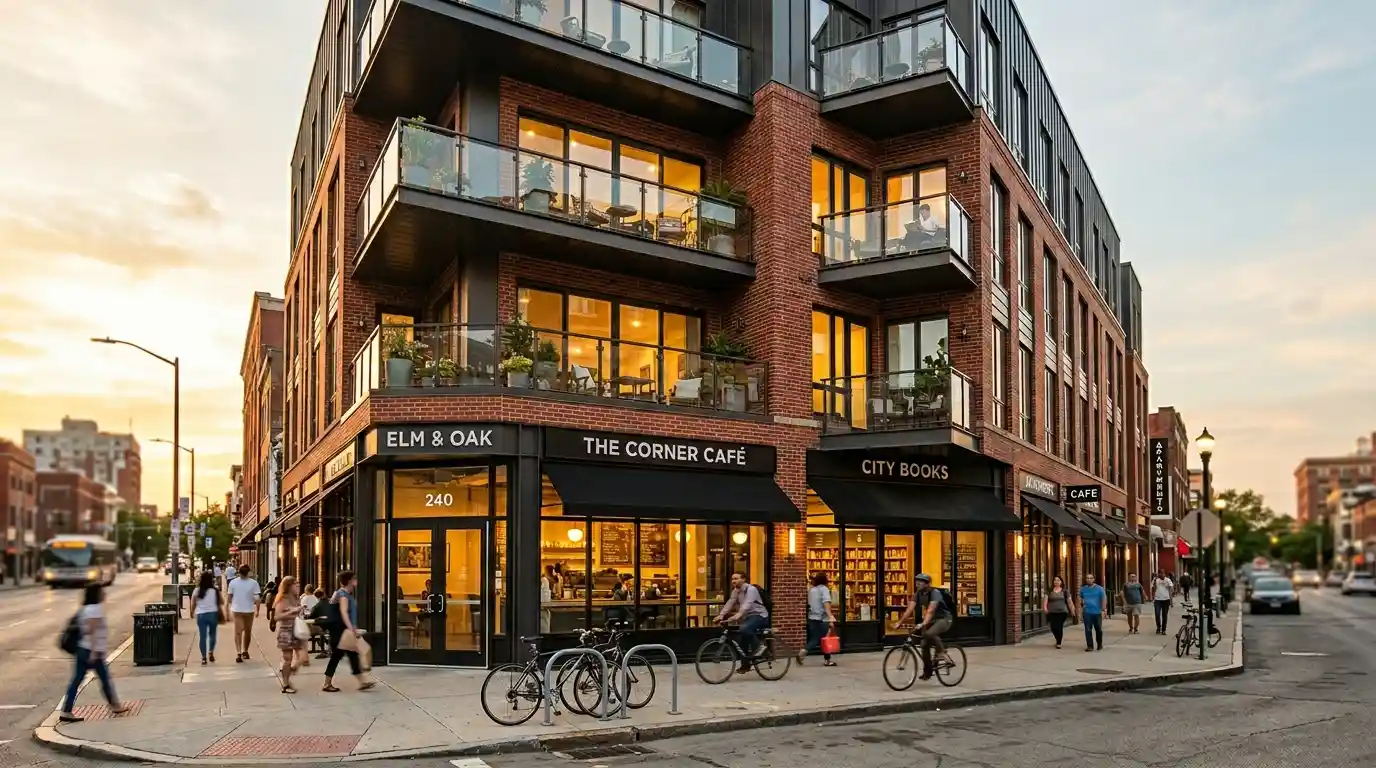

A few years back, a client walked into our studio with a narrow corner lot on a transit corridor and a deceptively simple brief: ground-floor retail, two flats above, ready in under a year. I’d designed plenty of single family homes by that point, but small mixed use building design turned out to be its own animal one where curb appeal, property value, and a stack of invisible code requirements all have to agree with each other before a single wall goes up.
Curb appeal still earns its keep here. A well-massed mixed-use building design lifts property value and neighborhood character in a way a flat box of apartments rarely manages on its own. But what actually keeps a small mixed-use building standing, leasing, and out of code trouble happens underneath that surface, and that’s where I want to start.
Where Residents and Customers Don’t Get in Each Other’s Way
Privacy gets overlooked on small sites because everyone assumes “small” means simple. It doesn’t. The moment you stack residential units over a café or retail tenant, you’re managing acoustic separation, vibration isolation, and STC ratings between two completely different lifestyles sharing one structural system. We typically push for separate entries and a dedicated elevator core for the residential floors, even on a four-unit building, because nothing kills tenant retention faster than a stranger from the shop downstairs wandering past someone’s front door at 11pm.
Ground floor commercial space and the upper floor residential units also need their own fire-rated floor assembly, not just a polite suggestion of separation. This is mixed occupancy in the literal building-code sense, and it’s non-negotiable.
Fire Safety Isn’t an Afterthought, It’s a Code Requirement
This is where small mixed-use building design and building security overlap most directly with the International Building Code. The IBC classifies retail under Group S-2 occupancy, parking similarly, and residential under Group R occupancy and depending on whether you choose a separated or non-separated occupancy approach, fire separation requirements change completely. A 2-hour fire-rated assembly between the commercial ground floor and the residential floors above is standard on most projects we’ve worked on, paired with an NFPA-compliant sprinkler system throughout the building.
Means of egress, accessibility under the ADA, and ventilation for any restaurant tenant negative pressure, dedicated exhaust, proper odor control all get folded into this same conversation early, not bolted on after the structural drawings are done.
Where the Real Construction Savings Hide
Saving money on a small mixed-use building rarely comes from cutting finishes. It comes from the structural strategy. Concrete podium construction with wood-frame residential floors above commercial space is the workhorse approach across North America it satisfies fire separation while letting the upper floors use cheaper, faster wood-frame construction instead of running steel or reinforced concrete the entire way up.
Construction cost per square foot on these projects typically runs $200 to $450 depending on location and finish level, and a shared parking strategy between residential and commercial uses can trim total parking by 15 to 30 percent. Lenders also tend to favor a residential-heavy program, so a feasibility study early in design saves you from chasing a configuration nobody will finance.
Getting Ground-Floor Retail to Feel Open Without Overexposing It
Reducing glare and harsh light at street level matters more in mixed-use buildings than people give it credit for. Ground floor transparency requirements often a minimum 50 to 60 percent of street-facing frontage push for generous glazing, but that same glazing needs thermal break detailing and, frequently, double-glazed assemblies so the retail tenant isn’t fighting heat gain all afternoon. Active frontage and thoughtful storefront design aren’t just an aesthetic preference for the leasing broker; they’re doing real work for whoever’s running that ground-floor shop.
Orientation, Daylighting, and Why Solar Design Still Matters
Solar orientation on a small footprint matters because you don’t have room to compensate later with mechanical brute force. Passive solar design, smart placement of glazing, and a dynamic façade that responds to sun angle can meaningfully cut energy-efficient lighting and HVAC loads. We’ve started specifying basic smart building technology and IoT controls even on small four-to-six-unit projects, mostly because tenants now expect it and it pays back faster than people assume.
Check the Zoning Before You Fall in Love With a Site
Before you get attached to a lot, check what the zoning ordinance actually allows. Overlay districts and planned community designations carry different setback requirements, build-to lines, and frontage requirements, and a conditional use permit can add months to your schedule if anything unusual gets flagged. Floor area ratio, lot coverage, and any available height bonus or density bonus through incentive zoning should be confirmed with the planning department before you commission drawings, not after.
When Mixing Too Many Uses Backfires
Here’s the part nobody likes hearing: cramming in too many uses can work against a building, the same way over-tinting a window in a cold climate blocks light you actually wanted. A tenant mix that’s too ambitious retail, office, and residential all competing for the same small footprint creates odor control headaches, loading dock conflicts, and reciprocal easement agreements that lawyers spend months negotiating. Most successful small projects lean 65 to 80 percent residential and 10 to 20 percent ground-floor retail, skipping office space entirely unless the local market clearly supports it.
Vertical, Horizontal, or Walkable — Picking the Right Configuration
Not every mixed-use building is built the same way. Vertical mixed-use stacks uses within one structure, with retail or office below and residential above. Horizontal mixed-use spreads uses across separate buildings on the same site. Mixed-use walkable combines both into a small, neighborhood-scale cluster. Within those categories you’ll find live-work units, work-live lofts, studio light-industrial setups, a classic main street mixed-use storefront, office-residential hybrids, even shopping mall conversions and retail district retrofits in older suburban corridors.
On the smaller end, think shophouses, corner stores, duplexes, triplexes, fourplexes, townhouses, rowhouses, courtyard apartments, accessory dwelling units, and stacked flats the missing middle housing types that fill the gap between single-family homes and big apartment blocks. We tend to call these compact-use or multi-functional buildings, and a boutique low-rise mixed-use project on an infill lot is usually where small mixed-use building design actually lives.
Not Every Site Is Compatible With Mixed-Use
Compatibility is the quiet deciding factor. A narrow lot infill design or corner lot mixed-use building works best near a bus rapid transit line or a light rail stop, where bike storage, bicycle parking, and a ride-share pick-up zone actually get used instead of sitting empty. Walkable neighborhoods with traffic calming and human-scale design support compact urban housing far better than a site stranded along an arterial road built only for cars. Context-sensitive infill design and neighborhood character compatibility matter just as much as the zoning math a building that technically complies but ignores its neighborhood retail corridor rarely ages well, and a careful site plan review early on tends to catch that mismatch before it’s built.
Energy Efficiency Pays for Itself Faster Than You’d Think
Sustainable building design on a small mixed-use project isn’t a luxury add-on anymore. Rainwater harvesting, a modest green roof, biophilic design touches, and basic green building practices toward LEED certification or a BREEAM rating reduce both operating costs and the building’s contribution to urban heat island effects. Carbon emission reduction targets are increasingly written into permit conditions in several cities, so coordinating HVAC zoning, electrical metering, and plumbing requirements early avoids an expensive redesign later.
The Aesthetic Layer: Materials, Façade, and Street Character
This is the part clients usually want to talk about first, even though it’s the last thing we actually lock down. Building massing, articulation, and a coherent façade composition keep a small structure from looking like two unrelated buildings stacked awkwardly. We lean on brick facades, natural stone cladding, and architectural metal panels for durability at street level, saving engineered wood products for upper floors where the wear is lighter. Awnings, canopies, parapets, and a well-detailed cornice do more for a building’s character than people expect, and a small plaza or courtyard off the sidewalk turns a building into part of the public realm instead of just sitting beside it.
The Bigger Case for Building Small and Mixed
Beyond any single project, small mixed-use building design supports walkable, 24-hour neighborhoods, eases car dependency, and brings “eyes on the street” back to blocks that single-use zoning hollowed out a debate Jane Jacobs and Robert Moses fought over long before current zoning codes existed. The Urban Land Institute and the Congress for New Urbanism have documented how adaptive reuse and brownfield redevelopment raise land value and economic vitality without bulldozing a neighborhood’s character. From a corner shophouse in Toronto to a fourplex-over-retail in Portland, the format scales from the United States to the United Kingdom, Europe, Canada, and Australia precisely because it solves the same problem everywhere: housing demand outpacing what single-family zoning alone can ever deliver.
Conclusion
Small mixed-use building design rewards the projects that handle the unglamorous parts well fire separation, zoning compliance, acoustic isolation, parking strategy just as much as the ones with a striking façade. Get the code, the configuration, and the site compatibility sorted first, and the curb appeal tends to take care of itself. That balance, more than any single design move, is what separates a small mixed-use building people just look at from one they actually live, shop, and work in for the long run.
Frequently Asked Questions (FAQ’s)
Small mixed-use building design combines different functions, usually commercial spaces on the ground floor with residential units above. These projects aim to create efficient, walkable spaces where people can live, work, and shop within the same building.
Unlike single-purpose residential buildings, mixed-use buildings integrate commercial and residential spaces. This requires additional planning for privacy, noise control, fire separation, and separate access between residents and customers.
Before starting a project, developers should review zoning rules, site compatibility, parking requirements, and possible density limits. Checking these details early helps avoid design changes and approval delays later.
Construction costs for small mixed-use buildings vary by location, materials, and finishes. The article notes that costs often range from $200 to $450 per square foot, with structural choices and shared parking strategies affecting the budget.
The best configuration depends on the project’s location and goals. Vertical mixed-use designs with retail below and residential above often work well on compact urban lots, especially in walkable areas near transit.

2 thoughts on “Small Mixed Use Building Design: A Complete Guide”