


The best living room ideas have never been found in a showroom. The best ideas for designing living rooms come from understanding the way an individual living room really works how the light falls on it throughout the day, how the traffic works between the sofa and the kitchen, how the room feels at nine o’clock at night when the overhead light has been turned off and there is nothing but the floor lamps illuminating it.
I have had my share of transforming living rooms into something better, and I have seen that most people have gotten the process wrong by starting with a great looking sofa and working around it. In 2026, we will be talking about living rooms in a new way, and the trends to watch out for will be the ones based on reality, not on the ideal.
Color Is No Longer Safe and That’s the Best Living Room Idea of 2026
It is in color where the most significant change in the living room has occurred from 2024 to 2026. There is a noticeable and quantifiable trend for the grey and beige fading color scheme. Grounded colors have won at all levels of taste from warm neutrals through wall colors that make a living room sparkle like a jewel box.
Color Drenching and Color Capping: The Two Techniques Worth Understanding
Color drenching is the living room concept that never stops being trendy, and there’s no wonder why it is like that. It involves coloring the walls, trim, and the ceiling in one saturated color, providing an immersive color environment that feels intentional rather than reserved. Such colors as deep charcoal green, electric blue, olive green, and rich amber are perfect in this concept. The main thing here is to pick a paint that will have enough pigment to pull the room together. Benjamin Moore 2026 Color of the Year Silhouette, which is a deep blue-grey, is perfect in this concept.
The other choice for the warm neutral version is Sherwin-Williams Alabaster. Color capping is the other way to do it it implies using the saturated color for the ceiling and the upper walls, while the lower walls and the trim will be in the lighter complementary color. These two techniques cost between $40 and $70 per gallon of premium paint and are the most efficient investments into a living room.
Bold Accent Colors That Bring a Living Room to Life
In addition to a full-wall approach, living room design trends of 2026 feature accent colors through furniture and decor objects. Orange accents, acid green living room pillows, electric blue accent chairs are seen in living spaces where before everything would default to neutral only.
There is an easy way to think about this in terms of the 70/30 rule. Create 70 percent of your space in one overarching style in your case, warm neutrals, your basic furniture, and then use the other 30 percent of space for complementing and contrasting colors. This could be butter yellow curtains in a space of warm white walls, amber, cobalt, emerald shades in a pendant lights in a reading corner, colorful glass decor pieces on an open shelf.
The Return of Personality Led Furniture and the Layered Look
Designs for 2026 living room concepts have become much more intriguing, more individualized, and more intentionally imperfect. Showroom-perfect design on one side contrasts against the idea of everything being matched, coming from the same collection on the other. The curated maximalist approach and the grandmillennial style, along with eclectic living rooms made up of heirloom pieces of furniture, thrifted elements, and vintage sofas with new upholstery, take center stage in design magazines focused on the way people really live.
Curved Sofas, Skirted Furniture, and the Forms Defining 2026
Curved sofas have taken off in popularity over the last three years, and now in 2026, they’ve found themselves firmly within mainstream design while still retaining their charm. Curving silhouettes, plush dimensions, wide arm sofas, and curve-backed sofas convey an atmosphere of welcoming that cannot be easily matched by contemporary sharp edge designs. In tandem with curved sofas, skirted furniture pieces have been making a true return, including pleated skirted sofas, tufted sofas with fringe details, and even lounges with exposed legs being found together in the same room, sometimes at the opposite ends of the same conversational space.
It is here that grandmillennials’ living room comes to life elegant yet not rigid, vintage yet not antique. The combination of floral sofa designs, Victorian chairs, and reupholstered vintage pieces from Arhaus, Birch Lane, and West Elm’s vintage line is found along side contemporary coffee table options with sculptural silhouettes and fused glass tabletops.
Layered Textures, Rugs, and the Materials Building Depth
Texture is the concept of the living room that does not photograph well but looks amazing in person. Rugs layered on top of oak and pine flooring, leather cushions layered on a velvet sofa, armchairs embellished with fused glass on the table top, and layered glass objects on wood shelving these are just some examples of rooms with a lot of textures without looking busy. A layered look of the living room implies using the limited color scheme but mixing up a lot of material textures.
Ceramics, stone finished lamp bases, indoor plants, and bamboo elements, layered rugs on top of another layer, chunky knits on a love seat these elements add a certain lived-in look to the living room that is impossible in a one material room. Finally, layered window treatments with Roman blinds used for light control and a valance placed above the window with high and wide hanging curtains create this look even for the windows of the living room.
Small Living Room Ideas That Actually Work Without Compromise
Ideas for small living rooms necessitate a completely different approach from conventional interior design. What would be successful in a house of 1,300 square feet in London or an apartment of 900 square feet in Chicago is fundamentally different from what would work with limitless floor space. After experimenting with various strategies in well over 50 small living rooms, it seems clear that small spaces demand bold decisions.
Scale, Mirrors, and the Visual Tricks That Make Small Rooms Feel Larger
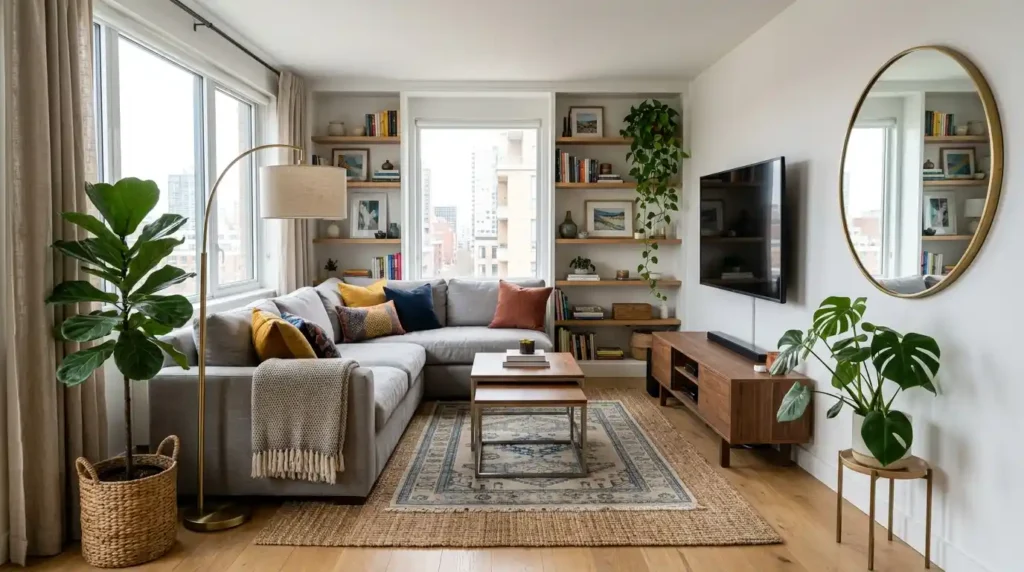
The best living room idea for a small space is the use of scale contrary to conventional wisdom. The bigger the sofa, the bigger the mirror, the bigger the lights, and the bigger the floor rug in a small living room will always work better than the intuitive smaller furniture solution. Placing a big mirror opposite the major window in a small living room will make the room feel 25-30 percent larger because it will double natural light without any physical manipulation to the room’s structure. Floor lights instead of ceiling lights will give the impression of softening of the space’s borders.
Window treatments hung high up on the ceiling and extending beyond the actual window will give the impression of a ceiling line and therefore height. Plants placed strategically throughout the room and cabinets reaching the ceiling from the walls will give height and create vertical storage. For a small living room/dining room combination, placing a circular dining table behind the sofa will define spaces without the need for a wall while a rug in the dining area will provide visual definition between the two spaces.
Multi Functional Furniture and Focal Points in Compact Living Room Ideas
No small living room can ever function without one focal point, which can be anything from a fireplace to a gallery wall or an artwork and even cabinetry. Once the focal point is established, multi-purpose furniture takes care of creating functional living spaces in small living rooms. Furniture like an ottoman with storage capabilities that works as a coffee table; a sleeper sofa that takes care of accommodating your guests overnight without the need for any extra room; nesting tables that add more surface area when required and disappear once their job is done; and a wall-mounted TV set with a skinny table instead of a heavy TV cabinet all cut down on clutter.
Conclusion
The living room trends worth considering in 2026 have one thing in common they prioritize the residents of the room. The effect of color flooding and color capping immediately adds character to any living room. A living room featuring personality-driven furniture, such as curving sofas, skirted furniture, and second-hand items, is what makes the unique atmosphere showrooms simply cannot offer. Textural layering, warm wooden finishes, and smart lighting add the atmosphere a good living room deserves. Moreover, in small rooms, the counterintuitive scale and focal points always outperform the safer approach. Think about the room’s architecture and lighting, then plan the color palette and furniture accordingly.
Frequently Asked Questions (FAQ’s)
Among the largest living room trends in 2026 are color drenching using saturated walls and ceilings, grandmillennial comeback with furniture skirts and antiques, curated maximalism with layers of textures and antique pieces, curves and puffy sofa shapes, accent colors using objects and pillows, and fluted panels as a feature wall. The trend of beige dying out remains, being substituted by warm neutrals with pigment saturation and immersive color palettes of jewel tones.
The 2026 Color of the Year is Benjamin Moore Silhouette a deep blue-grey. Other examples of this trend can be seen in such shades as Sherwin-Williams Universal Khaki, Behr Hidden Gem smoky jade, and Sherwin-Williams Alabaster. Warm yellow-green neutrals and espresso finish are among other examples that are widely used in the living rooms featured in the publications such as Homes and Gardens, Architectural Digest, and House Beautiful.
Utilize a big mirror opposite to the window for an illusion of 25 to 30 percent enlargement of the space. Hang draperies on the ceiling, larger than the actual window frame. Select an area rug which covers the whole seating arrangement. Make use of floor lights along with the ceiling light. Choose pieces of furniture with legs exposed. Never opt for tiny scale furniture as it may make the room appear even smaller.
Begin with the architectural structure and the natural light of your living room rather than with the choice of sofa or color. Look for a good feature in the room (window, fireplace, vaulted ceiling) and then plan according to it. Choose your color scheme next based on the dominant-complementing concept of 70 to 30 ratio. Next, arrange your seating around the main focal point. Incorporate the lighting system in layers (overhead, floor lamp, table lamp and accent).

2 thoughts on “35 Living Room Ideas to Create a Stylish, Cozy, and Functional Space”