

The search for “house window tinting near me” looks simple until you actually start comparing what you find. On one end of the results, you have a veteran-owned window tinting specialist running a small operation with genuine architectural window film expertise and a lifetime warranty. On the other, you have an automotive tinting franchise that takes residential work as a side offering, uses the same films it puts on car glass, and doesn’t know or care about the difference between a dyed window film that fades in five years and a ceramic window film that performs for decades.
I’ve had conversations with homeowners who were genuinely surprised when their new home window film started peeling or clouding within 18 months of installation because they chose a contractor based on a discount rather than credentials. The window film market in 2026 is mature enough that the performance difference between a correctly specified, professionally installed film and a wrong-material rush job is large and obvious. The installer question matters as much as the film question, and they have to be answered together.
The Film Type Question Nobody Answers Before Getting a Quote
Most homeowners searching for residential window tinting near me get quotes before they understand what they’re being quoted for. This creates a situation where the cheapest number wins a comparison that should never have been a price comparison because dyed film, metalized film, ceramic film, and adaptive architectural film are not equivalent products with different price tags. They are fundamentally different technologies with different performance profiles, different lifespans, and different appropriate applications.
Dyed Window Film
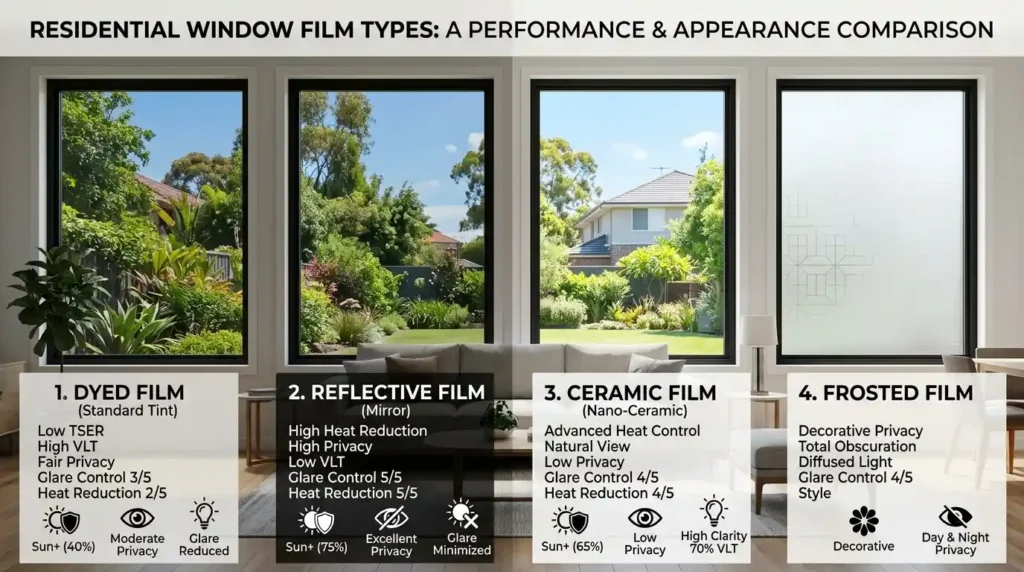
The dyed window film is the lower-end range. It is a kind of interlayer that reflects sunlight, giving the user minimal protection against glare and privacy, and is the cheapest film to install. The heat rejection will be from 30% to 45% useful to moderate sunlight rooms but not enough for western windows, sun rooms, or spaces that become too hot due to summer afternoon heat. The heat rejection issue which is not mentioned in the quote is that the dyed film fades over time, thus making its performance worse over time.
Reflective And Metallized Window Films
Reflective and metallized window films reflect heat energy away from windows rather than using dye to absorb heat energy; therefore, they exhibit enhanced heat rejection capabilities along with a reflective appearance that provides for day time privacy. In case homeowners choose privacy film over neutral film, metallized films provide 100 percent day time privacy and also block a lot of solar heat compared to dyed films. This is because the one-way mirror effect of the film becomes the opposite at night; hence, when lighting is on inside the house, the glass becomes visible from the outside.
Ceramic Film And Nano Ceramic Film
Ceramic film and nano-ceramic film are the current standards in home window tinting applications. The system makes use of ceramic nanoparticles instead of metallic layer and/or dye in order to provide infrared blocking without sacrificing visible light transmittance or resulting in dark films. Multi-layer films such as Kepler which include ceramic, UV filter, and ultra-bonding adhesive technologies are just some of the ways that nano-ceramic films have developed since their architectural predecessors.
Search terms such as ceramic tinting near me in heat-laden regions like Las Vegas, which experience up to 300 sunny days per year and thus a large amount of UV radiation and heat gain, regularly come back with the highest level of customer satisfaction from any film type due to the very nature of the product itself.
Adaptive Architectural Film
Adaptive architectural film the transitional window film category automatically shifts from clear to tinted states based on incoming solar radiation, combining high visible transmittance with meaningful heat reduction in a way that static films can’t match for spaces where both clarity and performance matter simultaneously. The installed cost premium is significant compared to static ceramic film, but for sunrooms, skylights, or floor to ceiling glass where the view is as important as the comfort, adaptive film solves a problem that any fixed-shade product only partially addresses.
Decorative Window Film
Decorative window film, frosted window film, and etched glass film serve design and privacy functions that performance films don’t transforming ordinary glass surfaces into distinctive design elements with varying opacities calibrated to the homeowner’s privacy and light transmittance preferences. Security window film adds a safety layer that retains glass fragments during impacts, slows forced entry attempts, and in specialized high-security applications extends into bomb-blast-resistant window film systems and ballistic window film configurations for properties with elevated threat profiles.
The Skin Cancer Foundation has specifically recommended UV protection film for daily residential use, given that 90 to 95 percent of sunlight entering a home carries UVA and UVB rays capable of causing furniture fading, flooring fading, artwork fading, rug fading, and cumulative skin and eye health risks to occupants.
Finding and Vetting a Local Window Film Installer
The quality difference between a master technician who specializes in architectural window film and a general installer doing residential tinting as a secondary offering is real and measurable in the finished result. Architectural window film installation requires different adhesive handling, different surface preparation, different film tension management, and different curing environment awareness than automotive window tinting and the consequences of doing it wrong on a large residential glass panel are considerably harder to correct than a car window.
When searching for home window tinting near me, the most reliable filters before you contact anyone are specialization and credentials. Search specifically for contractors advertising residential window film installation or architectural window film expertise, not just “window tinting near me” broadly. CoolVu, Tint World, Glass Doctor, Midwest Tinting, and 3M authorized dealer networks maintain regional installer directories that pre-qualify installation quality a 3M authorized installer, for example, has met specific training and quality standards set by the manufacturer, which provides meaningful assurance that the product being installed matches the manufacturer’s specifications.
Verify License And Insurance
Verify license and insurance directly not from the contractor’s website, which is self-reported, but by asking for the actual documentation and calling the issuing authority to confirm currency. Ask explicitly whether the contractor carries commercial general liability coverage for residential installation work, since automotive tinting shops converting to home projects sometimes maintain only the insurance coverage appropriate for their automotive work. Request references from homeowners who had residential window film installed at least two years ago the feedback from someone living with a film installation for two years is more informative than a fresh-off-the-project review.
The Angi and Yelp platforms provide useful starting points for identifying highly-rated local window tinting companies, but reading reviews for specific detail rather than aggregate star ratings is the operative approach. Look for reviews that mention the installation process, how the contractor handled questions, and what the film looks like and performs like at six and twelve months not just the initial install experience. Commonwealth Window Tinting’s Chesapeake Virginia operation, Midwest Tinting’s 45-year Kansas City presence, and Custom Tint Solutions’ nearly two decades of Las Vegas installations across Summerlin, Green Valley, and commercial properties along The Strip all illustrate what genuine specialization looks like in terms of market tenure and local expertise depth.
Reading the Quote: What Should and Shouldn’t Be on the Line Item
An itemized cost estimate from a residential window film installer should separate labor costs from film material costs, include old film removal if applicable, specify the exact film product being installed by manufacturer and series name, and note the VLT percentage visible light transmittance of the specified film. VLT is the percentage of visible light that passes through the finished installation, and it’s the primary specification that determines how dark or clear the windows appear after installation. A quote that doesn’t specify VLT percentage is a quote you can’t meaningfully compare against any other.
Regional Cost Factors
Regional cost factors affect residential window tinting pricing significantly. Las Vegas desert climate installations involving high-performance heat rejection film command different pricing than installations in Minneapolis or New Jersey, reflecting both local labor rates and the intensity of demand for heat management solutions in high-sunshine markets. Fort Wayne Indiana window tinting starting from $349 represents the lower end of the residential market for a small-scope installation; premium nano-ceramic film across a larger home in a high cost coastal market will land considerably higher.
Confirm warranty terms as clearly as the film specification. A lifetime warranty from a company like Midwest Tinting or a manufacturers lifetime warranty backed by a major brand like 3M carries real value it means that if the film bubbles, peels, discolors, or fails to perform as specified, replacement is covered. An “installation warranty” from a contractor without manufacturer backing typically covers workmanship only for a short defined period, leaving material performance risk with the homeowner. Up to 15 years warranty coverage from Custom Tint Solutions on their fade prevention films, and the manufacturer lifetime warranty that Midwest Tinting provides, represent the standard worth expecting from a quality residential window film installation.
HOA, Permit, and Compatibility Checks That Save Later Headaches
HOA restrictions on home window tinting are more common than most homeowners expect, particularly for reflective window film and silver mirror-tinted configurations that alter the exterior appearance of a residence. Checking HOA requirements before specifying a film type is the step that prevents an installation from being required to be removed which costs more than the original installation and leaves you no better positioned than when you started.
Local permit requirements for residential window tinting vary by municipality. Most interior window film applications don’t require a building permit, but exterior facing decorative window film, security film installations on certain structural glass types, and any modification that affects the fire egress characteristics of emergency exit windows may require documentation. Asking the contractor about permit requirements in your specific municipality before signing a contract is a ten-minute phone call that occasionally prevents a multi week delay.
Double Pane Window
Double pane window compatibility is a technical check that ceramic and multi-layer film installations require before specification the heat absorption of certain high performance films can create thermal stress differentials in double pane units that contribute to seal failure or glass cracking over time. A qualified window film installer will assess the specific glass unit being treated, check the manufacturer’s compatibility guidelines for the specified film, and advise accordingly before installation rather than leaving this as a homeowner discovery post-installation. Bird-safe window film patterned or UV reflective surface films that reduce bird strike frequency without compromising interior aesthetics is a complementary consideration for homes with large glass areas in treed or wildlife-adjacent settings.
Conclusion
In seeking for effective residential window tinting near me, one must make sure that there is compatibility between the film type used and the intended use whether it be to reduce heat or protect from UV rays, provide privacy or security and finally ensure that the local film installer has the expertise to do it properly. For instance, using ceramic or nano-ceramic film installed by an accredited architect with manufacturer’s lifetime warranty and proper VLT specification in the contract would easily surpass any other cheap installation done by non-residential film specialists irrespective of the short-term price differences.
Frequently Asked Questions (FAQ’s)
Residential window tinting applies architectural film to home glass to reduce heat, glare, UV exposure, and outside visibility. Some films also improve privacy, hold broken glass together, or add a decorative finish.
Ceramic film usually offers stronger infrared and UV protection without making windows too dark, and it often lasts longer. Dyed film costs less but provides weaker heat control and may fade over time.
Look for a contractor who specialises in architectural window film, not one treating home tinting as automotive work. Verify insurance, manufacturer authorisation, past residential projects, and reviews showing how the film performed months after installation.
A proper quote should identify the film manufacturer, product series, VLT percentage, material cost, labour, removal charges, and warranty terms. Without those details, you cannot accurately compare the quality or expected performance of different offers.
Reflective film suits homeowners who prioritise daytime privacy and strong solar-heat rejection, while adaptive film works well when maintaining a clear view matters too. Ceramic film remains the most balanced option for many homes because it controls heat and UV rays without a mirror-like appearance.
