
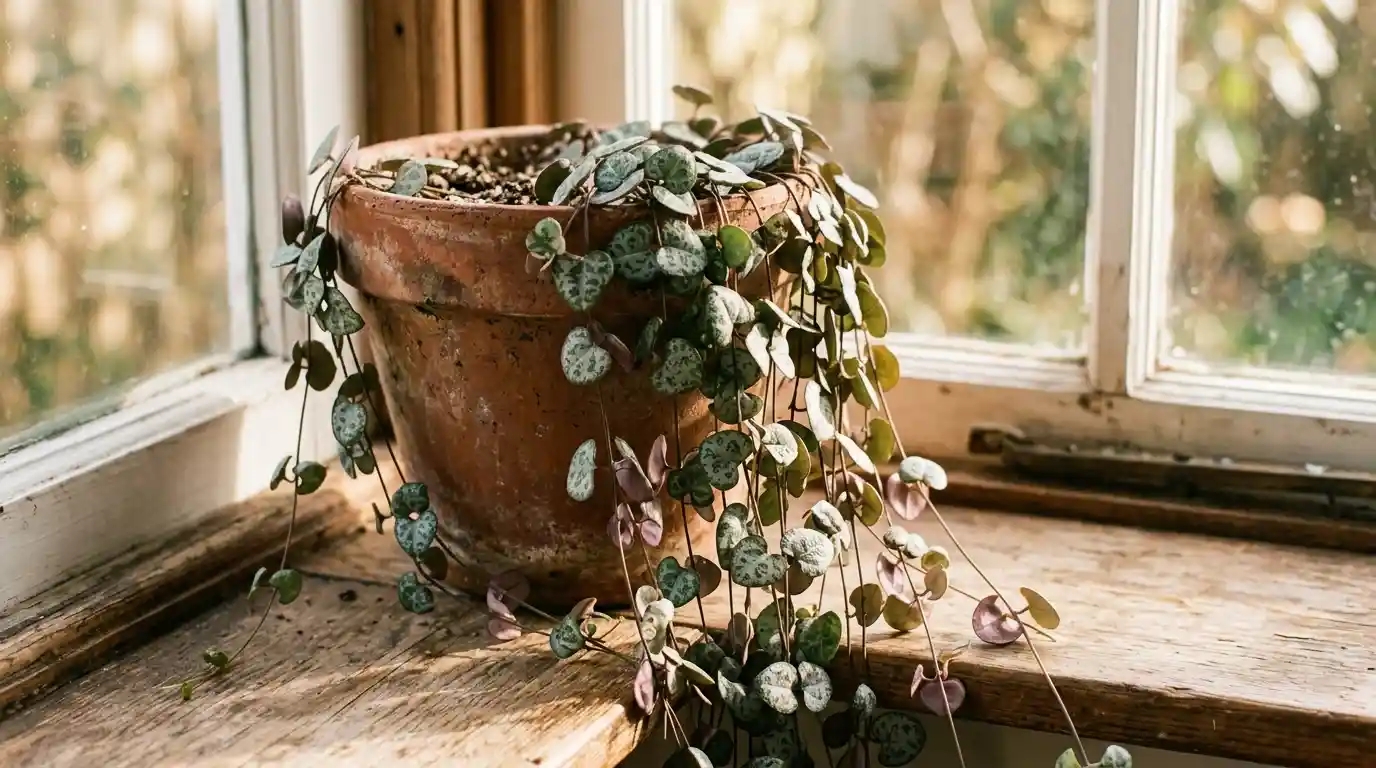

I killed my first string of hearts in eleven days. Didn’t even have time to name it. Bought it from a little nursery near my place one of those hanging basket ones with the vines already trailing down past the rim brought it home, stuck it on a shelf, and watered it the way I watered everything else. Twice a week. Good intentions. Within a fortnight the grey-green leaves had gone yellow, then a kind of translucent brown that meant things were already over. I thought I hadn’t watered enough. So I watered more. That was the second mistake.
The third plant is the one hanging in my east-facing window right now, doing exactly nothing dramatic and looking completely perfect for it. Three to four feet of trailing vine, heart-shaped leaves with that silver marbling on top and the faint lilac tint underneath. The odd lantern-shaped flower small, tubular, pink showing up in summer without any input from me. I didn’t get better at caring for it. I got better at leaving it alone.
That’s what nobody says clearly enough about Ceropegia woodii. The rosary vine, sweetheart vine, chain of hearts, collar of hearts — it has more common names than most plants have fans, and every single one of those names ends up in the hands of someone who overwatered it within the month. It’s not a difficult plant. It’s a plant that punishes attentiveness.
The Leaves Talk — You Just Have to Know What They’re Saying
The foliage on a string of hearts is weirdly communicative once you’ve had one long enough to read it. The leaf surface changes depending on what’s wrong, and the changes are specific enough that you can usually diagnose the problem without touching the soil at all.
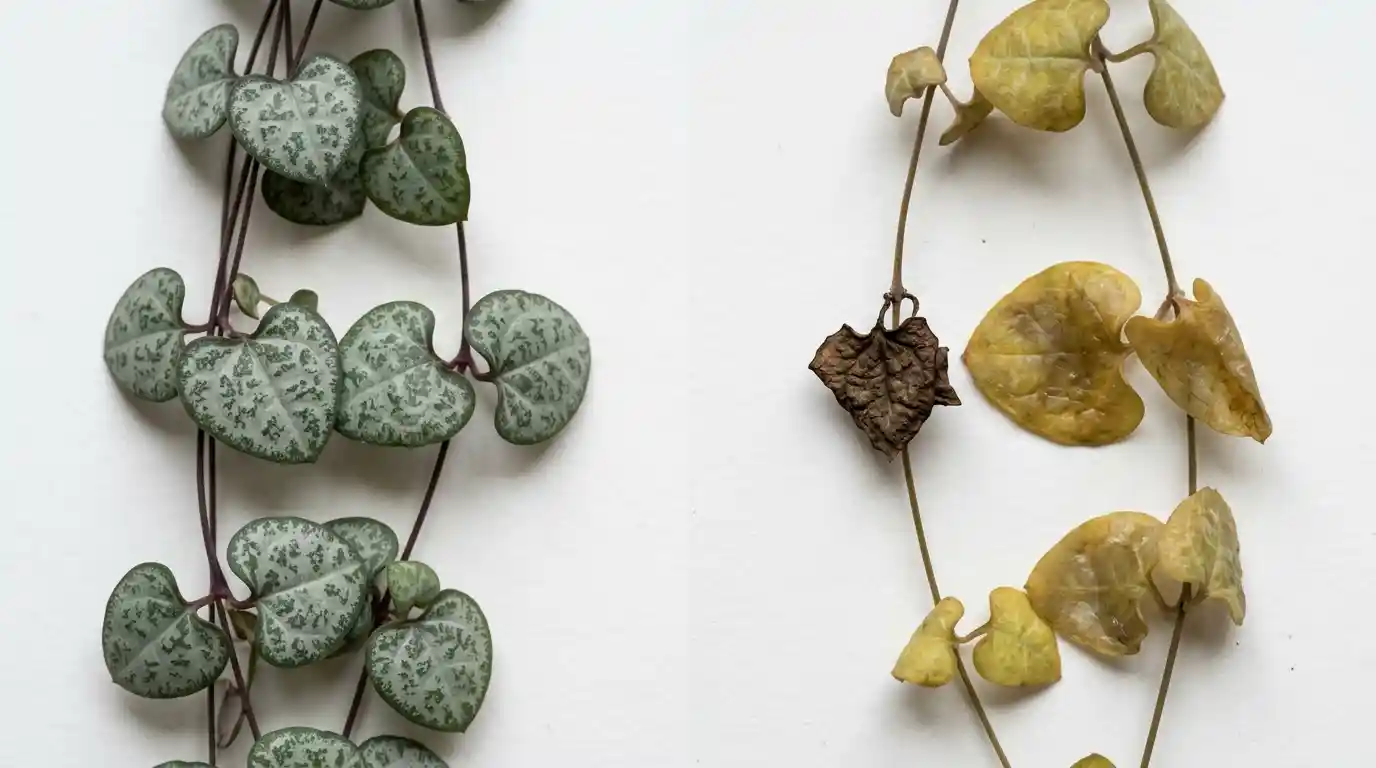
Wrinkled leaves, shriveled leaves — that’s thirst. The aerial tubers and stem tubers along the vine store water and they empty out eventually if you stretch the watering too long. I once left mine for nearly three weeks in late summer and came back to leaves that looked half-deflated. Watered it thoroughly, let it drain, and by the next morning the leaves had plumped back up. That’s the semi-succulent nature of it — the recovery is fast once it actually gets water.
Yellowing leaves are the opposite story. That’s overwatering, usually. The waterlogged soil flushes nutrients before the roots can absorb them, iron deficiency follows, and yellow leaves are what you get. I’ve seen people respond to yellow leaves by watering more — same mistake I made the first time. If the soil’s still wet and the leaves are going yellow, the answer is to stop entirely, let it dry out, and inspect the roots if it gets worse. Mushy roots, black roots — that’s root rot setting in. White roots, firm roots — you caught it in time.
Brown leaves with a sort of crispy edge are sunburn. Direct sunlight in peak summer against those thin, variegated leaves causes leaf burn fast. Scorched leaves don’t recover; you trim them off and move the plant. Curling leaves combined with sparse leaves and widely spaced growth along a vine — that one confused me for the longest time. I kept thinking it was thirsty. It was light-starved. The light deficiency was making the vines stretch, pushing nodes further apart, producing that leggy, scraggly silhouette. Moved it closer to the window. New growth came back compact within a few weeks.
Where You Put It Is Honestly 70% of the Battle
I’ve moved mine three times in two years trying to find the right spot, and I’ve seen the difference in growth across all three locations in a way that no plant care guide fully prepared me for.
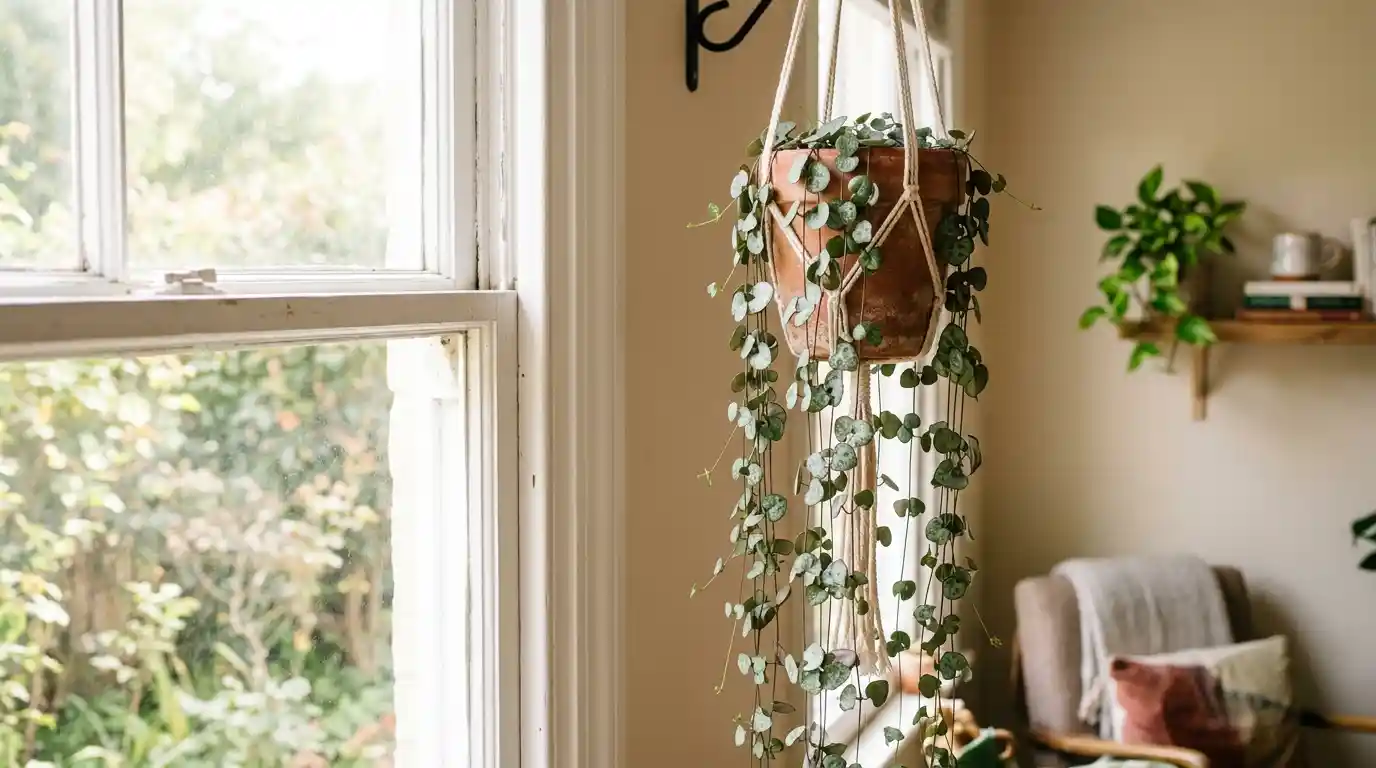
The non-drafty east window it’s in now is the winner. Morning sun, bright indirect light through the rest of the day, no cold air from gaps in the frame in winter. The leaf variegation is sharp — that silver marbling pops against the green, the lilac tint on the undersides is visible. Compact growth. It flowered twice last year.
Before that it was in a south-facing window with no sheer curtain. Summer sunlight was too intense — scorched leaves, leaf drop, stunted growth. Before that it was in what I thought was a bright spot on a high shelf, but it turned out to be much dimmer than it looked. Leggy growth within six weeks. Vines going stringy, leaves tiny and widely spaced, no colour to speak of.
A western-facing window with afternoon light works. A south-facing window works with something to diffuse the direct sun in summer. A corner placement or a high shelf in a dim room — it’ll survive, technically, but you won’t see the plant at its best and you’ll probably start overwatering it to compensate for the slow growth. That’s the trap.
What the plant is originally from — South Africa, Zimbabwe, Swaziland, a native habitat of warm rocky outcrops with strong light and fast-draining ground — that geography tells you a lot. A Mediterranean climate suits it outdoors. Indoors, approximate that as closely as you can.
The Soil Setup That Fixed All My Root Problems
After the second dead plant, I had a long look at what I’d been potting things in. General-purpose compost. Dense, moisture-retentive, completely wrong for something with a woody caudex adapted to nutrient-poor, fast-draining ground.
The mix I’ve used since — and genuinely haven’t had a root problem since switching — is two parts succulent and cactus mix, one part perlite, and a smaller amount of coarse sand. The growing medium dries within a few days of watering even in cooler autumn temperatures. Some people blend in coco coir for a bit more moisture retention without saturation; I’ve tried that and it works fine, especially in summer. Others go half cymbidium orchid mix, half aroid mix — I haven’t tried that combination personally, but I’ve seen it recommended by growers whose plants look better than mine, so I’m not going to argue with it.
Terra cotta pot over plastic. Not flexible on this one. The evaporation through the sides of a terra cotta pot adds a meaningful drying buffer that a plastic grow pot just doesn’t give you. Drainage holes are non-negotiable — without them, no soil mix in the world compensates for water sitting at the bottom.
Pot size matters more than most people think. The root ball should sit snug, not loose. Going one to two inches bigger than the current pot is the rule when repotting — anything more and the fresh soil holds moisture that the roots can’t reach fast enough, which is, again, the overwatering trap. Spring is the time to repot — just as dormancy ends and active growth begins. A healthy plant in a four-inch grow pot can stay there for three years without complaint.
Watering Across the Year — a Real Schedule, Not a General One
The soak and dry method is correct but incomplete advice on its own. The interval changes across spring, summer, autumn, and winter in ways that matter.
Growing season — spring and summer — I water mine every seven to fourteen days. Bright spot, terra cotta pot, warm room: it’s usually closer to seven or eight. Cooler spring week, less light: it stretches toward fourteen. The finger test is still the most honest method regardless. Press into the top two inches of soil. If it’s dry a few inches down, water. If it’s still cool and slightly damp, leave it. Room temperature water, let it run out of the drainage holes completely, then leave the plant alone.
Autumn and winter change things significantly. The plant goes dormant, slows right down, and the water needs drop sharply. I go to every fourteen to twenty-one days in winter. Sometimes every ten days if the room is warm and dry from central heating — heating systems reduce humidity and can dry soil faster than the outdoor temperature would suggest. But the rule stays the same: soil must be dry before you water again. Letting the root ball sit wet while the plant isn’t actively growing is how you get root rot in January from a plant you’ve kept healthy for eight months.
Propagation — Three Methods I’ve Tried, One I Keep Coming Back To
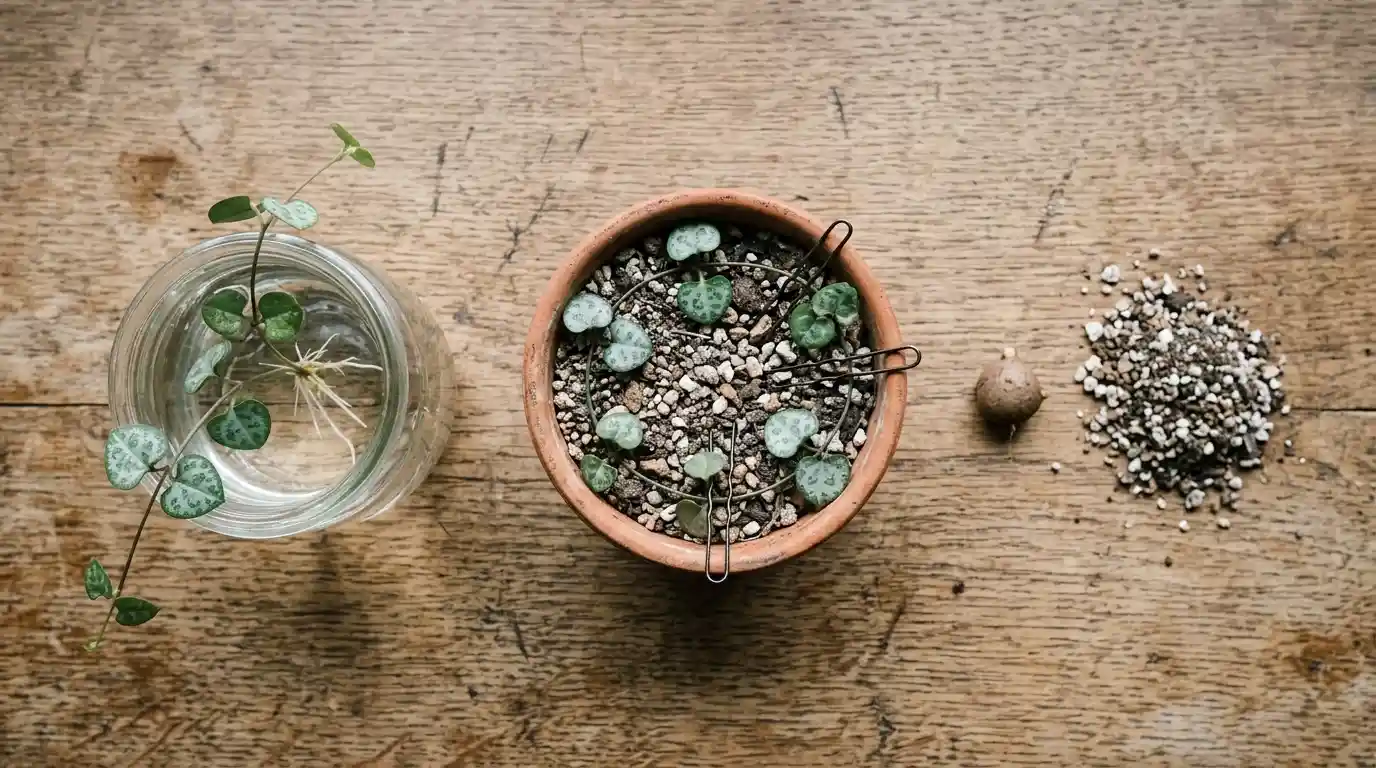
Water propagation is the one people start with, and it works. Stem cutting just below a node, lower leaves off, cutting in a jar of water with the node submerged, bright indirect light, water change every few days. Roots in a few days sometimes, a week or two usually. Transfer to soil when they’re about an inch long.
Tuber propagation I tried once when I repotted and found the bead-like structures along the root system more developed than I expected. Separated a few, planted them lightly at the surface of the soil mix, and waited. New growth appeared in about three weeks. Less fuss than cutting propagation, honestly — no callousing, no water jar, no root monitoring. Just place them and leave them. Works well for variegated string of hearts and the string of spades variety particularly.
The butterfly method is what I use now when the plant gets leggy and I want to fix the shape while propagating at the same time. Long vines cut into sections at each node, segments laid flat on the surface of the rooting medium — sphagnum moss or moist perlite — nodes facing down, pinned with a hairpin or paperclip to keep contact. The strand method, which I tried after a friend mentioned it, skips the cutting step: you spiral the whole vine across the soil surface and pin it at intervals. Higher success rate in my experience because the leaf surfaces stay drier and there’s less chance of rot at the cut points.
Pests, Feeding, and the Stuff That Trips You Up at the End
Mealybugs are the main pest problem I’ve dealt with on this plant — white insects that leave a cotton-like substance in the joints where leaves meet stem. Cotton swab and rubbing alcohol, applied directly. Neem oil on the foliage handles spider mites; they leave webbing across leaves and cause speckled yellowing. Powdery mildew is rare but happens in low air circulation situations — white coating on the leaf surface, treat with neem oil or a fungicide and improve the airflow around the plant. Leaf spot — brown or black spots with a yellow halo — usually responds to removing affected leaves and stopping overhead watering.
Fertilizing I do once in spring, sometimes twice if the plant is actively growing and I feel like it needs a push. A diluted liquid fertilizer — standard houseplant fertilizer, nothing specialist — is sufficient. The sweetheart vine doesn’t need heavy feeding and too much produces soft, leggy growth instead of the compact trailing tendrils you’re aiming for.
One thing I started doing last year that changed how the plant looks in the room: instead of a hanging basket, I trained part of it along a small trellis leaned against the wall. Ground cover isn’t a use case most people think of for a cascading plant, but in warm temperate or Mediterranean climates outdoors, it spreads beautifully across a rock garden. As a wall plant indoors against a white surface, the trailing effect and the contrast of the heart-shaped leaves reads completely differently than a hanging planter. It’s the same plant, different relationship with it. Sometimes that’s the thing that makes you finally appreciate what you’ve got.
Conclusion
The string of hearts doesn’t need much from you — and that’s the part most people never quite believe until they’ve killed one or two proving it wrong. Give it the right light, let the soil dry completely before you touch the watering can again, get the potting mix right once, and then mostly leave it alone. It’ll trail, it’ll tuber, it’ll throw out the odd pink flower when it feels like it. What it won’t do is reward hovering. That’s the deal with Ceropegia woodii — step back, and it quietly becomes one of the most satisfying plants you own.
Frequently Asked Questions (FAQ’s)
The string of hearts, or Ceropegia woodii, is a semi-succulent trailing houseplant with heart-shaped leaves and silver markings. It stores water in its tubers, so it generally needs less frequent watering than many common indoor plants.
Wrinkled or deflated leaves usually indicate the plant needs water, while yellow leaves and soft, dark roots often indicate overwatering. Check the soil before taking action, as watering an already-wet plant can quickly lead to root rot.
During spring and summer, water it about every 7–14 days, depending on temperature, light levels, and pot type. In autumn and winter, watering may drop to every 14–21 days, but the soil should always be allowed to dry before the next watering.
A fast-draining succulent or cactus mix amended with perlite and coarse sand works well. A snug terra cotta pot with drainage holes is usually the best option because it allows excess moisture to escape more quickly.
Water propagation is simple for beginners, but the butterfly or strand method can be more effective if you want to fill out a leggy plant. Choose the method that best matches your goal, and keep the nodes in contact with moist sphagnum moss, perlite, or soil until new roots and growth appear.

5 thoughts on “The String of Hearts Guide Nobody Wrote Until Now”