
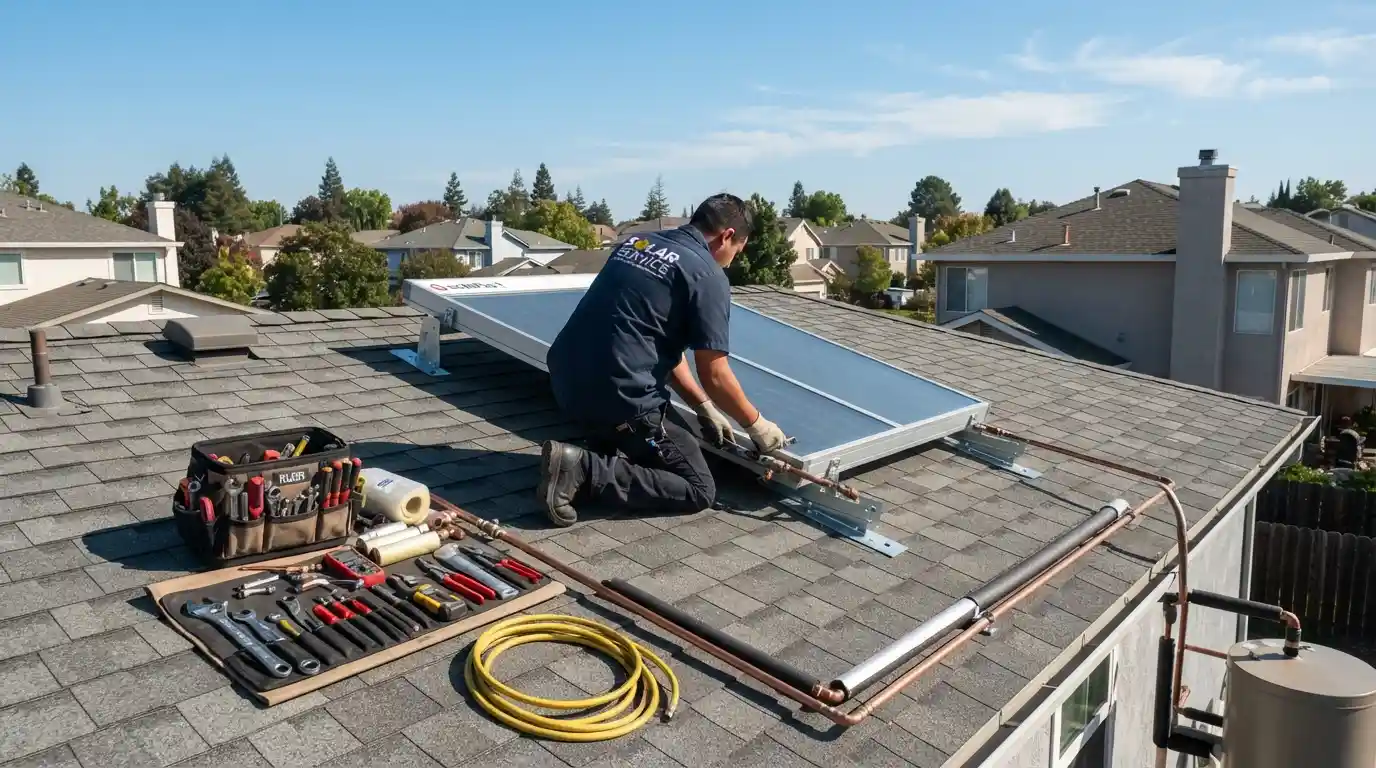

My in-laws had a solar hot water system for twelve years before it quit on them. Cold showers for a week before anyone figured out why. Turned out to be a stuck check valve. Forty-dollar part, not the whole system dying like they’d feared. That’s usually how this goes. Solar water heater panel repair sounds expensive and complicated until you actually know what’s broken. Six problems cause almost every “no hot water” call I’ve come across. This guide walks through each one. What it actually costs to fix. When you’re looking at real replacement instead of a simple repair. No guessing here, just what actually breaks and why.
What Causes Most Solar Water Heater Problems?
Solar hot water systems are pretty simple underneath all the plumbing. A collector absorbs heat. A pump moves fluid through a loop. A controller decides when to circulate. A tank stores the hot water until you need it. Four parts, basically. Most failures happen at one of them, not the whole system falling apart at once.
I watched my father-in-law assume total system failure once, convinced the whole thing was dead. Called a technician expecting bad news. Turned out to be one bad sensor. Ten bucks worth of part. The collector itself was fine the entire time, sitting there absorbing heat exactly like it should, while a single failed component made the whole system look dead from the outside.
Why is my solar water heater not producing hot water?
The most common reason is a pump or controller failure. Not the collector panel itself, despite what most people assume first. Check whether the pump’s actually running when the sun’s out. Silent pump, dead controller, bad sensor, all more likely than a damaged panel, especially on anything under ten years old.
6 Common Solar Water Heater Panel Repair Issues
I’ve dealt with most of these firsthand. My own system, or helping a neighbor figure out theirs over a weekend. Each one has a distinct symptom. That’s what makes diagnosis faster than people expect once you know what to look for.
1. Cracked collector glazing
A cracked or broken glass covering on a flat-plate collector lets heat escape and moisture in. You’ll usually spot this visually. A hairline crack, sometimes a full break across the panel surface. Replacement glazing runs somewhere in the $200 to $500 range depending on collector size. Cheaper than replacing the whole panel, worth remembering before you panic.
2. Broken evacuated tubes
One cracked tube on an evacuated-tube system won’t kill the whole array. It does drop efficiency though. Look for white condensation building up inside a tube. That’s usually the vacuum seal failing, and the tube needs replacing at that point. Single tube replacement typically runs $100 to $300 depending on the system.
3. Pump failure
A pump that’s stopped circulating means fluid just sits there, even with the sun heating the collector directly above it. You’ll hear it, or rather you won’t. No hum, no vibration at the pump housing at all. Solar pump replacement generally costs $300 to $750 installed, higher end for bigger residential systems.
4. Controller or sensor failure
An error code on the controller display, or no display whatsoever, usually points here first. A bad temperature sensor can trick the whole system into thinking it’s already hot enough. So it never circulates, ever. Sensor replacement is cheap, often under $150. Worth checking this before assuming something bigger’s gone wrong.
5. Air lock in the solar loop
Air trapped in a closed-loop system blocks fluid circulation completely, even with a pump that’s working fine. Shows up as inconsistent heating. Hot one day, stone cold the next, no obvious pattern to it. Bleeding the air out is usually a quick service call, often under $200.
6. Corroded storage tank
Tank corrosion shows up as rust-colored water, sometimes a slow leak near the tank base. Unlike the other five problems here, this one usually means replacement, not repair. A corroded tank rarely gets fixed cleanly, in my experience anyway. Tank replacement can run $300 to $500 for the unit alone, more once installation’s added in.
Solar Water Heater Panel Repair vs. Full System Replacement
Here’s where I tell people to actually think it through instead of panicking. Most solar water heater panel repair jobs, pump, sensor, controller, a single tube, cost a few hundred dollars and take one visit. Full system replacement runs closer to $4,000 to nearly $15,000 depending on size and collector type, based on typical residential solar thermal installation quotes.
Age is really the deciding factor here. A well-maintained system typically lasts 10 to 20 years. Sometimes longer with proper annual maintenance behind it. System’s under 15 years old, tank hasn’t corroded? Repair almost always makes more sense financially than starting over.
Is it cheaper to repair or replace a solar water heater panel?
Repair, almost always, for isolated failures like a pump, a sensor, a single broken tube. Replacement only makes sense once the tank’s corroded badly, or the system’s already past its 15 to 20 year expected lifespan with multiple parts failing at the same time.
Maintenance That Prevents Most Repair Calls
A lot of what I just listed is preventable. Basic maintenance, and I mean genuinely basic, not complicated stuff requiring special tools. Annual inspection catches small problems while they’re still small, before they turn into expensive ones down the line.
I clean my own collector every spring and fall now, warm soapy water, a soft brush, nothing fancy. Skip anything abrasive. It scratches the glazing and quietly kills your heat absorption over time, something I learned after scrubbing too hard with the wrong sponge once. Check antifreeze concentration yearly if you’re anywhere freeze-prone, since degraded glycol loses its protective properties slowly. Not all at once, which is exactly why people miss it until a hard freeze hits.
How often should a solar water heater get professional maintenance?
Twice a year, roughly. Once in spring, once in fall. Catches issues before extreme heat or freeze conditions really stress the system. A technician checking pressure, fluid condition, electrical connections during these visits catches most problems while they’re still cheap. Ten to fifty dollar fixes instead of full component replacements down the road.
Conclusion
Solar water heater panel repair almost never means starting over from scratch. Six specific problems, cracked glazing, broken tubes, pump failure, controller or sensor issues, air lock, tank corrosion, cause nearly every “no hot water” call out there. Most cost a few hundred dollars and take one visit to fix. Replacement only makes sense once the tank’s corroded or the system’s already past its expected lifespan. Check the obvious stuff first. The pump, the sensor, before assuming the worst about your panel.
FAQs
How do I know if my solar water heater panel needs repair or replacement?
Check the age first. Systems under 15 years old with an intact storage tank usually just need one specific component repaired. Tank showing corrosion, or multiple parts failing at once on an older system? Replacement typically makes more financial sense than chasing repairs one at a time.
Can I repair a solar water heater panel myself?
Basic maintenance like cleaning the collector or checking antifreeze concentration, sure, doable yourself with the right precautions. Anything involving the pressurized loop, electrical wiring, or pump replacement should go to a qualified technician. Mistakes here risk scalding, electrical shock, or voiding your warranty.
How much does it cost to fix a solar water heater panel?
Most individual repairs, a pump, sensor, or single broken tube, run between $100 and $750 depending on the part and labor. Full system replacement costs a lot more, often into the thousands, so isolated component repair is almost always the cheaper first thing to try.
Why does my solar water heater work fine in summer but not winter?
This usually points to freeze protection or antifreeze concentration, not a broken collector. Degraded glycol loses its protective properties over time. A system that ran fine last winter can start failing this year if the fluid wasn’t checked or replaced.
