
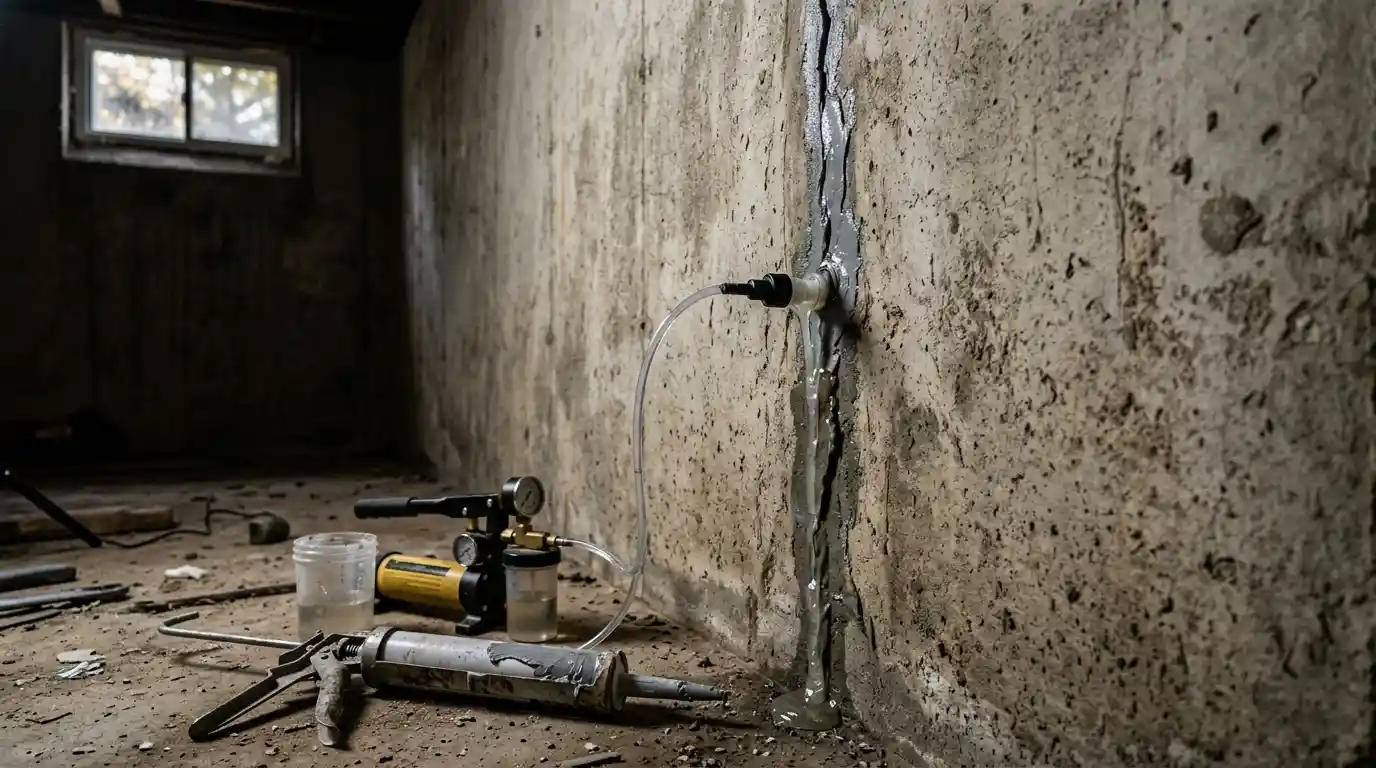

Had a homeowner call last spring convinced her basement needed a full waterproofing overhaul, ten grand minimum in her head already. Turned out to be one hairline crack near a window well, injected with polyurethane resin in under an hour, maybe six hundred dollars total. Basement repair gets treated as one big scary category online, when really it splits into wildly different jobs at wildly different price points. A hairline crack and a bowing foundation wall aren’t the same problem, don’t cost the same, and honestly don’t even get fixed by the same method. Going through what actually separates a small fix from a real structural job below, plus real cost ranges instead of vague estimates.
Diagnosing the Problem Before Anyone Touches Concrete
Crack width tells you most of what you need to know before a contractor even shows up. Anything under a quarter inch, hairline or vertical, usually falls into non-structural territory. More of a moisture entry point than a sign the foundation’s failing. Once a crack widens past that quarter-inch mark, or runs diagonally. Or shows the classic stair-step pattern along block joints, that’s when I’d genuinely start worrying about something structural underneath it.
Active leaks versus dried efflorescence tells a different story too. White powdery residue on a wall means water’s been moving through at some point, but isn’t necessarily leaking right now. An actively weeping crack, water visibly coming through during or after rain, needs faster attention since. It means hydrostatic pressure is actively pushing water through the wall in real time, not just historically.
A simple garden hose test, run for fifteen to twenty minutes against the suspected trouble spot. Often confirms exactly where water’s actually entering. Cheap, fast, and it saves paying a contractor just to locate what a hose could show for free.
What Basement Repair Actually Costs
Costs split hard depending on scope, and this is where a lot of homeowners get anxious for no reason. Minor interior crack sealing starts around six hundred dollars on the low end. A full interior drainage system with a sump pump runs closer to three thousand on average. Extensive exterior waterproofing, the kind involving actual excavation around the foundation, averages closer to seven thousand. Sometimes climbing toward fifteen thousand for a complete system on a larger or more complicated foundation.
National averages from recent industry data land somewhere around 4,900 to 5,200 dollars for a full waterproofing job. With typical homeowner payments falling between roughly 2,400 and 8,200 depending on region and scope. That’s a wide range, worth saying clearly. And it’s wide because basement repair genuinely covers everything. From a forty-dollar tube of hydraulic cement to a full perimeter drain system with excavation equipment involved.
What’s the real cost difference between interior and exterior basement repair? Interior fixes, crack injection or an interior drainage channel, typically run far cheaper. Since there’s no excavation involved, often landing in the six hundred to three thousand dollar range. Exterior waterproofing costs significantly more, frequently five thousand and up. Because it requires digging down to the foundation itself. But it addresses water at the source rather than just managing it once it’s already inside.
Crack Injection: When It Works and When It Doesn’t
Polyurethane and epoxy are the two materials that come up constantly for crack repair. And honestly which one gets used depends entirely on whether the crack is actively leaking. Polyurethane resin expands on contact with water, making it the better choice. For active or weeping cracks since it seals even while moisture is present. Epoxy bonds more rigidly and works best on dry, structural cracks. Where you actually want the material to help restore some strength to the wall itself, not just block water.
Injection ports typically get spaced six to eight inches apart along the length of a crack, and cure time runs anywhere from twenty-four to forty-eight hours at room temperature before the repair’s fully set. This is genuinely one of the more DIY-friendly basement repairs out there, small injection kits exist in ten, thirty, and sixty-foot sizes depending on how much crack length needs treating, though I’d still recommend a professional for anything showing structural warning signs like stair-step cracking or visible wall bowing.
Can a homeowner do basement crack injection themselves? Yes, for straightforward non-structural cracks under a quarter inch wide, a DIY injection kit handles the job reasonably well with some patience and careful prep work. Structural cracks, active bowing, or anything involving foundation movement should go to a professional, since misdiagnosing a structural issue as a simple leak can mean expensive problems down the line that a tube of resin was never going to fix.
Exterior Grading and Drainage Prevent Most Future Problems
A huge share of basement leaks trace back to something outside the house entirely, not a failure in the concrete itself. Grading that slopes toward the foundation instead of away from it is probably the single most common cause I run into, and it’s also one of the cheapest to fix. Proper grading should slope roughly one inch per foot moving away from the house for at least the first several feet.
Downspouts dumping water right at the foundation cause the same problem constantly. Extensions pushing discharge at least six feet away, sometimes closer to two meters in newer recommendations, keep roof runoff from pooling right where it can seep into the basement. Window wells need working drains too, since a well that fills with water during heavy rain just becomes another entry point regardless of how solid the foundation itself is.
Conclusion
Basement repair covers a genuinely wide range of problems, and matching the right fix to the actual issue matters more than defaulting to the most expensive option out of anxiety. A hairline crack rarely needs the same treatment as a bowing wall, and confusing the two either wastes money or leaves a real structural problem unaddressed. Start with proper diagnosis, crack width, active versus historical moisture, exterior drainage conditions, before committing to any repair method, and the actual cost usually ends up far more reasonable than most homeowners initially fear.
FAQs
How much does basement repair typically cost?
Costs range widely depending on scope, from around six hundred dollars for minor interior crack sealing up to fifteen thousand for a complete waterproofing system with excavation. Most homeowners land somewhere between 2,400 and 8,200 dollars for a standard repair, based on recent national industry averages.
Is a small crack in my basement wall dangerous?
Not usually, if it’s under a quarter inch wide and running vertically rather than diagonally or in a stair-step pattern. Cracks that widen over time, run diagonally, or follow block joints in a stepped pattern warrant a structural engineer’s opinion rather than a simple sealing job.
Can basement leaks be fixed permanently, or do they come back?
Properly diagnosed and repaired leaks, especially those addressed with exterior waterproofing or corrected grading, typically stay fixed for many years. Leaks that return usually indicate the original repair addressed a symptom rather than the actual water source, often poor exterior drainage that was never corrected alongside the interior fix.
Should I fix basement cracks myself or hire a professional?
Simple hairline or non-structural cracks under a quarter inch are reasonable DIY projects using an injection kit and some patience. Anything showing signs of structural movement, wall bowing, stair-step cracking, or active foundation shifting should go to a licensed contractor or structural engineer instead.

2 thoughts on “Basement Repair: 7 Costs and Fixes Homeowners Get Wrong”