
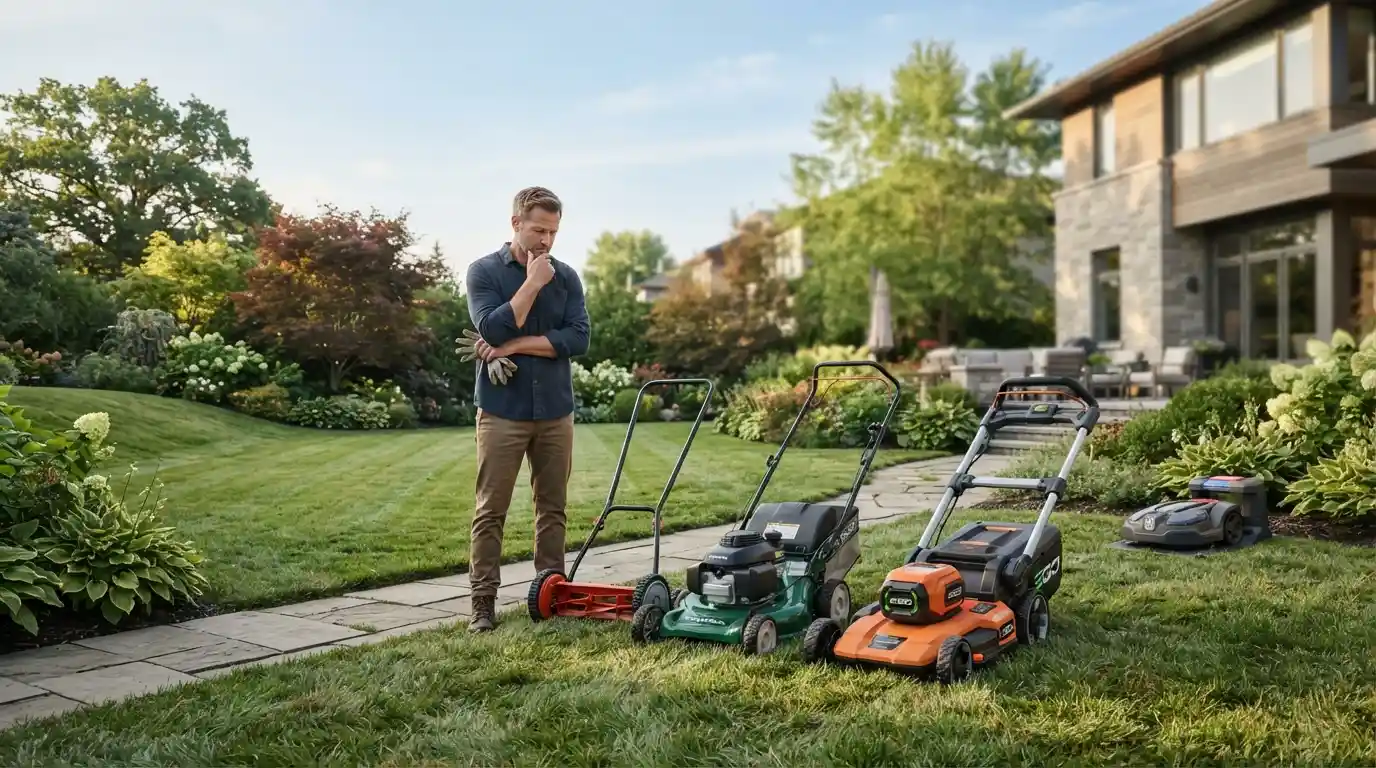

Pick up any mower buying guide and the opening move is almost identical: measure the yard, set a budget, find something in the middle. What that sequence consistently misses is that yard size and price are two of maybe five variables that actually determine whether a mower works for a specific property. The slope near the back fence doesn’t care what the mower cost. Damp grass doesn’t care how large or small the yard is. A dead battery halfway through the back section is a runtime problem that the square footage number never flagged.
I’ve used enough outdoor power equipment across enough different yard configurations to know that the mower decision has more moving parts than most buying guides acknowledge. A 5,000 square foot flat suburban front lawn and a 15,000 square foot property with a slope, a flower bed, a tree or two, and tight corners near a planting bed are not the same problem, and they don’t have the same answer. Getting this right before money changes hands is the entire point of what follows.
The Yard Size and Terrain Calculation That Should Come Before Any Brand Discussion
Most lawn care services and buying guides carve the market into three rough tiers by size, though the lines are softer than they look on paper. Under about 800 square metres or 5,000 square feet, a push mower or manual reel mower gets the job done without overcomplicating it. Somewhere between that and 1,250 square metres or 15,000 square feet, a self-propelled walk-behind starts earning its keep. Beyond half an acre, walking the whole thing stops making practical sense and a riding mower, lawn tractor, or zero-turn enters the conversation properly.
Terrain is where that framework immediately starts getting complicated. A flat lawn at the upper limit of push mower territory is genuinely manageable on foot. The same square footage with a 20 degree slope running through the middle is a different physical experience entirely, one where a rear-wheel drive self-propelled mower with good traction starts making considerably more sense than a push model regardless of the area calculation. Wet grass compounds slope problems fast, producing the clumping, clogging, and ragged cut that most homeowners attribute to a dull blade when the real issue is a combination of terrain and conditions the mower was never well-suited for.
When a yard has a tree here, a couple of flower beds, planting beds along the fence line, and tight corners where the garden edging meets a wall, the deck width calculation that made a wide riding mower look efficient on open ground starts working against you at every turn. A walk-behind with a tighter turning radius handles that kind of garden geometry considerably better than a wider deck that needs multiple passes and awkward reversals to clear the same spots.
Zero-turn mowers are the obvious answer to the turning radius question, and they deliver on that, but on slopes and uneven ground the same zero-degree turning that makes them fast and precise on flat turf can become a traction problem rather than an advantage.
Gas vs Battery vs Manual — What Each Type Actually Costs Over Time
Gas-powered mowers built around Briggs and Stratton, Honda, or comparable small engines in the 160cc to 200cc range have held their ground as the default choice for homeowners who need runtime and cutting grunt more than they need quiet or convenience. When the grass is tall, damp, or thick, a petrol mower simply complains less than battery alternatives at comparable price points, and for bigger properties where a single charge wouldn’t complete the job anyway, the argument for gas remains straightforward.
The maintenance side of that argument is also real and worth stating plainly before committing. Oil changes on SAE 30 or 10W-30 every 25 to 50 hours, annual spark plug replacement, air filter cleaning and foam filter checks, fuel stabilizer added before winter storage, and a pull-cord start that reminds you every spring that small engine repair is a skill worth knowing.
Battery-powered mowers from EGO Power+, Greenworks, Ryobi, and Makita have crossed the performance threshold where the comparison with gas is genuinely competitive for most residential lawns. A 40 volt or 80 volt system with an 8.0Ah or 12.0Ah lithium-ion battery delivers runtime in the 45 to 90 minute range depending on conditions, which covers most suburban lawns with capacity to spare.
The brushless motor drives blade tip speed comparable to rotary blade performance on gas models, and push-button start with no pull-cord, no primer, no choke, and no carburetor maintenance removes the entire category of seasonal small engine complaints. The upfront cost runs higher than budget gas alternatives, but running costs and fuel savings over a five-year period typically close that gap or eliminate it entirely.
The real consideration with battery platforms is long-term compatibility. EGO Power+, Ryobi, and Greenworks each run proprietary lithium-ion systems where the battery works across their string trimmer, leaf blower, chainsaw, and snow blower in the same range. Building a garden tool collection around one battery platform makes each subsequent tool purchase cheaper and simpler. Buying a mower from one brand and a trimmer from another means carrying two chargers, two sets of batteries, and two different charging cycles indefinitely.
The cylinder mower and reel mower category is worth understanding on its own terms. American Lawn Mower Company models show up most in recommendations for small, flat, fine-turf lawns, and there’s a genuine reason for that: the reel blade’s scissor action produces a noticeably cleaner cut on well-kept grass compared to a rotary at the same height setting.
That said, the physical effort is substantial, cutting width rarely stretches past 21 inches, and the moment a property picks up any slope, throws in a few obstacles, or pushes toward a third of an acre in size, the manual option crosses from hard work into the wrong tool entirely. On a compact urban garden or a neat front lawn where the finish quality matters more than how long the job takes, the argument is solid.
The One-Third Rule and Why Mowing Height Matters More Than Mowing Frequency
Most homeowners mow on a schedule. A specific day of the week, regardless of what the grass has actually done since the last cut. The University of Maryland Extension, University of Minnesota Extension, and Kansas State University turf science resources all point to the same principle as a more reliable guide: never take more than a third of the leaf tissue off in a single cut.
Height setting and how often the mower comes out of the shed have to be managed as one decision, not two separate ones. Drop the height one week and then leave three weeks before the next cut and the grass gets hit with exactly the stress the one-third principle exists to prevent. Cool-season grasses, Kentucky bluegrass, perennial ryegrass, and tall fescue stay healthiest somewhere between 2.5 and 4 inches, mowed regularly enough that each session stays within the top third of that range.
Warm-season types follow a different logic, Bermuda grass, Zoysia grass, and centipede grass prefer to sit lower in the 1 to 2 inch band, while St. Augustine in shaded spots tends to hold up better left closer to 2 to 3 inches rather than pushed down to the lower end.
Going too short in a single pass, whether the height dial was set wrong or the lawn sat uncut long enough to overgrow, puts the root system under stress that takes the turf several weeks to properly come back from. Weed establishment moves in fast when turf density drops. Heat stress follows.
Brown tips across the lawn after mowing almost always mean too much came off in one go, and the torn look behind those edges is usually a blade condition problem running alongside the height mistake rather than instead of it. Running the rotary blade across a bench grinder, metal file, or grindstone every 20 to 25 hours of use keeps the cut sharp and prevents the tearing that produces browning along the grass tips.
Leaving clippings down or collecting them comes down to one thing: whether the mowing routine was disciplined enough to keep the cuts short and timely. Short clippings from a well-timed cut break down quickly and feed nitrogen back into the soil, acting as a natural fertilizer that reduces how much supplemental feeding the lawn actually needs. Long clippings from a lawn that got away sit on the surface too long, slow the decomposition process right down, and build thatch rather than supporting soil fertility.
TruGreen and ScottsMiracle-Gro both document this nutrient return benefit. The mowing pattern matters too: alternating direction each session reduces soil compaction from wheel tracks and produces the lawn striping that comes from the striping roller on rear roller mower designs or from a striping attachment on standard walk-behind decks. Grasscycling only works consistently when the cuts are happening on time.
Robotic Mowers — What They Actually Solve and What They Don’t
Robotic mowers have moved out of the gadget category and into something worth considering seriously for specific yard profiles, though the selling point isn’t cutting quality or cost efficiency. It’s time. Running daily or near-daily, a machine from Husqvarna Automower, Segway Navimow, Mammotion, or the Stihl iMow range trims a small amount each pass rather than waiting until the grass needs a proper cut. The one-third rule stops being something to track because the mower never lets enough growth accumulate to make it relevant.
The limitations are equally specific. Perimeter wire or boundary wire installation is a one-time setup task that adds to the real entry cost and takes time to do correctly. Obstacle detection handles fixed garden features reliably but gets tested by anything left on the lawn unexpectedly. Slopes above roughly 20 to 22 degrees sit outside the operational range of most consumer models. Mammotion’s Luba 2 AWD handles steeper terrain than most competitors through all-wheel drive traction and skips the boundary wire installation via RTK navigation, which changes the setup equation for yards that would otherwise need extensive perimeter wire laying. The Segway Navimow i208 uses LiDAR guidance rather than perimeter wire and handles moderate obstacle environments well.
The honest profile of a robotic mower’s best application: a relatively flat lawn between a third and one acre with moderate obstacle complexity, owned by someone who values reclaimed time over upfront cost and is willing to do the initial setup correctly.
Maintenance That Actually Extends a Mower’s Life
Seasonal maintenance done consistently keeps a mower running for ten to fifteen years. Skipped annually, the same mower needs professional tune-up or parts replacement within five. The spring tune-up covers oil change with the correct grade, spark plug replacement using the right spark plug gap for the engine spec, air filter cleaning or foam filter replacement, deck cleaning with a putty knife and wire brush to remove packed grass from underneath, blade inspection and sharpening or replacement, drive cable check on self-propelled models, and tire pressure verification on riding mowers and lawn tractors.
Winter storage requires fuel stabilizer added to the tank before the final mow of the season, fogging oil sprayed into the cylinder through the spark plug socket if storing through a long cold winter, blade removal for sharpening over the off-season, and deck cleaning to prevent rust and corrosion sitting against damp debris through the months of disuse. Battery-powered mowers need the lithium-ion battery stored at roughly 50 percent charge in a location that won’t drop below freezing, since cold weather battery performance degrades more quickly from storage at full or empty charge than from the middle state.
Keeping a maintenance log, even a simple one in the back of the owner’s manual, turns the question of when the last oil change happened from a guess into a documented fact. The oil goes at 25 hours. After 50 hours of use, the deck belt, spindle bearing, and pulley need a proper inspection rather than a glance. Hit 100 hours of heavy regular use and a professional tune-up is the smarter call before wear that was already showing becomes a parts replacement job. Servicing on this kind of interval basis removes the guesswork from seasonal maintenance and catches wear patterns early enough that fixing them is still cheap.
Conclusion
A lawn mower is the one piece of outdoor power equipment most homeowners buy once and expect to work correctly for a decade. Whether it does depends almost entirely on decisions made before the purchase rather than after. Yard size gets the mower into the right category. Terrain, obstacle density, and how the lawn actually gets used narrow that category down to the right type. Gas, battery, or manual comes down to what the property demands and how much maintenance tolerance the owner genuinely has rather than what the marketing promises.
The one-third rule, blade sharpness, and a consistent mowing schedule determine whether the lawn stays healthy or recovers slowly from every cut. Grasscycling, mowing pattern variation, and correct cutting height for the grass type do more long-term work than any fertilizer programme applied on top of a poorly managed mowing routine. And maintenance on an interval basis rather than a calendar one keeps the machine running long enough to justify whatever was spent on it.
The mower that lasts isn’t always the most expensive one. It’s the one matched correctly to the property from the start and serviced consistently enough that small problems never get the chance to become expensive ones.
