
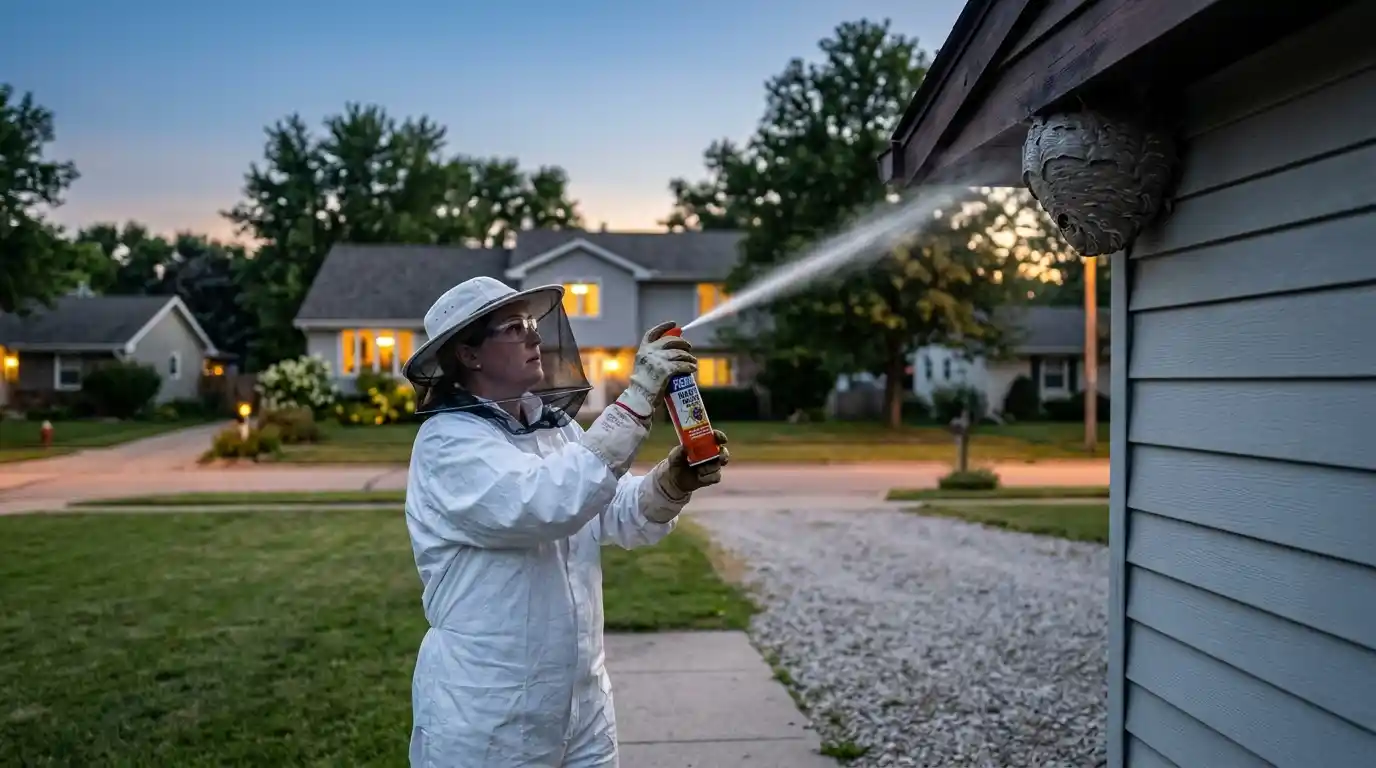

On my first encounter with a wasp nest in the roof space, I did precisely what everyone does reach for the closest can of wasp killer spray that is in the shed, get close to the nest at 2 PM in the afternoon while wearing just a t-shirt, and spray it from a distance of about three feet. What ensued was far from pleasant. Knowing how to behave with a wasp, using the appropriate wasp spray for the particular nest you are going to tackle, and getting the procedure right the first time will make the difference between solving your problem within ten minutes and making a trip to the pharmacy or even worse.
Understanding What You Are Actually Dealing With Before You Spray Anything
Identifying wasps is the really useful first step which most homeowners tend to overlook completely. It is the common wasp, Vespula vulgaris and German wasp, Vespula germanica which account for nearly all the domestic wasp stings reported in UK, Europe, US, Canada and Australia; these are the wasps which make enclosed paper nests in the eaves, roof spaces, wall cavities and underground areas. The bald faced hornet and the European hornets make the larger aerial nests in trees, shrubs and sometimes in wall spaces. Paper wasps make the open comb nests underneath decks, shed roofs, and porch overhangs. Mud Dauber Wasps make the characteristic clay tube nests in the walls and garages and are relatively more docile than social wasps.
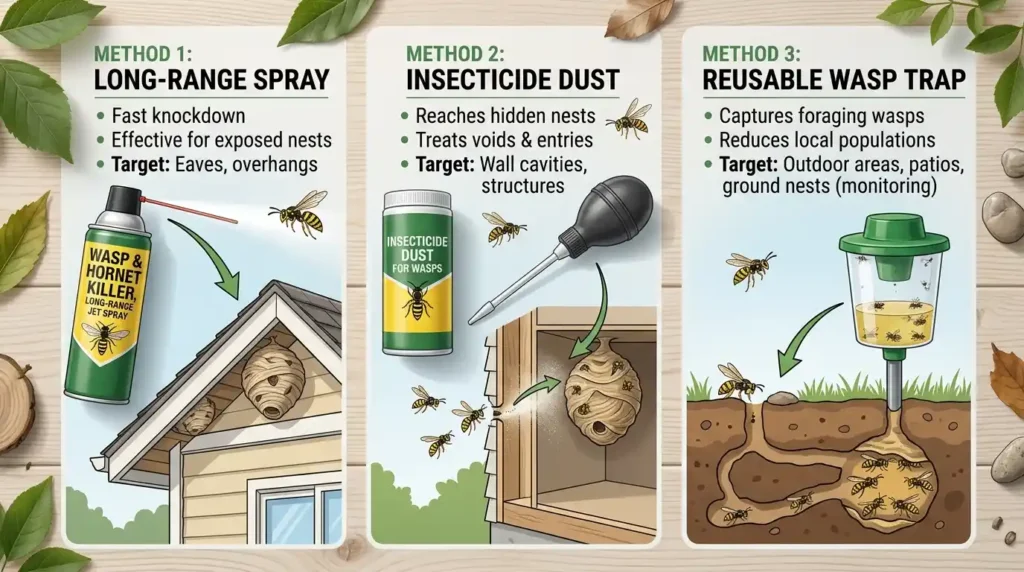
Each nest type responds differently to different products and application methods. An underground wasp nest spray needs to penetrate deep into the entry tunnel. A wall cavity nest needs crack and crevice treatment or wasp freeze spray rather than a directional jet. An aerial nest on an eave needs a long range spray with genuine 20 to 27 feet reach. Getting the product wrong for the nest type wastes money and provokes the colony without eliminating it which is exactly the outcome you want to avoid.
Wasp Season
Wasp season peaks from June through September across most of the northern hemisphere. Spring wasp activity is primarily queen wasps establishing new colonies the nest will be small and relatively easy to treat. Summer wasp activity means a growing colony potentially reaching 1,000 to 5,000 worker wasps by late August. Autumn wasp behavior changes significantly as the colony stops raising new workers and the remaining wasps become protein-seeking and noticeably more aggressive. This late summer wasp behavior sometimes called the drunk wasp phenomenon because workers seek fermented fruit is when the majority of sting incidents happen.
How Wasp Spray Products Actually Work Active Ingredients Explained
The active ingredient in the vast majority of wasp and hornet spray products is a synthetic pyrethroid. Permethrin, deltamethrin, cypermethrin, lambda-cyhalothrin, bifenthrin, tetramethrin, prallethrin, and d-phenothrin all belong to this chemical family. They work by disrupting the nervous system of the insect on contact, causing rapid knockdown and contact kill. Most formulations also contain piperonyl butoxide PBO as a synergist that enhances the effectiveness of the active pyrethroid by inhibiting the insect’s metabolic defense response.
Synergized Pyrethrin Products
Synergized pyrethrin products use natural pyrethrin derived from chrysanthemum flowers rather than synthetic pyrethroid. These offer quicker breakdown in the environment and are the basis for most organic wasp spray and botanical insecticide formulations. The trade-off is shorter residual effect compared to a synthetic pyrethroid residual insecticide natural pyrethrin degrades rapidly in UV light and rain, while bifenthrin or cypermethrin residual treatments can remain active on treated surfaces for several weeks.
Wasp Freeze Spray Products
Wasp freeze spray products like PT Wasp-Freeze and CB D-Force HPX use a compressed gas propellant to chill insects on contact rather than purely relying on chemical toxicity. The freeze on contact mechanism is particularly effective inside wall voids and enclosed spaces where immediate knockdown is more important than residual effect.
Consumer Products
The most widely available consumer products by market Raid Wasp and Hornet Killer, Spectracide Wasp and Hornet Killer, Hot Shot Wasp and Hornet Killer, and Ortho Home Defense Hornet Killer in the USA and Canada; Rentokil wasp spray, Nippon wasp killer, Zero In wasp spray, Digrain wasp spray, Vitax Nippon, and Defenders wasp killer in the UK; and wasp spray Bunnings ranges in Australia all use pyrethroid chemistry as their base. Professional pest control operators use commercial wasp spray products like Temprid FX, Bayer Suspend SC, Stryker Wasp and Hornet Killer, and Bengal Gold Roach and Wasp Killer at higher active ingredient concentrations than consumer aerosols.
Natural and Pet Safe Wasp Spray Options That Actually Perform
The demand for pet safe wasp spray, child safe wasp spray, and eco-friendly wasp killer has grown significantly as more households prioritize non-toxic wasp spray solutions that do not compromise on effectiveness. EcoSmart Wasp and Hornet Killer uses geraniol and peppermint oil spray as its active system a plant-based insecticide approach that kills on contact without synthetic pyrethroids.
Homemade wasp spray recipes based on dish soap wasp spray a concentrated solution of washing-up liquid and water in a spray bottle work by blocking the spiracles wasps breathe through, causing suffocation on contact. This is a genuinely effective DEET-free wasp spray for direct contact situations but provides no residual effect and no reach for elevated or enclosed nests. White vinegar spray disrupts wasp pheromone trails and deters foraging activity but does not kill nests. Clove oil spray and essential oil wasp repellent blends using geraniol and peppermint oil provide deterrence around outdoor eating areas.
Neem oil spray offers both contact kill and some residual deterrence and is classified as a botanical insecticide. For anyone navigating California Proposition 65 requirements, UK HSE regulations, or seeking EPA registered products that balance efficacy with reduced environmental impact, natural pyrethrin combined with PBO in an aerosol format gives the most reliable performance in the natural insecticide category.
Spray Safety, PPE, and How to Approach a Nest Without Getting Stung
Every professional pest controller will tell you the same three things about wasp spray safety timing, distance, and exit route. Spray at night or in the evening when worker wasps have returned to the nest and are less active. Maintain maximum spray distance 20 to 27 feet for long range spray products means you should never be closer than that to an active nest when you depress the nozzle. Plan your exit route before you spray, not after. Protective clothing matters even at distance. A long sleeve shirt, safety goggles, gloves, and ideally a full wasp suit with veil provide meaningful protection during nest treatment. Spray upwind wind direction determines whether the spray reaches the nest or blows back toward you. Never spray into wind.
Temperature effect influences spray performance significantly. Most aerosol wasp sprays are rated to work above 50°F cold weather spray performance drops measurably below this threshold and some pressurized spray cans lose propellant effectiveness in temperatures approaching freezing. Re entry interval after treatment is typically 24 hours for enclosed spaces and several hours for outdoor treated areas. The re-spray interval for persistent colonies particularly underground wasp nest spray situations is usually 48 to 72 hours before a second application is warranted.
Wasp Sting Risk, First Aid, and When to Call Professional Pest Control
It is worth noting that the risk posed by wasp stings varies from person to person. A single sting from a typical wasp will cause local swelling at the sting site, sting pain, and localized inflammation in the majority of cases. Stingings by several wasps arising from a disturbed colony made up of 1,000 or more worker wasps pose a considerably higher risk especially for children and elderly persons.
Epinephrine administration is mandatory in case of anaphylaxis caused by wasp sting. Any patient suffering from allergy to stings should have his/her EpiPen with them at all times, not attempt treating any wasp nests personally, and employ the services of exterminators or pest control professionals. The composition of the venom is different from that of the bees’ and no stinger is left behind after a sting.
All non-allergic reactions can be handled through use of cold compress, anti-histamines, hydrocortisone cream, and observation for next 24 hours, in most domestic instances. It is essential to contact poison control right away in case of exposure to any form of spray, adhere to first aid procedure listed in safety data sheet, and ventilate the room with spray in it.
Choosing the Right Format Aerosol, Dust, or Trap
Wasp spray in aerosol format suits most nest situations the pressurized spray can delivers both immediate knockdown and directional accuracy. However, insecticide dust products including Delta Dust, Tempo Dust, drione dust, and cypermethrin dust are consistently more effective for wall void treatment, crack and crevice treatment, and underground wasp nest spray situations where liquid spray cannot penetrate. Diatomaceous earth and wasp powder provide low-toxicity alternatives for void treatment where residual physical action rather than chemical kill is preferred.
Wasp trap and wasp lure products with wasp bait or wasp poison bait address foraging wasps around outdoor eating areas rather than eliminating the colony at source. Gel bait formats are emerging in professional pest control but are not yet widely available as consumer products. For large mature nests above a certain size, wasp spray vs wasp trap is not a meaningful comparison only direct nest treatment eliminates the stinging hazard at source.
Aerosol can size matters for large nest treatment. A 14 oz can may be insufficient for a large nest requiring multiple applications. A 17.5 oz or 20 oz can, or purchasing multiple cans, is the practical approach for any nest you suspect has reached mature colony size of several hundred to several thousand workers.
Conclusion
The wasp spray is highly effective only if the proper spray for the proper type of nest is used at the proper time with the proper protective gear and the proper escape plan in mind. If you use a synthetic pyrethroid spray for fast knockdown and lasting effectiveness, peppermint oil spray that can be safely used around pets outdoors, or a dust that can be used in wall cavity nests, or you choose to call a professional exterminator, the choice should be determined by the size of the nest, its location, and by your honest evaluation of your willingness to use personal protective equipment. The treatment done right once from the right distance at the right time of day solves the problem. But without the proper preparation you get into the middle of a really angry colony.
Frequently Asked Questions (FAQ’s)
Wasp spray is an insecticide designed to knock down or kill wasps on contact, typically using synthetic pyrethroids that disrupt their nervous system. Some products also leave a residual layer that continues working on treated surfaces.
Natural sprays made with pyrethrin, peppermint oil, geraniol, or soap may suit direct-contact or low-risk situations, but they usually offer less reach and shorter residual effect. Synthetic products are generally more practical for active nests where fast knockdown and longer protection are needed.
Match the treatment to the nest’s location: use long-range aerosol for exposed aerial nests, dust for wall cavities or underground tunnels, and freeze spray for enclosed spaces needing immediate knockdown. Using the wrong format may disturb the colony without reaching the queen or eliminating the nest.
Treat the nest in the evening or at night, when most workers have returned, and activity is lower. Wear protective clothing, spray from the product’s full recommended distance, stay upwind, and plan a clear escape route before starting.
Professional pest control is the better option for large mature colonies, inaccessible wall or roof nests, repeated treatment failures, or households with a known sting allergy. Anyone at risk of anaphylaxis should not approach or treat an active wasp nest.

2 thoughts on “7 Powerful Wasp Spray Tips to Safely Eliminate Dangerous Nests”