

Foundation repair cost in 2026 averages around $5,175 a project. I’ve watched that number scare homeowners half to death before they even know what’s actually wrong with their house. Then they find out their problem is a hairline crack, not a sinking corner, and the real bill lands a lot closer to $300 than $5,000. That’s the thing nobody says loudly enough: the range runs from a $300 crack injection all the way to a $35,000 underpinning job, and which end you land on has almost nothing to do with some national average and everything to do with method and severity. This piece breaks real project pricing down by repair type, gets into when insurance actually helps (rarely), and shows what pushes the number up or down before a contractor ever walks your yard.
Angi’s 2026 data puts that average at $5,175, typical range $2,225 to $8,135. A handful of other guides, This Old House, HomeAdvisor, Modernize, all report numbers within a few dollars of that. Here’s the part worth knowing though. Almost all of them are pulling from the same Angi dataset rather than running their own research. So when you see five sites “confirm” the same figure, you’re really seeing one number echoed five times, not five independent studies landing on the same truth by coincidence.
What Drives Foundation Repair Cost Up or Down
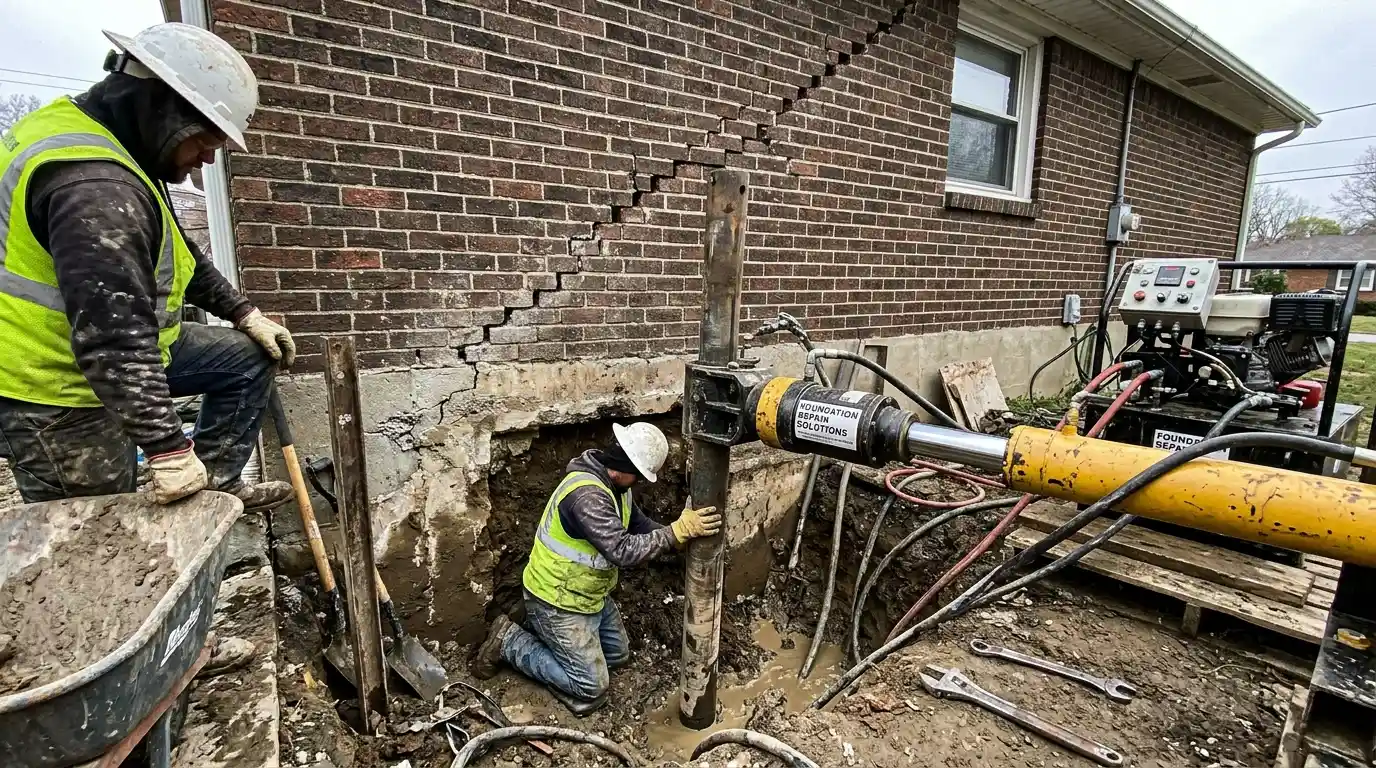
Five repair methods cover most residential jobs. Crack injection handles minor, non-structural cracks, cheap and fast. Slab jacking and polyurethane foam lift a settled concrete slab back into place. Steel or helical piers go in when a foundation is actively sinking, they carry the house’s weight down to stable soil. Full underpinning is the big structural fix for widespread settlement. Bowed wall stabilization, carbon fiber straps or wall anchors, fights lateral pressure from expansive soil pushing in on a basement wall. Pick the wrong method and you lose money twice, once on the wrong fix and again when you hire someone to do the right one.
| Repair method | Typical cost | Best for |
|---|---|---|
| Crack injection | $300–$900 | Minor, non-structural cracks |
| Slab jacking / mudjacking | $500–$2,500 | Settled slabs, driveways, walkways |
| Steel or helical piers | $1,500–$3,500 per pier | Active sinking, most homes need 3–8 piers |
| Bowed wall stabilization | $4,000–$10,000 | Lateral pressure from expansive soil |
| Full underpinning | $12,000–$35,000+ | Widespread structural settlement |
A friend of mine outside Dallas sits on the kind of expansive clay soil that makes Texas one of the heaviest pier markets in the country. He ignored a stair-step crack for two years. By the time he called someone, he needed six piers and a $16,000 check. Helical piers usually cost 15 to 20 percent more than steel push piers for the same job, since each one takes longer to install.
How Severity Changes the Price
Method and severity aren’t the same thing, even though they move together most of the time. A single hairline crack costs almost nothing no matter what kind of foundation you have. Active, widespread settlement costs a lot regardless of which method a contractor ends up recommending, because the underlying problem is bigger, not because the fix got fancier.
What does it actually cost to fix a crack? Minor, non-structural repair runs $300 to $900 with epoxy or polyurethane injection, usually a single day’s work. Structural cracks are a different animal, the kind that keep widening or run diagonally, and they often point to a settlement problem underneath that ends with a piering recommendation instead of a simple injection job.
Full underpinning is the other end of the spectrum. Typical cost sits at $12,000 to $35,000, though severe cases with deep-refusal piers or extensive structural work can climb past $80,000 in the worst reported scenarios. This tier is reserved for homes with real, ongoing settlement, not routine maintenance, and a contractor almost never starts this kind of work without a structural engineer’s report in hand first.
Insurance Won’t Save You Here, Usually
Most standard homeowners policies exclude foundation damage caused by settling, earth movement, or gradual deterioration. That covers the overwhelming majority of real foundation problems people actually have. Insurance typically only steps in when the damage traces to a covered peril, a burst pipe flooding the foundation, say, rather than plain old soil movement over years. A lot of homeowners assume a five-figure repair bill gets at least partially covered. It usually doesn’t. That’s a big reason getting the repair method right the first time matters so much financially, there’s no safety net waiting to catch a bad guess.
Will insurance pay if a plumbing leak caused the damage? Sometimes, if the foundation problem traces directly to a sudden, covered event rather than gradual settling. Check your specific policy’s exclusions before assuming either way. Gradual-damage and earth-movement exclusions are common enough that they knock out most claims before they even get filed.
Get the Diagnosis Right Before You Get Quotes
None of the numbers above predict your specific bill. Only a contractor standing on your property can do that. Get an independent structural engineer’s assessment before hiring anyone to actually do the repair, especially for anything beyond a minor crack. A soil report runs $500 to $3,000, and it tells you what you’re dealing with, expansive clay, a high water table, unstable fill, instead of leaving a contractor to guess and maybe recommend a bigger fix than you need.
Why does the engineer matter separately from the contractor? Because they don’t profit from the repair. A contractor’s quote is never entirely neutral, they make money on the work they recommend. An independent engineer has no stake in whether you end up needing three piers or thirty.
Conclusion
Foundation repair cost in 2026 comes down to two questions really. Which method does your damage actually need, and how severe is it. The $5,175 average is a fine starting benchmark, but a $300 crack injection and a $35,000 underpinning job both technically fall inside that same statistic, which tells you how little the average alone can predict. Get an independent assessment before contractor quotes. Ask for multiple bids on the same diagnosed method. And don’t count on insurance to soften the blow, because most of the time it won’t.
FAQ
How much does it cost to fix a sinking foundation?
Sinking foundations typically need steel or helical piers, running $1,500 to $3,500 per pier, with most homes needing 3 to 8 piers depending on severity. That puts a typical piering job somewhere between $4,500 and $28,000, though severe cases needing full underpinning can run higher.
Is foundation repair worth it before selling a house?
Usually yes. Undisclosed or unrepaired foundation damage tends to scare off buyers and trigger price negotiations that often exceed the repair cost itself. Most states also require sellers to disclose known foundation issues, so fixing it first typically protects both the price and the timeline.
Can you DIY foundation crack repair?
Minor, non-structural crack injection is one of the few foundation repairs worth doing yourself, basic epoxy or polyurethane kits cost well under $100. Anything involving piers, underpinning, or structural cracks belongs with a licensed foundation repair specialist, since a misdiagnosed structural issue gets a lot more expensive to fix later.
How do you know if a foundation crack is serious?
Stair-step cracks in brick or block, cracks wider than a quarter inch, and cracks that keep growing over a few months are the clearest signs of a real structural problem rather than cosmetic settling. Sticking doors, sloping floors, and gaps around window frames are the other common warning signs worth getting a professional to look at.
