

A sewer repair quote can swing from a few hundred dollars to well past $10,000 depending on what’s actually wrong. And most homeowners have no way to tell whether a number is fair until they’ve already signed something. The gap usually comes down to three variables: how much of the line needs work. Whether trenchless methods are even an option for your yard, and how deep the pipe sits. This piece breaks down real cost ranges for the most common sewer problems. Explains when trenchless repair actually saves money versus when it doesn’t. And covers what your homeowners insurance will and won’t touch because most policies cover less of this than people assume.
What actually determines a sewer repair cost
National averages give you a starting point, but the real number depends heavily on scope. HomeAdvisor’s data puts a simple blockage removal around $295 on average. While a collapsed section replacement runs closer to $1,581, and a full lateral replacement spanning 25 to 75 feet averages roughly $6,633. Across all sewer repair types combined. The broader industry average sits around $3,319. With a realistic low end near $225 for a minor fix and a high end pushing past $10,000 for a full scope replacement under difficult conditions.
How much does sewer line repair cost on average?
Most homeowners land somewhere between $1,500 and $5,000 for a standard repair. With full replacements running $3,000 to $25,000 depending on length, depth, and access. That’s a wide range on purpose a 20-foot spot repair in an easily accessible yard and a 75-foot replacement under a driveway are barely comparable jobs. Even though both fall under “sewer repair” as a category. Per linear foot, expect somewhere between $50 and $250 for traditional trenching once you include labor and materials. With trenchless methods often running $60 to $250 per foot depending on which technique gets used.
Trenchless vs. traditional: which actually makes sense for your yard
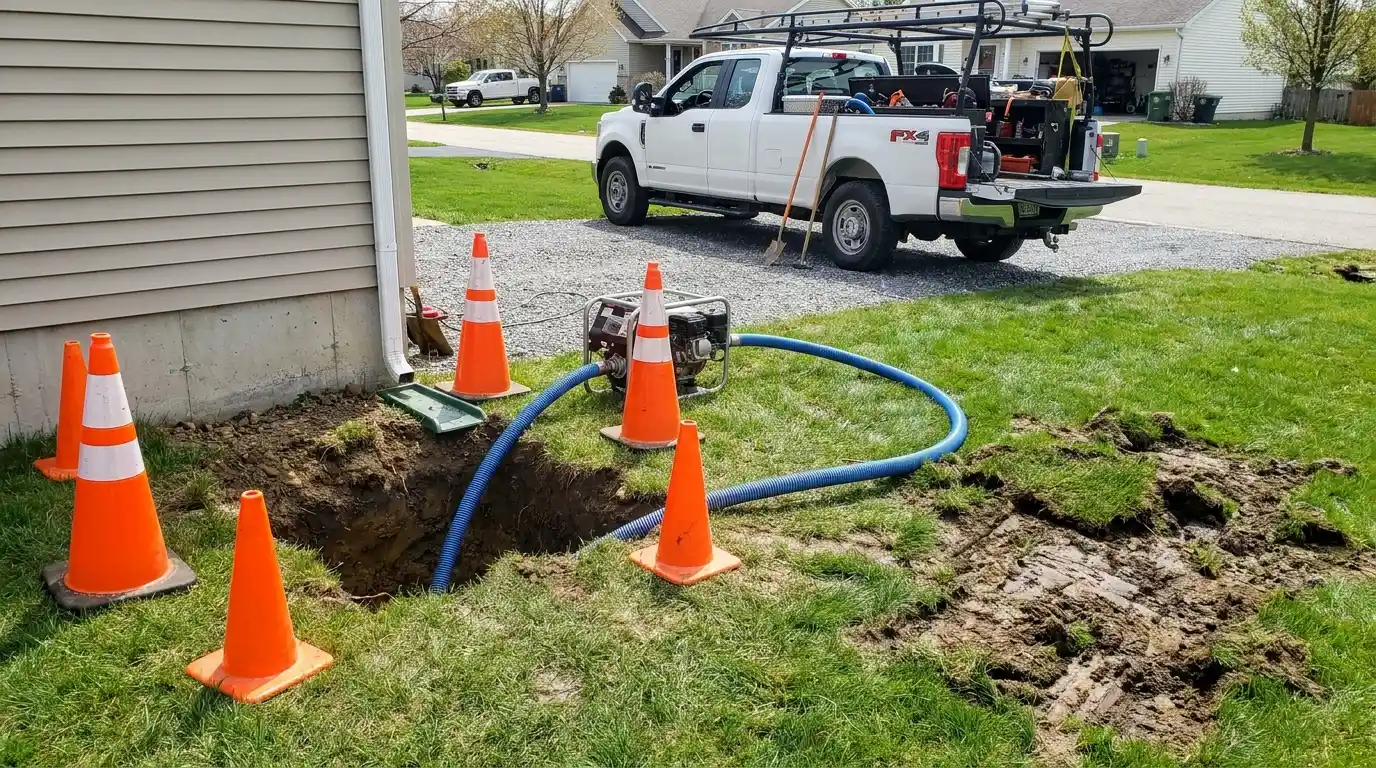
This is the decision that has the biggest effect on your final bill, and it’s not always intuitive. Trenchless sewer repair covers two main techniques CIPP lining and pipe bursting both of which avoid digging a continuous trench along the pipe’s full length. Traditional open-cut excavation, by contrast, digs up the yard, driveway, or whatever sits above the pipe to access it directly.
CIPP, or cured-in-place pipe lining, works by inserting an epoxy-saturated liner into the existing pipe and curing it in place to form a new structural layer inside the old one. It typically runs $70 to $150 per linear foot for a predictable job, though the pipe generally needs to retain at least 40 percent of its original structural integrity for lining to be a viable option a badly collapsed or severely corroded section usually needs bursting or full replacement instead. Pipe bursting, which pulls a new pipe through while a bursting head fractures the old one outward, tends to run a bit higher per foot but handles pipes in worse condition than lining can.
Is trenchless sewer repair actually cheaper than digging up the yard?
Not always per linear foot, but often cheaper overall once you add restoration costs. Traditional open-cut work runs $50 to $125 per foot for the digging itself, but that number doesn’t include repairing whatever got dug up driveway, landscaping, hardscape, sod which can easily add several thousand dollars on top. A 100-foot trenchless CIPP job might total $7,000 to $15,000 all-in, while the equivalent open-trench job, restoration included, often lands in a similar or higher range once everything’s accounted for. Trenchless usually wins on timeline too one to two days versus three to five for traditional trenching which matters if you’re without a working sewer line in the meantime.
Common problems that actually trigger a repair call
Root intrusion is probably the most frequent cause of an emergency sewer repair, and the fix depends heavily on how far the roots have traveled into the line. A spot repair addressing a single intrusion point runs $500 to $1,500, but if roots have compromised a longer stretch of pipe, excavation-based repair jumps to $3,000 to $7,000. Offset joints, where sections of pipe have shifted out of alignment, follow a similar pattern: $1,500 to $4,000 for a trenchless fix, $3,500 to $8,000 if open-cut repair is needed instead.
Full pipe collapse is the most expensive scenario, generally running $8,000 to $30,000 depending on length and access difficulty. Older pipe materials make collapse more likely clay pipe, cast iron, and especially Orangeburg pipe (a bitumen-impregnated fiber material common in mid-20th-century construction) all degrade in ways that PVC and HDPE simply don’t, so a home with original 1950s-era plumbing carries meaningfully more collapse risk than one with modern piping.
Does homeowners insurance actually cover sewer repair?
Usually not, and this catches people off guard more than almost anything else in this process. Standard homeowners policies typically exclude gradual deterioration the kind caused by root intrusion, corrosion, or age-related wear, which covers most sewer repair scenarios. Coverage usually kicks in only for sudden, accidental damage, and even then, only if you’ve added a specific service line endorsement to your policy beforehand. Check your policy for that endorsement now, before you need it, since it’s not something insurers add retroactively after a problem shows up. For larger jobs, insurers commonly require pre-authorization once repair costs cross roughly $10,000, so get that conversation started early if your estimate is climbing toward that range.
What to ask before hiring a contractor
Get a written estimate that separates the repair method, per-foot pricing, and restoration costs as distinct line items a vague lump sum quote makes it much harder to compare bids or catch an inflated number. Confirm the contractor is licensed for sewer work specifically, since general plumbing licensing doesn’t always cover excavation or trenchless equipment operation. Ask who’s pulling permits and handling utility locating before any digging starts, and get the warranty terms in writing, covering both materials and workmanship separately.
Conclusion
Sewer repair costs vary enormously because the underlying jobs vary enormously a root-intrusion spot repair and a full collapsed-pipe replacement share a category but nothing else. Know your pipe’s condition and material before you call anyone, ask specifically whether trenchless methods apply to your situation, and check your insurance policy for a service line endorsement before you actually need one.
FAQs
How do I know if I need sewer repair or just a drain cleaning?
A drain cleaning fixes soft blockages like grease or minor debris, while sewer repair addresses structural problems like root intrusion, offset joints, or pipe collapse a camera inspection, usually around $150, is the fastest way to tell which one you’re actually dealing with.
Is trenchless sewer repair available for every home?
No it depends on the pipe’s condition and remaining structural integrity, since a badly collapsed section generally can’t be lined or burst and needs traditional excavation instead.
How long does a sewer repair typically take?
Trenchless methods usually take one to two days, while traditional open-trench excavation runs three to five days depending on length, depth, and site access.
Will my homeowners insurance help pay for sewer repair?
Only in limited cases most policies exclude gradual deterioration like root intrusion or corrosion, so coverage generally requires a specific service line endorsement added to your policy before the damage occurs.
