
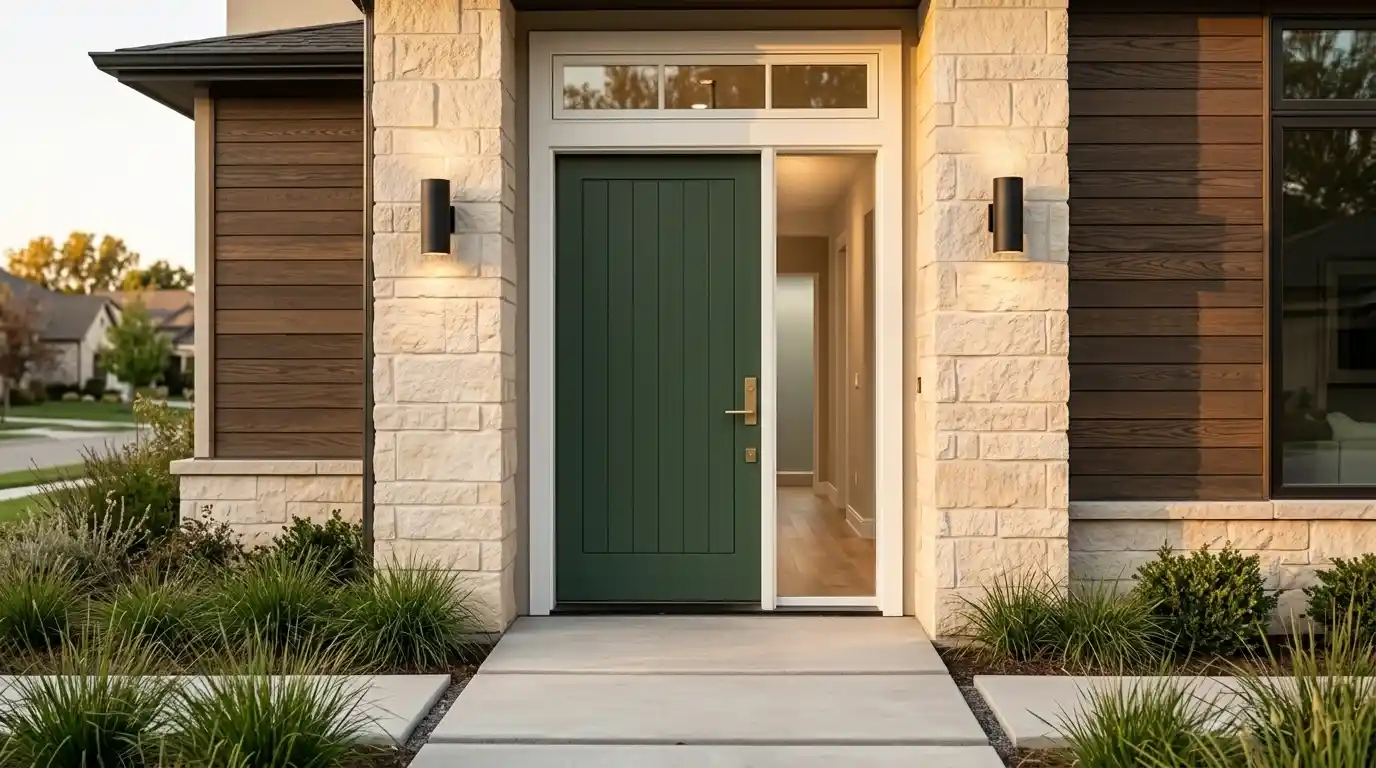

Nobody grows up thinking seriously about doors. These doors you push open, pull closed, perhaps even paint when you get tired of looking at their original color all the time. And then one day, something happens: the frame expands so much in the heat of July that you end up pushing the door open, as if breaking into your own house; or a prospective buyer leaves after looking at a house because the front door looks dated, and suddenly doors become something else entirely.
That happened to a friend of mine two summers ago. Lost a sale. Not because of the kitchen or the roof or the boiler. The front door looked cheap, and it colored every impression that followed. He replaced it before the next viewing. Different result.
This piece is about avoiding that kind of lesson. We are going through door types, materials, costs, colors, smart technology, and the stuff that renovation guides tend to skip because it makes the process sound more complicated than they want it to seem.
What a Door Is Actually Doing for Your Home:
People underestimate this. A door is not passive. It is managing sound, temperature, security, and the visual story your home tells before anyone steps inside. Get it right and none of that registers consciously. Get it wrong and visitors notice before they know why.
There is a reason entry door replacement consistently ranks near the top of ROI studies for exterior home upgrades. Return on renovation studies in North America and Europe suggests the return to be between 60% to 80%. The reason behind this is the effect of an appropriate choice of the front door that makes people change their perception about the property upon viewing it from outside.
The First Impression Effect Is Real and Measurable:
A front door with a sharp bold door color, decent hardware, and a clean frame does something subtle but powerful. It tells whoever is looking that someone pays attention here. That perception travels into every room they walk through afterward. Real estate professionals talk about this constantly. The visual flow from a strong entry door across to a matching garage door, flanked by a well-placed sidelight window, creates coherence that aged mismatched hardware simply cannot produce. Resale value responds. So does daily enjoyment, though nobody puts that in a spreadsheet.
Sound Reduction Is the Benefit Nobody Budgets For:
Most people replacing an interior door are thinking about looks. Fair enough. But a solid core door or solid wood door reduces sound transmission by up to 50 percent compared to a hollow core door. That gap is enormous in practice. Bedroom doors, bathroom doors, office doors, all of them perform differently depending on whether there is anything substantial inside the panel.
In a house where someone works from home, or where teenagers stay up later than everyone else, that 50 percent difference is not a minor comfort upgrade. It genuinely changes how spaces feel to use. A frosted glass panel door or glass partition handles this differently, trading some acoustic control for light flow and visual openness, which suits certain layouts far better than a solid option would.
Door Types and Where Each One Actually Belongs:
The most common and expensive mistake homeowners make is assuming all door decisions follow the same logic. They do not. What works for a bedroom doorway is probably wrong for a small bathroom. What suits a farmhouse kitchen is likely wrong for a minimalist apartment hallway. Getting specific about the use case before choosing a type saves money and regret.
Interior Doors Worth Understanding Properly:
Start with the Shaker door, because it comes up in almost every interior project for good reason. Flat panel, simple frame construction with stiles and rails, no fuss, no period-specific detailing. It fits farmhouse homes, contemporary apartments, transitional suburban houses without looking like it is trying too hard in any of them. That versatility is genuinely rare in a door style and it is why designers keep defaulting to it.
The flush door works differently. No panel detail at all, just a smooth face. Its whole point is to not be noticed, to become part of the wall rather than a feature in the room. In minimalist and contemporary interiors where the furniture and finishes are doing the expressive work, that invisibility is exactly what you want. For tight spaces, though, neither of those is the right answer. A pocket door slides entirely into a wall cavity. No arc. No swing clearance stolen from the room.
Installation costs run 800 to 2,500 dollars, which is more than a standard door swap, but consider what you get back: usable floor space, permanently. In a narrow hallway or small ensuite bathroom, that return justifies the spend almost every time. Bifold doors cover closets and laundry alcoves efficiently, 100 to 300 dollars per door installed. Barn doors land between 200 and 2,500 dollars depending on material and the hardware track system, and they bring something the other types genuinely do not, visible personality. The sliding mechanism is useful. The look is what actually sells people on them.
Exterior Doors and the Weight They Carry:
The front door has the hardest job on the exterior. Double doors signal arrival and scale before anyone touches the handle. A pivot door rotates on a central pivot mechanism rather than traditional side hinges, producing this slow, weighted swing that registers as genuinely impressive in person in a way that photographs only partially capture. Some reach 12 feet tall. These are architectural statements and people treat them accordingly.
French doors work differently again, bringing glass panels across the full frame to flood the adjacent interior with natural light. They work as a patio door opening onto a garden, as a formal entryway in a period home, as an interior divider between a dining room and sitting room. The transition between spaces feels fluid rather than blocked. Arched doors reference European architectural tradition in a way that no flat-top door can quite replicate.
When one is paired with a transom window or decorative glass, the entry design becomes entirely different. When one gets the dutch door design that has the top portion separately openable, it can be useful in kitchen areas and the entry to porches. In case of an exposed rear entry area, a storm door added ahead of the main door will increase the life of the interior door.
Materials: This Choice Outlasts Every Style Trend
Here is a truth that renovation content tends to bury. Style decisions age. Material decisions stay with you for fifteen to twenty years. The wrong material in the wrong location costs money gradually, through maintenance, through early replacement, through heating and cooling losses that show up on energy bills season after season.
Wood, Fiberglass, and Steel Without the Marketing Language:
Solid wood doors look like nothing manufactured can quite match. Natural grain, genuine weight, the way the surface takes stain and paint differently depending on the wood species. Pine is affordable. Oak costs more. Mahogany costs considerably more and earns that price in appearance and density. The issue is straightforward though. Wood moves. Summer heat and humidity swell it. Winter cold and dry air contract it. An exterior solid wood door on a south-facing facade without careful, consistent sealing will warp within a few seasons. That is not an edge case. It happens regularly to expensive doors that people loved when they installed them.
Fiberglass handles almost every problem wood creates. Wood-grain fiberglass finishes have become convincing enough that most visitors cannot identify the material without touching it. The door resists warping, needs minimal maintenance, and insulates reliably with a polyurethane foam core. Costs range widely, 150 to 5,000 dollars, which gives buyers at every budget a practical option. Steel delivers the strongest forced entry resistance at the lowest price point for exterior doors, typically 500 to 1,300 dollars installed. It dents rather than warps, and without consistent care can develop rust, but for homeowners where security and budget are the primary concerns, steel is simply the rational choice.
Composite, Reclaimed, and Eco-Conscious Options:
Composite doors dominate significant portions of the UK residential market and are gaining ground elsewhere for good reasons.Exceptional thermal efficiency, extremely low maintenance requirements, wide variety of design and color choices. They perform well in terms of dimensional stability in contrast to wood as their performance does not get affected by seasonal temperature and humidity changes; thus, preventing those sticking and warping issues that people who own wooden doors have to experience. Doors made of sustainably harvested wood and reclaimed wood materials provide genuine material texture and eco-friendly option. Carbon neutral production and low-VOC paints, along with low-VOC stains, become industry standards for reliable manufacturers, not an added value anymore.
Fire-rated doors are not part of the style conversation, but they belong in any serious discussion of door choices. Between an attached garage and living space is the most common residential requirement in North America. A 20 minute fire rating with appropriate fire-rated hardware built to UL standards is what code compliance actually looks like. These doors are heavier, more expensive, and require specific hardware that cannot be substituted. There is no sensible workaround.
Door Trends That Are Genuinely Worth Paying Attention To:
Not all trends deserve equal attention. Some reflect real shifts in how people live and what they value. Others are aesthetic cycles that will date badly in five years. The trends shaping door choices in 2025 and 2026 lean toward the former.
Colors and Finishes Leading the Market Right Now:
Bold door colors replaced cautious neutral palettes fast and the shift looks durable rather than temporary.
The two colors that appear to be the most prominent in design magazines and actual renovations, including inspiration boards, are forest green and navy blue. These are followed by olive green, sage green, and turquoise. The color cardinal red seems like one which has been consistently in vogue for several decades now. Charcoal and matte black are two such colors which would lend elegance to any entrance door painted in combination with white or light bricks.
Some colors that people tend to search for are Cracked Pepper, Smoky White, Polar Bear, Gold Mist, and Arabica. Two-tone doors, where a distinct color is used for the door and another one for its surrounding frame, are quite common because of their enhanced appearance. Hardware has become a separate discussion topic in the world of interior design. Brushed brass hardware is reclaiming significant ground from the matte black hardware that dominated recent years. Warm bronze hardware pairs particularly well with woodgrain door finishes and earthy tone exterior palettes. A floor-to-ceiling pull bar on an oversized pivot or flush panel door is one of those details that guests notice and mention without necessarily knowing why.
Smart Door Technology: No Longer Optional in Serious Renovations
Five years ago, smart lock integration was a premium novelty. Now it is moving toward standard expectation in new builds and quality renovations across most markets. App-controlled locks let homeowners monitor who enters and when from anywhere. Fingerprint lock and biometric entry systems are reliable in ways early versions were not. Voice-activated lock access integrates with existing home automation systems without separate hardware in most cases.
Smartphones with compatible lock systems can provide access without having to duplicate a physical key for either a contractor or guest. Multi-point locks will provide protection in multiple areas at once as opposed to just providing one point of protection from the door. Using multi-point locks together with non-removable hinge pins and reinforced door frames is something an older system can’t match. Some manufacturers now build smart hardware slots directly into door frames during production, making future technology upgrades straightforward. A Wi-Fi lock and connected door system also integrates naturally into the broader home automation ecosystem that increasing numbers of households are building incrementally.
What Door Installation Costs in 2026: The Full Picture
The number that surprises most people is not the door price. It is everything around it. Frame condition, labor complexity, hardware selection, old door disposal, permit requirements, and the structural surprises that older homes deliver regularly. Budgeting only for the door itself is how projects go over budget in ways that feel unfair but are entirely predictable.
Actual Cost Ranges for Interior and Exterior Installation:
Installation of the interior doors costs between 200 and 600 dollars for a regular pre-hung door with simple hardware included. Pocket doors cost 800 to 2,500 dollars to install. Installation of the French door starts at 600 dollars and goes up to 6,000 dollars when large glass door construction is involved that needs special framing. Entry door replacement normally costs from 400 to 2,000 dollars. Installation of steel doors costs from 500 to 1,300 dollars.
Double door installation, with proper shimming and sealing of the central joint, costs at least 1,400 dollars. Contractors’ hourly rates range from 40 to 90 dollars an hour depending on location and expertise. Handyman rates are from 35 to 50 dollars an hour. Standard installations take 2 to 6 hours. Door frame replacement costs an additional 120 to 350 dollars for interior frames and 400 to 700 dollars and more for exterior ones.
Where the Real Savings Come From:
Before ordering anything, assess the existing door frame honestly.A slab door installation would certainly prove to be more economical as compared to pre-hung if the jamb is level, square and sound. Only if the current frame is defective can pre-hung prove to be economically viable. Scheduling multiple installations at one time helps save the fixed call-out fee of 200-250 dollars since the same is spread over all the jobs rather than paying the call out fee on an individual basis.
If one opts for fiberglass instead of solid wood, he would definitely be saving money while getting similar levels of insulation. It would help conserve some money for other doors such as entry doors and bedroom doors where the money can be better spent.Written estimates breaking out labor cost, material cost, hardware cost, and disposal fee separately are the single most reliable way to catch inflated line items before they become arguments.
Conclusion:
Your door quietly and consistently fulfills many functions, which are generally appreciated only when absent or not fulfilled properly. Security, sound insulation, thermal properties, lighting, and appearance of your house from the outside. Material selection for a door in consideration with its function and place is the most critical single factor to consider. Allowing the architecture of your house dictate your style choices instead of following trends is one way to have a successful result. Allocating sufficient funds for installation in addition to purchasing the door will help you avoid any unpleasant surprises. Start from the point of the greatest importance, the entrance or major interior door.
Frequently Asked Questions (FAQ’s)
Common interior options include Shaker, flush, pocket, bifold, barn, and glass-panel doors. Exterior choices include French, Dutch, pivot, double, arched, storm, and standard entry doors, each designed for different spaces or functions.
A solid-core door offers better sound reduction, durability, and privacy, making it more suitable for bedrooms, bathrooms, and home offices. A hollow-core door costs less and suits rooms where noise control is less important.
Choose wood for natural character, fibreglass for insulation and low maintenance, or steel when security and affordability matter most. The right material depends on the door’s location, weather exposure, budget, and expected upkeep.
A pocket door is worth considering in a narrow hallway, small bathroom, or other area where a swinging door takes up floor space. Installation costs more because the door slides inside the wall, but the usable space can justify the expense.
A standard interior door may cost around $200–$600 to install, while exterior, pocket, French, and double doors can cost more. Frame repairs, hardware, labour, disposal, and structural changes can also raise the final price.

2 thoughts on “Door Ideas That Powerfully Refresh Every Corner of Your Home (And 9 Regrettable Slip-Ups to Skip in 2026)”