
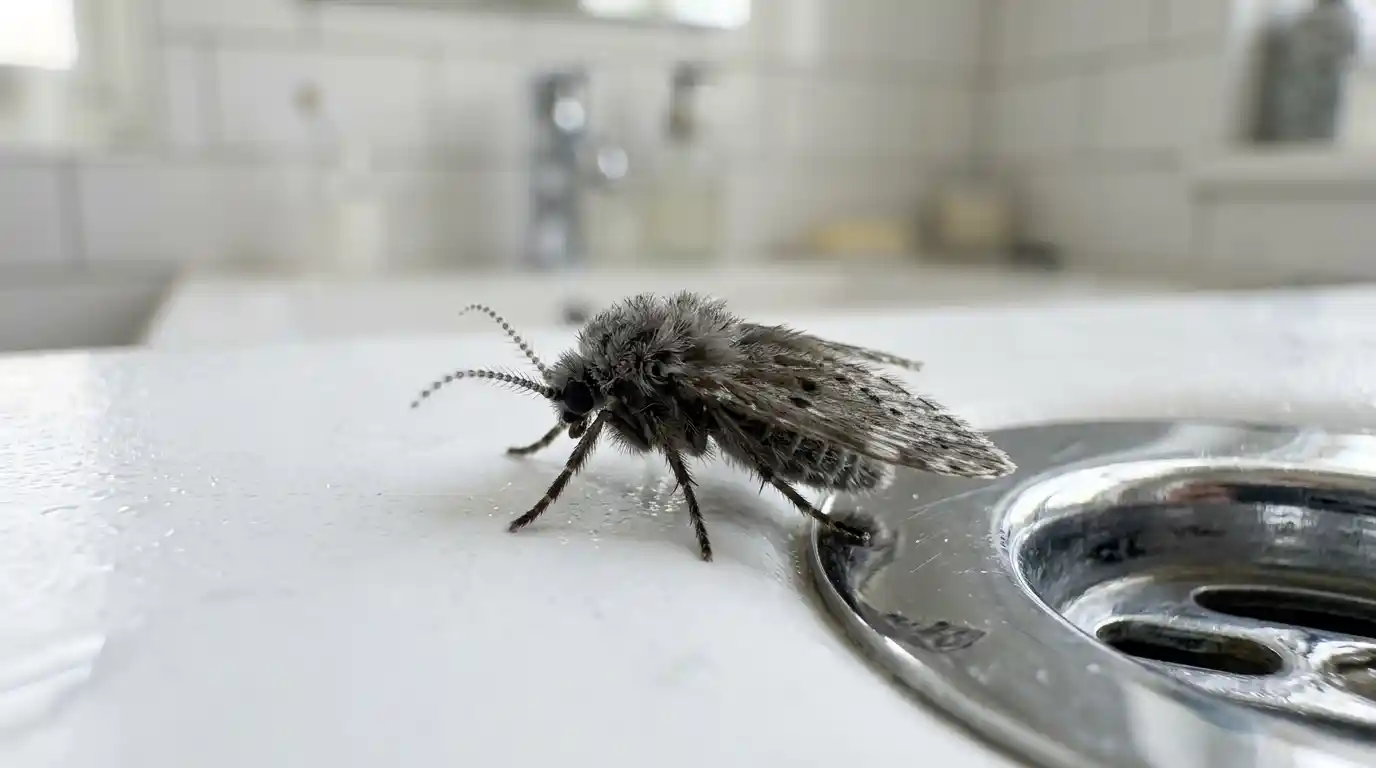

There is a certain frustration that arises when you start seeing tiny, fuzzy insects buzzing around your bathroom sink late at night. You kill one and two more appear. You clean your sink. But the moths reappear. And when you realize that they’re not fruit flies, you’ll have your answer to why these bugs seem to just keep coming no matter what you do to prevent them from appearing. While they may not be a problem in the visible parts of your bathroom, these moth flies are very much alive, growing, and reproducing far beneath your sinks and tubs.
This guide explores the full facts about drain flies who they are, why they exist, their life cycle, and finally the best way to get rid of them.
What Are Drain Flies?
Drain flies are known by different names depending on the person or region being referred to. Moth flies, sewer flies, filter flies, and bathroom flies are among other alternative names that describe them. The technical name for the typical domesticated variety of the drain fly is Clogmia albipunctata, which belongs to the Psychodidae family under the insect order Diptera. This variety has global distribution and thrives around human settlements.
Moth fly derives its name from the appearance of the species. Adult drain flies are very small and are about 2 to 4 millimeters in length, or about 1/5 to 1/6 inches in length, and have a fuzzy appearance, which results from dense hair cover on their body surface and wings. Antennae have 13 segments, which look bead-like and hairy due to numerous hair growths. Their wings are longer than their body and rest roof-like over their abdomen when they are not in flight although other species keep wings stretched forward and sideways giving them the appearance of moths.
The adult flies have only two wings and have parallel veins distinguishing them from real moths. The colors range from dark gray to light gray and brown having spots on the wings. They are very poor flyers and move in an irregular and hesitant pattern within short distances. This is because they rarely can fly and usually can be seen perched on bathroom walls, counter surfaces, and shower sides among other places.
Where Do Drain Flies Come From?
Knowing what kind of environment drain flies come from is the crucial element for their permanent elimination. Briefly stated, drain flies thrive on the layer of gelatinous slime that accumulates inside drain pipes, and after the breeding ground has been created, the larvae will continue to develop continuously irrespective of the number of adult flies exterminated at the surface level.
In nature, drain flies are typically found in shady places with decomposing organic matter. Such places include shaded woodland areas, swamps, and similar places that experience ongoing decomposition. Inside the house, on the other hand, such places can be found in the form of drain pipes that have built up layers of soap scum, bacteria, fungi, algae, and other organic material over several months or even years.
To memorize, here are the places identified by Jon Zawislak from UAEX as breeding grounds for drain flies: sink drains, toilet drains, tub drains, floor drains, and leaky shower pan. The guest bathroom shower drains that get seldom use also serve as a great place for larval development because the standing water combined with the organic material coating the pipes create an ideal breeding ground.
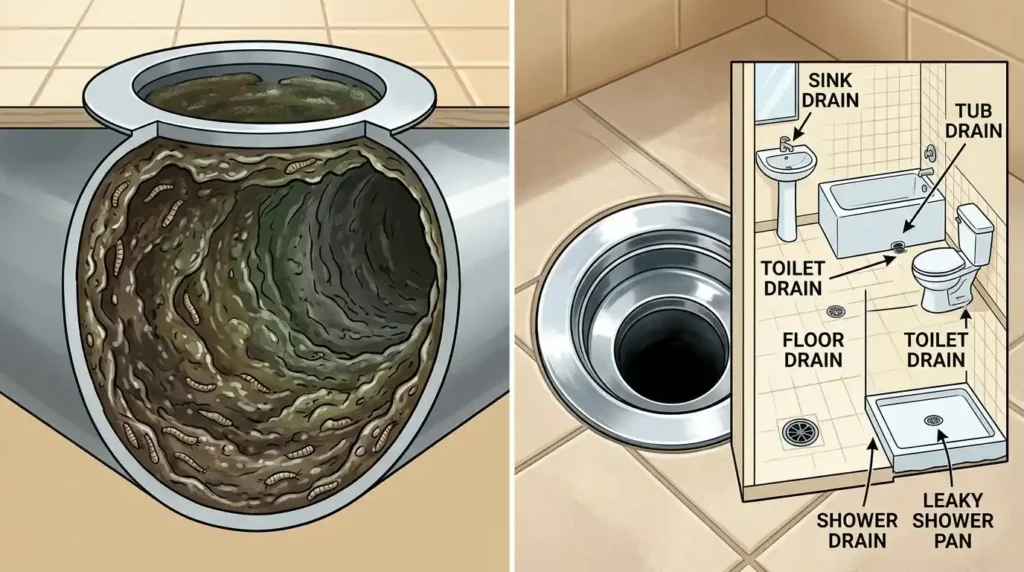
Breeding Sites
In addition to sinks, toilets, sewage plants, sewage pipes, septic tanks, sewage fields, wet compost heaps, garbage cans with stagnant water in them, blocked roof gutters, flower pots containing stagnant water, and drain pans from air conditioning units, these have all been proven to be breeding sites. In businesses and industries, large-scale cooling towers, bases of elevators, and agricultural drainage systems that receive moist manure are capable of sustaining large fly populations.
An often overlooked source of re-infestation is a leaking pipe or slab leak under the house when the drain has been thoroughly cleaned but adult flies continue to appear. A slab leak or crawlspace leak creates an organic and moist environment which is inaccessible through traditional drain cleaning. Should you find yourself with a clean drain yet still facing an infestation, consider looking into a slab leak.
The Drain Fly Life Cycle Why Killing Adults Never Works
The immediate reaction of most people is to take out the spray canister and spray the adult flies that are visible. This approach seems very efficient, as the adults get killed. However, after a few days or even hours, another batch of adults will come along. The explanation for this phenomenon is rather straightforward but should be understood thoroughly: spraying the adult flies does nothing to disrupt the life cycle in any way.
This is the way in which the actual life cycle proceeds. The eggs are minute, brown or cream in color and laid in clusters numbering between 10 and 200 in an irregular fashion on or in the organic matter covering the pipe walls, moist environment. At 70°F, hatching occurs in 32 to 48 hours. The larvae, legless and resembling small maggots, have gray bodies, about 3/8 inches long, and with both their ends being dark gray in color. T
hey breathe by sticking out tube like tails to the water’s surface. Larvae feed on decaying organic matter, bacterial film, algae, and mud on moist breeding substrates and develop through four stages within 9 to 15 days.
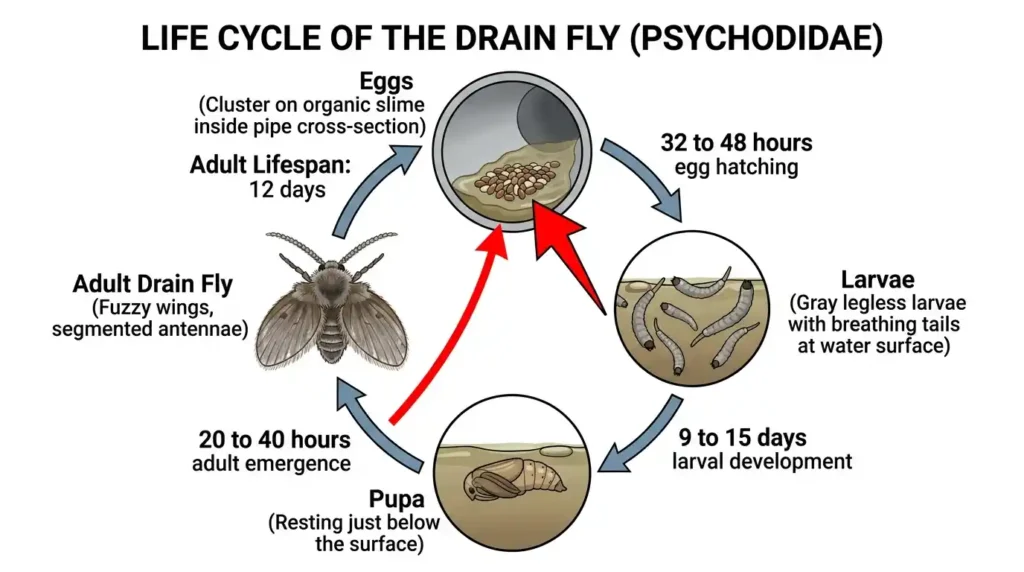
Pupae, After Larva Development
The pupae, after larva development, occur on or just below the surface of the breeding medium, and the adult emergence takes place within 20 to 40 hours. Adults survive for only about two weeks or more specifically 12 days and their life cycle can take as short as one to three weeks when warm weather prevails. An adult female fly is capable of laying sufficient eggs to maintain continuous generations provided the breeding substrates remain available indefinitely.
This is why David Shetlar from the Entomology Department of Ohio State University (CFAES) makes it abundantly clear in his ENT-41 fact sheet that all your efforts should be aimed solely at ridding yourself of the larval breeding sites.
Are Drain Flies Actually Dangerous?
The honest answer from both UAEX and Ohio State University research is: mostly no, but there are real considerations worth knowing.
Drain flies do not bite humans. They are not attracted to human food and will not contaminate it intentionally. They do not sting. They will not damage agricultural plants or ornamental plants. In natural ecosystems, their larvae are actually beneficial they help purify water by consuming organic waste and are themselves food for many small insectivorous animals.
That said, their presence in a home is not entirely without consequence. Because they breed in filthy conditions bacterial scum, sewage disposal beds, polluted water there is a documented possibility of physical transmission of microbes of human health concern. More concretely, bronchial asthma can be triggered by inhaling fragments and dust from dead drain flies, particularly in homes where large populations have built up. They can also be a genuine public nuisance outdoors getting into eyes, ears, and nose, getting stuck in fresh paint, and in agricultural and industrial settings, can clog sewage filter beds and drainage intakes.
Their presence also signals something more important than the flies themselves: there is a significant accumulation of moist organic material somewhere in your plumbing or home environment. That underlying condition not the flies is the real problem worth addressing.
How to Get Rid of Drain Flies What Actually Works
It seems that the most effective way to control drain flies is to apply one thing repeatedly in all sources worth considering: get rid of the breeding ground for larvae. Anything else is treating the problem and not its cause.
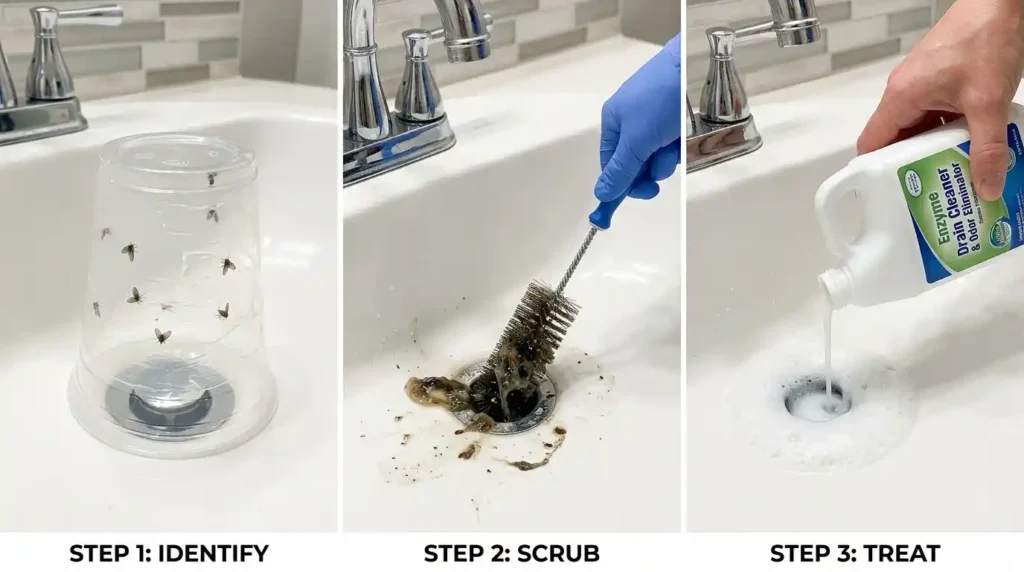
Step 1 Identify Which Drains Are Infested
Before proceeding to clean, make sure that the drains that are indeed producing the adults are known. A clear plastic cup or a glass jar should be placed upside down on each drain suspected of producing the adults. The bottom of the cup should be covered with oil or petroleum jelly on the inside. Another method is taping a plastic bag or the clear adhesive tape over the opening of the drain.
Step 2 Physical Cleaning of Drain Pipes
The only way to physically remove the gelatinous scum and the bacterial films from the walls of pipes is considered to be the most effective action. Use a stiff brush on a long handle or a drain snake with a brush attachment to scrape the inner surface of the drain pipes and drain traps, thus removing organic scum, soap scum, algae, fungi, and bacterial films which support the larvae.
The next step after scraping should be flushing the drain with boiling water, removing whatever else may be loosened by the brush. This action needs to be repeated regularly at least once per week for 3 weeks the shortest period of time necessary to disrupt their life cycle through all generations within the pipe.
One significant point to remember, both according to UAEX and Ohio State—bleach will not help to remove the gelatinous scum from the pipe walls and the drain flies larvae show surprising resistance to this chemical. Bleaching of drains cannot be viewed as a replacement for mechanical cleaning.
Step 3 Enzyme Cleaners
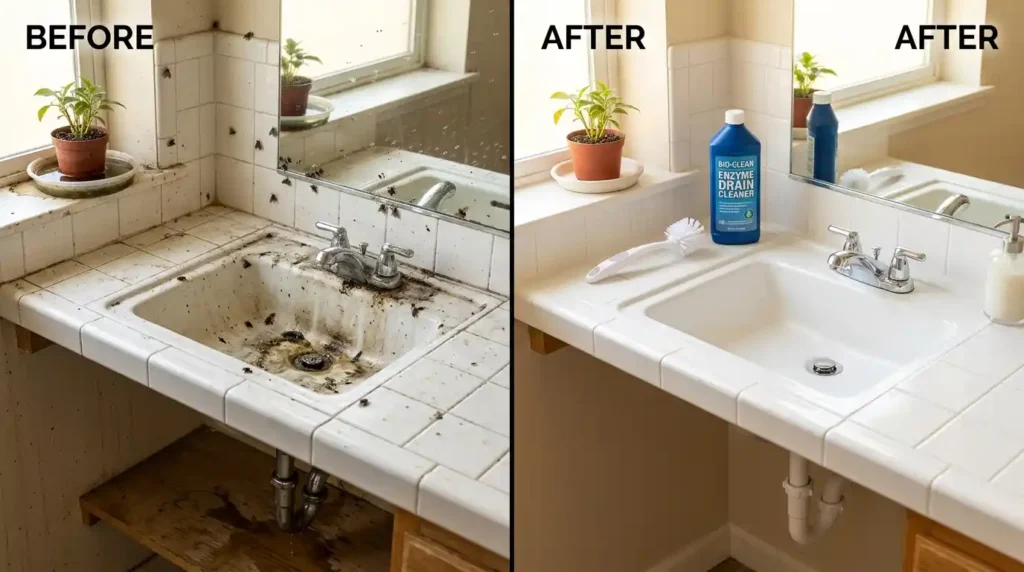
Products specifically formulated to dissolve the gel-like substance used by bacteria and algae to stick to pipe walls are far more effective than regular household drain cleaners. Enzymatic cleaners help remove the gel-like buildup that provides food for fly larvae.
Cleaning products containing foaming agents prove especially beneficial since they allow you to reach surfaces inaccessible to liquid drain cleaners. Professional drain cleaners using high pressure can help remove all organic matter along the length of your drain pipes and are recommended if your drain fly infestation cannot be solved through home methods.
The effectiveness of caustic drain cleaners, i.e., those that use lye as an active ingredient, in removing drain flies’ breeding grounds is minimal. However, most importantly, when using caustic drain cleaners, one should never use bleach afterwards since the combination produces dangerous chlorine gas.
Step 4 Address All Breeding Sites Simultaneously
Multiple drain fly colonies can form at the same time from different drains or breeding areas. Cleaning a single drain without addressing another means that you will only transfer the problem elsewhere, not get rid of it. Examine and clean every floor drain, sink drain, bathtub drain, toilet drain, and shower drain in the area, including those that are not used regularly, such as in guest baths, basements, and utility rooms.
In addition to drains, examine and fix any other breeding ground that could produce standing water inside and outside your house. Examples include potted plants holding water in saucers, garbage cans filled with water, bird baths, above-ground pools, lint accumulation under washers, and irrigation systems that keep mulch moist.
What Does Not Work
Flying insect sprays and fly bomb sprays kill adult flies but have absolutely no effect on the larvae. The new generation of adults becomes active again after a few days and the numbers return to normal. Fly tape and ultraviolet light traps are effective against adult flies but still do not solve the problem of the breeding ground.
No insecticides are available that can be used in sewers, and putting an insecticide down the drain will cause significant harm to the sewer system without offering any real pest management benefit.
Prevention: How to Stop Drain Flies Coming Back
After the removal of the infestation, prevention becomes quite easy. Clean drain pipes, traps, and parts of the plumbing system once a month by using an enzyme cleaner, which will be enough to stop the bacterial film that allows larvae development. Repair any leaks in the pipes and slab leaks immediately. Remove any standing water that may be present in any container inside and outside of the house.
Check the irrigation system for possible water accumulation caused by standing water. Keep the garbage containers clean and make sure that they allow drainage. Inspect the air conditioner and rain barrel as well as tree holes for any standing water accumulation in hot weather when drain flies are most active.
In commercial settings restaurants, schools, and other public buildings establish a regular drain maintenance schedule using enzyme cleaners and mechanical cleaning. Identify and eliminate any sewage filter plants or commercial cooling towers within up to a mile of the building that may be contributing adult populations carried by wind dispersal.
Conclusion
The drain fly problem can be solved, but not unless the approach taken to solving the problem tackles the problem at the appropriate hierarchical level. Adult flies are just an indicator of the problem that exists, while the gelatinous film, bacteria growth, and organic waste that accumulate in the drainage pipes are the root cause of the problem.
Physical cleaning of the drains, use of enzyme cleaners, tackling of all possible breeding grounds at once, and maintaining the process for at least three weeks will solve the problem permanently by eliminating the breeding grounds.
Frequently Asked Questions (FAQ’s)
Drain flies are small moth-like insects that usually develop in moist areas where organic buildup collects, especially inside drain pipes. They appear when a layer of slime, bacteria, and waste creates a suitable place for larvae to grow.
The most effective way to remove drain flies is to eliminate their breeding grounds by cleaning buildup in pipes and drains. Physical scrubbing, flushing with hot water, and using enzyme cleaners can help break down the material where larvae develop.
Spraying adult drain flies only removes the visible insects and does not affect eggs or larvae hidden inside drains. New adults may continue to appear until the breeding areas are properly cleaned and removed.
Drain flies commonly breed in sink, shower, toilet, and floor drains, as well as in areas with stagnant water or organic buildup. Less-used drains can also become breeding spots because moisture and debris allow larvae to develop.
Drain flies do not bite, sting, or intentionally contaminate food, but their presence can indicate unhealthy moisture and organic buildup in the environment. Large infestations may also contribute to concerns such as irritation from dead fly particles or exposure to microbes.

5 thoughts on “Drain Flies by Rapid Home Direct | The Complete Guide to Identifying, Eliminating, and Preventing Drain Flies in Your Home”