
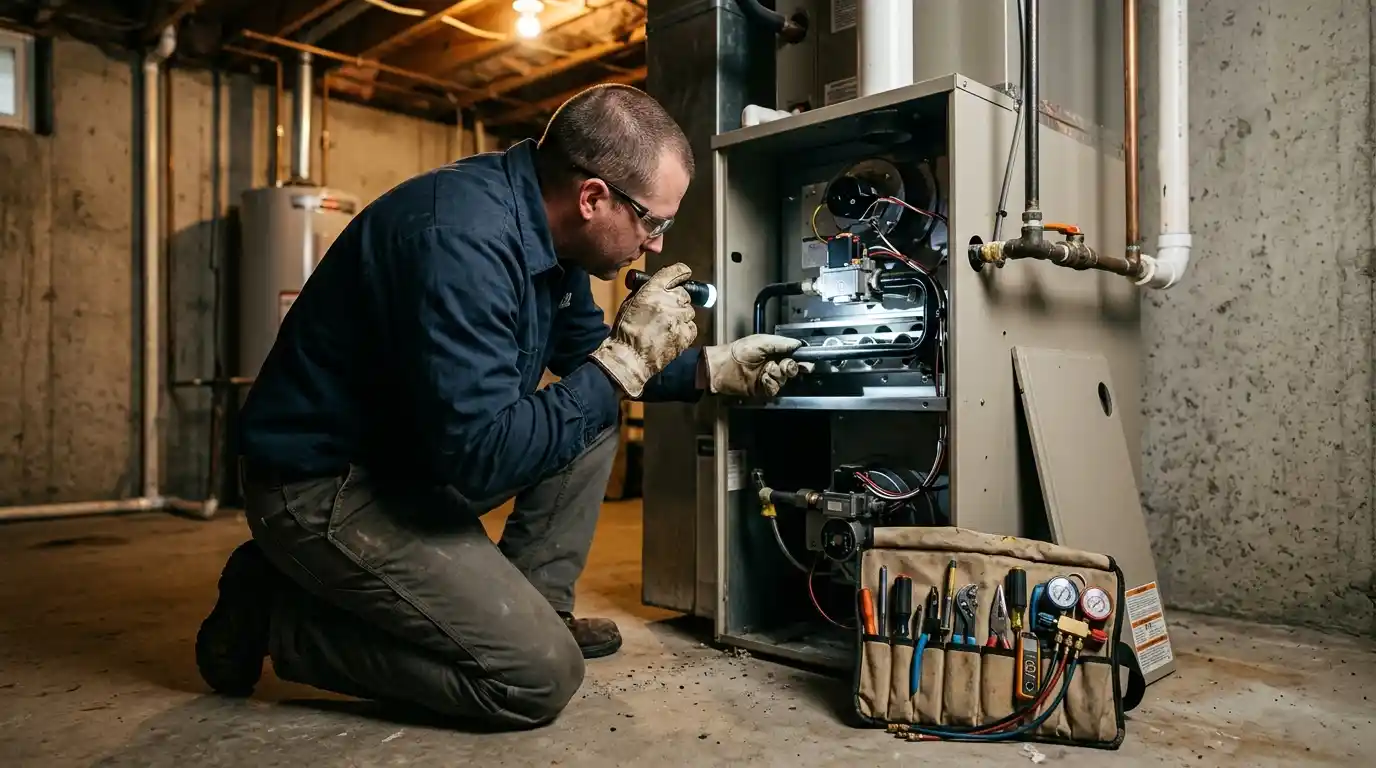

My furnace died on the coldest night of a January a few years back, right around 11pm, and I remember standing in the basement with a flashlight having absolutely no idea whether I was looking at a $150 problem or a $3,000 one. That’s the position most people are in when they’re dealing with furnace repair for the first time not knowing which symptoms point to a cheap part and which ones mean something expensive, when a dirty flame sensor and a cracked heat exchanger can look almost identical from where you’re standing at the thermostat. Here’s what I’ve learned since then about the most common furnace failures, what they actually cost, what’s safe to check yourself, and when repair stops making sense compared to just replacing the thing.
The Problems That Come Up Again and Again
Most furnace calls trace back to the same handful of parts, not anything exotic or rare. A dirty or failed flame sensor tops the list, and it’s kind of a funny little part when you think about it just a thin metal rod that checks whether the burner flame’s actually lit. Once it’s coated in carbon buildup, the whole system shuts itself off as a safety measure, even though technically nothing else is wrong. Ignitor failure comes in a close second. Hot-surface ignitors are basically heating elements, and like any heating element, they wear out eventually and stop glowing hot enough to light the gas. Dirty air filters cause more downstream chaos than people expect too restricted airflow can trigger a safety shutoff that looks, on the surface, like a totally different problem.
Further down the list you’ve got inducer motors, pressure switches, control boards parts that fail often enough that a technician with a few years in usually knows what’s wrong just from how you describe it, before they’ve even opened the cabinet. Clicking repeatedly without ever igniting? Probably the ignitor or gas valve. Starts, runs for a minute, shuts off, repeat that’s short cycling, and it’s almost always airflow or an overheating trip, not the burner itself. Knowing this stuff ahead of time won’t fix anything yourself, necessarily, but it saves real diagnostic time once someone’s actually there.
Short cycling specifically almost always comes back to overheating from restricted airflow a dirty filter, blocked vents, something forcing the high-limit switch to trip as a safety measure. Check the filter first. It’s the cheapest possible cause and the most common one, so rule it out before jumping to conclusions about a cracked heat exchanger.
What This Actually Costs
Prices swing a lot by region, furnace age, and local labor rates, but published pricing data gives a decent benchmark before a technician quotes you a number. A basic diagnostic visit usually runs $75 to $150, and most companies roll that fee into the repair cost if you go ahead with the work. Minor fixes cleaning a flame sensor, swapping an ignitor typically land somewhere in the $80 to $400 range. Bigger failures cost a lot more: control board replacement commonly runs $300 to $900, blower motor work often falls between $300 and $1,500, inducer motors frequently land around $200 to $1,100 depending on the specific model.
At the very top, heat exchanger replacement is where things get genuinely painful often $1,000 to $3,500 depending on the furnace and how accessible it is. That’s usually the moment where replacing the whole system starts sounding reasonable instead of throwing more money at repairs, especially since a full gas furnace installation typically runs $2,500 to $5,000 for standard efficiency, or $4,000 to $8,000 for a high-efficiency model. If a major part fails on something already 15 or 20 years old, replacement usually wins the math once you account for everything else on that furnace that’s probably not far behind.
Emergency and after-hours repair adds another $100 to $400 on top of the base cost, since after-hours labor tends to run $140 to $210 an hour instead of daytime rates. If the house stays livable overnight with space heaters or extra blankets, waiting until morning genuinely saves money.
What You Can Actually Check Yourself First
Some of this is genuinely safe to look at before you call anyone, and doing it first can save you a diagnostic fee that turns out to be unnecessary. Check the thermostat battery, settings first. Sounds too obvious to mention, but a dead battery or an accidentally bumped setting accounts for more “my furnace won’t start” calls than you’d guess. Check the filter next. If it’s visibly gray or clogged, replace it regardless of anything else going on, since bad airflow tends to cause or worsen most of the other problems on this list. And check the power switch and the breaker furnaces have a dedicated service switch that looks exactly like a regular light switch, and it gets bumped off by accident more often than people assume.
Anything touching gas components, a possible leak, carbon monoxide, or combustion problems that’s not DIY territory, ever. If you smell rotten eggs near the furnace or a CO detector goes off, get out of the house and call your gas utility or emergency services first. That’s not a repair situation anymore. That’s an emergency, full stop, and it deserves to be treated as one immediately.
Conclusion
Most furnace repair calls come down to a small, predictable list dirty filters, worn ignitors, failed flame sensors and knowing the rough cost ranges ahead of time helps you sanity-check whatever number a technician gives you instead of just accepting it blind. Check the easy stuff yourself first. Leave anything involving gas or carbon monoxide strictly to a professional, no exceptions. And when something major fails on an older furnace, do the replacement math honestly instead of pouring more money into a system that’s probably got another failure coming soon anyway.
FAQs
How much does a typical furnace repair cost?
Most repairs land somewhere between $125 and $600, with a commonly cited average around $318 once you include the service call and parts. Bigger failures a heat exchanger, a full blower assembly run considerably more, often $1,000 or above.
Is it worth repairing an old furnace or should I just replace it?
Past 15 years old and facing a major repair like a heat exchanger, replacement usually wins, since a new high-efficiency furnace runs $4,000 to $8,000 installed. Under 10 years old with a minor issue, repairing almost always makes more sense than starting over.
Why won’t my furnace turn on even though the thermostat’s set right?
Usually a tripped breaker, a flipped power switch, a dead thermostat battery, or something in the ignition system like a bad flame sensor. Rule out the free electrical stuff first before assuming you’re staring down an expensive repair.
Can I clean the flame sensor myself?
Yeah, honestly one screw, a bit of fine sandpaper or steel wool, and you’re basically done, just make sure the power and gas are actually off first. If you’d rather not risk it, professional flame-sensor service usually only runs $80 to $250, cheap enough that plenty of people just call someone instead.

1 thought on “Furnace Repair: 9 Common Fixes and What They Actually Cost You”