
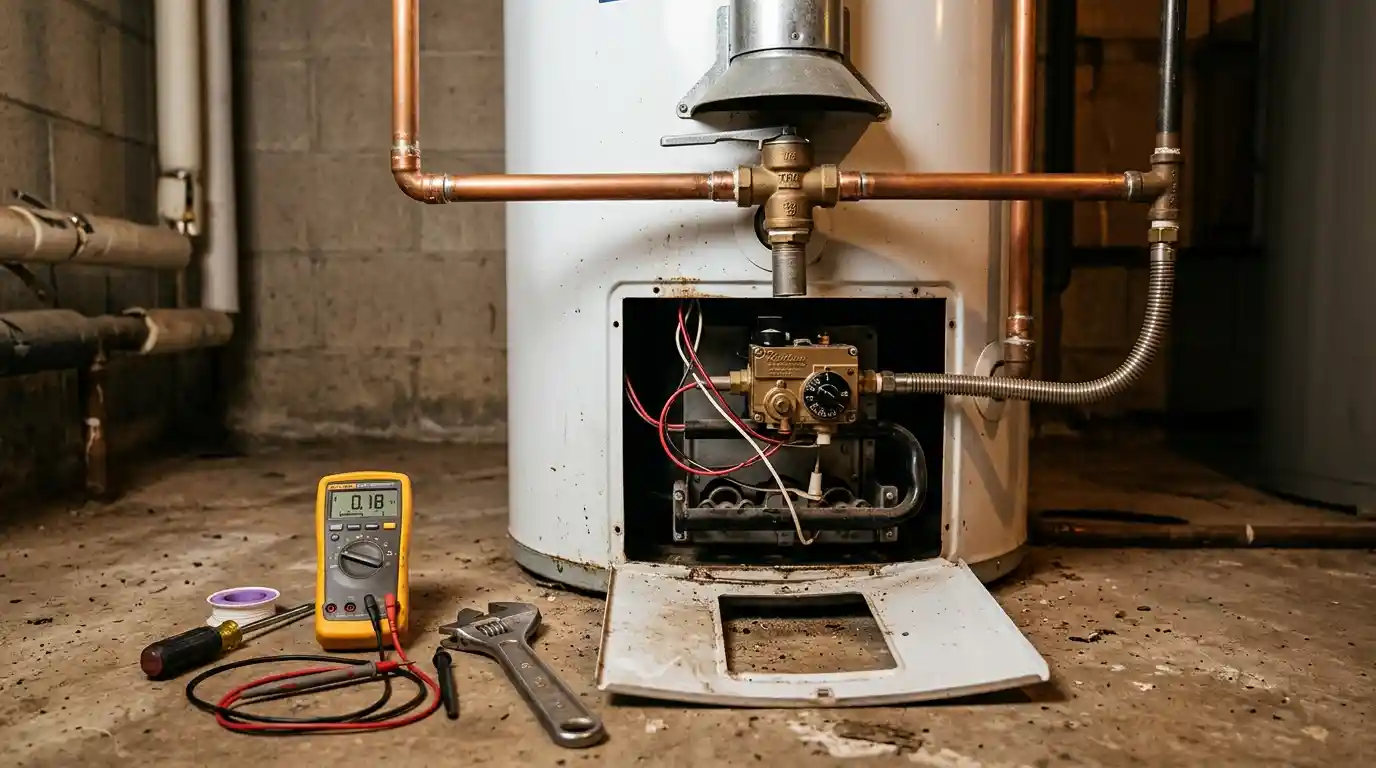

Had a client last winter, no hot water at all, already resigned to buying a new unit. Turned out to be a tripped breaker and a bad heating element, maybe two hundred dollars total, twenty minutes of actual labor. Water heater repair gets skipped constantly because people assume the whole tank’s shot the moment something goes wrong. Rarely true. Tripped breakers, bad thermostats, sediment buildup, a failed anode rod, most of what breaks on a water heater is fixable for well under half what a new unit costs installed. Walking through the real diagnostic steps below, what repairs actually run, and when replacement genuinely makes more sense.
Diagnosing the Problem Before Calling Anyone
Guessing wrong here wastes money fast, in both directions. Spend on a repair that was never going to fix a dying tank, or replace a unit that needed a forty-dollar part. Start simple. Check the breaker first, always, since a tripped breaker mimics complete failure and costs nothing to rule out. Takes maybe two minutes.
Next, identify what you’re actually working with. Gas or electric changes everything about where the fault probably sits. Gas units fail at the pilot light, thermocouple, or gas valve most often. Electric units fail at the heating element or thermostat instead. Verify power or gas supply is actually reaching the unit, then check thermostat settings, since a unit accidentally turned down or switched off mimics a real failure completely.
Is it worth diagnosing a water heater problem myself before calling a plumber? Yes, for the basic checks at least, breaker, thermostat setting, visible leaks, gas supply. Takes maybe ten minutes total and either solves the problem outright or gives a technician useful information upfront, which can shave real time off a service call. Component-level testing past that point, especially anything involving a multimeter or gas line work, is where I’d bring in someone licensed.
What Water Heater Repair Actually Costs
Costs vary a lot by what’s actually broken, and the range is wider than people expect walking in. A diagnostic service call typically runs somewhere between ninety-five and a hundred seventy-five dollars, often credited toward the repair if you move forward. Thermostat replacement usually falls in the hundred to three hundred dollar range. Heating elements run two hundred to four hundred. A new anode rod, one of the cheaper fixes on this list, typically lands around a hundred fifty to two hundred fifty.
Bigger jobs cost more, obviously. A full control board replacement on a tankless unit can run four hundred to nine hundred dollars, since tankless systems carry more electronics than a standard tank. Add it all up across a typical repair year and homeowners tend to land somewhere around five to six hundred dollars on average, based on aggregated data from several home-service pricing sources, though any single repair usually costs far less than that annual average suggests.
How much does water heater repair typically cost compared to full replacement? Most single repairs fall somewhere between ninety and five hundred fifty dollars, well under half the cost of a new unit installed, which commonly runs fifteen hundred dollars or more depending on type and labor. That gap is exactly why repair makes financial sense in most cases, unless the tank itself has failed structurally.
The Most Common Failures and How to Fix Them
Sediment buildup causes more problems than people realize, especially in hard water regions like parts of California’s wine country, Sonoma and Napa included, where mineral content accelerates the issue significantly. Popping or rumbling noises almost always trace back to sediment insulating the heating element from the water above it, forcing it to work harder and eventually fail early. Annual flushing prevents most of this before it ever becomes a repair call.
No hot water at all usually means one of three things: tripped breaker, failed heating element, or extinguished pilot light on gas units. Insufficient hot water points somewhere different, often a broken dip tube letting cold water mix into the hot supply, or simply an undersized tank for the household’s actual usage. Water that’s too hot, meanwhile, almost always traces back to a thermostat set too high or malfunctioning outright.
What’s the fastest way to fix a water heater that’s leaking? Identify where the leak’s actually coming from first, since the fix differs completely depending on the source. A leaking pressure relief valve often just needs replacement, cheap and straightforward. A leak from the tank body itself, though, usually means corrosion has set in, and that’s a repair no amount of tightening or patching will actually solve long-term.
When Repair Stops Making Sense
There’s a real point where fixing a water heater stops being the smart move, and I use a rough fifty percent rule with most clients. If a single repair quote approaches half the cost of a new unit installed, replacement usually wins out, especially once the tank’s past eight years old. Tank units typically last eight to twelve years. Tankless systems run considerably longer, often fifteen years or more, which changes the math on whether an aging unit’s worth fixing.
Age matters as much as the specific repair cost, honestly. A five-year-old tank with a failed thermostat is an easy repair call every time. A ten-year-old tank with the same failed thermostat is a different conversation, since something else is likely to fail within the next year or two regardless of what gets fixed today.
Conclusion
Water heater repair beats replacement in the large majority of cases, and the diagnostic process genuinely isn’t complicated for anyone willing to spend ten minutes checking the basics first. Rule out the breaker, verify the thermostat setting, confirm gas or power’s actually reaching the unit before assuming the worst. When a real repair is needed, most fixes land well under half the cost of a new installed unit, which makes the decision straightforward except in cases where the tank’s genuinely old or the damage runs structural.
FAQs
How do I know if my water heater needs repair or replacement?
If the repair cost approaches half of what a new unit would cost installed, especially on a tank older than eight years, replacement usually makes more financial sense. A single component failure on a younger unit is almost always worth repairing instead.
Why does my water heater make popping or rumbling noises?
Sediment buildup at the bottom of the tank is almost always the cause, especially in areas with hard water. Flushing the tank annually prevents this buildup from accumulating enough to cause noise or premature heating element failure.
Can I fix a water heater myself without hiring a plumber?
Basic troubleshooting like checking the breaker, verifying thermostat settings, and confirming gas supply is safe for most homeowners to handle. Anything involving gas line work, electrical component testing, or tank draining should generally go to a licensed professional given the safety risks involved.
How much does a typical water heater repair cost in 2026?
Most single repairs fall between ninety and five hundred fifty dollars depending on the specific part and labor involved, with a diagnostic service call typically running ninety-five to a hundred seventy-five dollars. Full control board replacements on tankless units run higher, often four hundred to nine hundred dollars.
